Gustave Doré · John 8:3-5
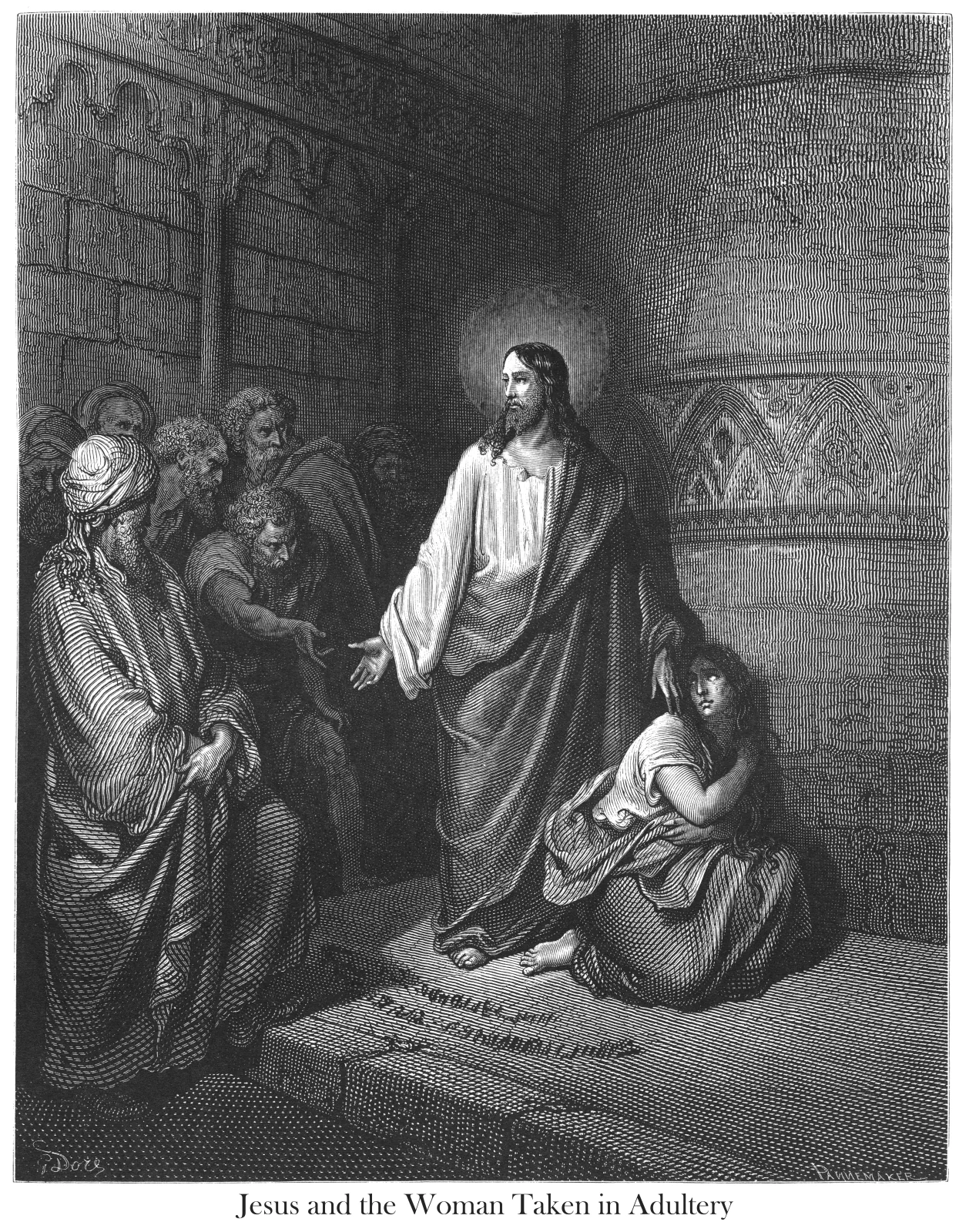
Jesus and the Woman Taken in Adultery
John 8:3-5 · World English Bible (Catholic)
3The scribes and the Pharisees brought a woman taken in adultery. Having set her in the middle,
4they told him, “Teacher, we found this woman in adultery, in the very act.
5Now in our law, Moses commanded us to stone such women. What then do you say about her?”
Jesus’ hand descends near the woman’s shoulder. On the other side, his open hand reaches toward the men gathered on the left. His upright body thus separates two groups that stand in complete opposition in the engraving: the accusers crowded close together, and the woman alone, seated on the ground against the wall.
She turns her face toward Jesus, while he looks at the men. With one arm folded against her chest, she occupies the edge of the space left open by the group. A man leaning forward reaches toward the center; before him, a large turbaned figure stands back. Their gazes and gestures converge without the figures touching. The distance between them gives visible form to the question put to Jesus.
In John’s account, the scribes and Pharisees bring the woman forward and invoke the law of Moses: it prescribes stoning. They then ask Jesus what he says about it. The immediate context makes clear that they are trying to test him; their accusation is therefore directed also at the one they address. In the engraving, Jesus does indeed stand between them and the woman. His closeness to her brings into view, alongside the debate about the Law, the person exposed by this accusation.
One detail nevertheless catches the eye at the figures’ feet: signs have been traced on the ground. The text relates that after the question Jesus bends down and writes with his finger. Here he is standing, and his hand is not writing. The marks bring two moments in the passage close together without fixing the gesture described by John. They remain in the foreground, while Jesus’ hands answer the positions of the other bodies. The word expected of him remains outside the engraving; on the stone, something has already been written.