Gustave Doré · John 6:19-20
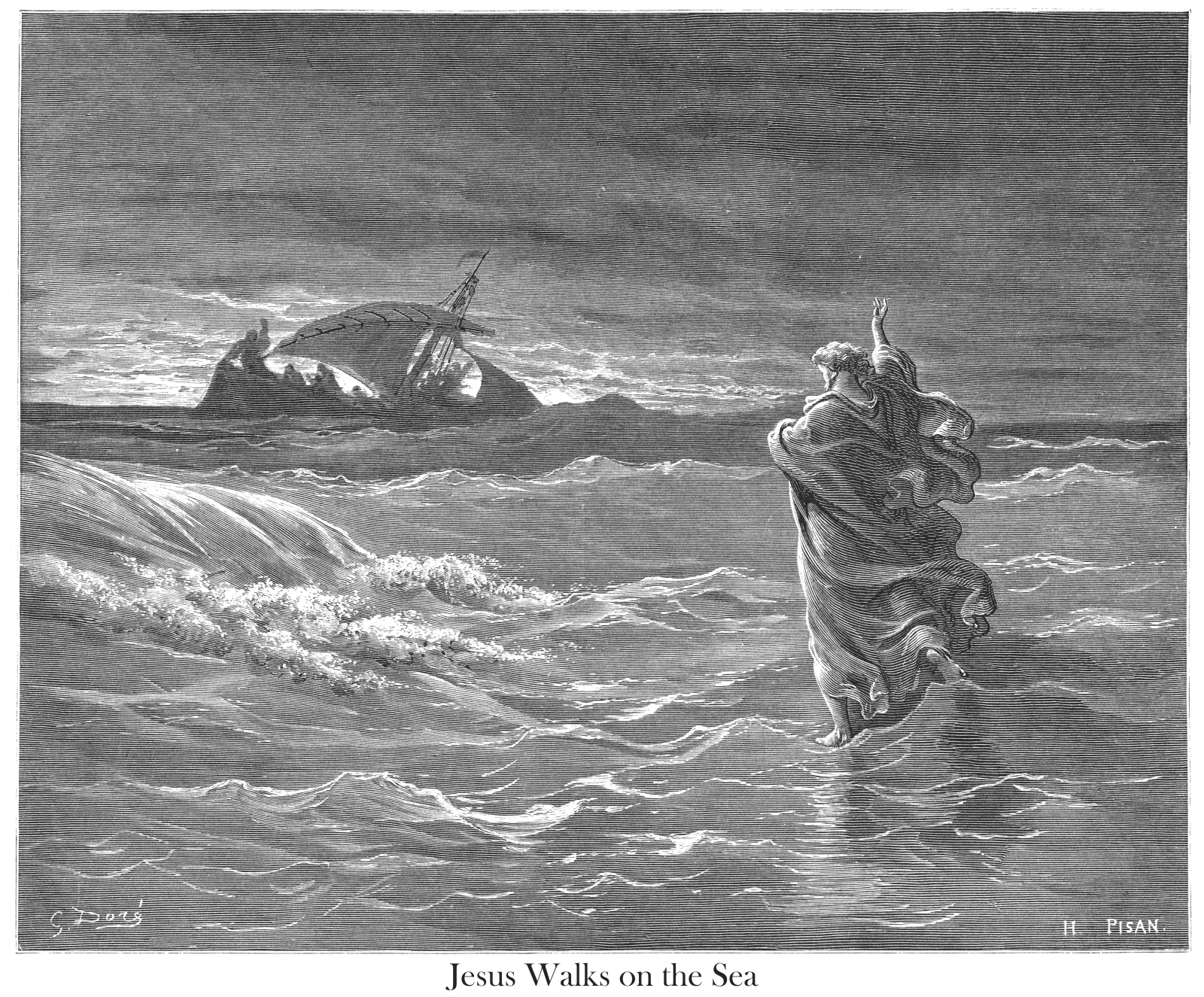
Jesus Walks on the Sea
John 6:19-20 · World English Bible (Catholic)
19When therefore they had rowed about twenty-five or thirty stadia, they saw Jesus walking on the sea and drawing near to the boat; and they were afraid.
20But he said to them, “It is I. Don’t be afraid.”
With one foot set on the crest of a wave, Jesus advances toward the boat. His cloak billows behind him; one hand is raised against the dark sky. He is seen from behind, so close to us that his figure dominates the men gathered in the distance. Yet before him, the expanse of water remains considerable.
The boat occupies the left side of the engraving. Its curved sail, tilted mast, and the figures clustered aboard form a fragile mass amid the waves. In the foreground, a breaking wave is far larger in the image than the men it separates from Jesus. The wind stirs both the sail and the garment: the same storm envelops the boat and the one coming to meet it.
In John’s account, the disciples have rowed for a long time when they see Jesus walking on the sea and drawing near to them. They are afraid. The distance created by the engraving gives duration to this approach: Jesus has not yet reached his own, and the passage of the eye remains exposed to the waves. The faces in the boat are too far away for their fear to be clearly discerned. It belongs first of all to the evangelist’s words.
Jesus says to them, “It is I; do not be afraid.” The raised hand may accompany these words, without translating them on its own. His face, turned toward the disciples, remains hidden; in the text, they recognize him through a voice that the engraving cannot make heard. Here the words do not still the troubled sea. They reach the men even before Jesus gets into the boat, in the midst of the distance that still separates them.