Gustave Doré · John 4:13-14
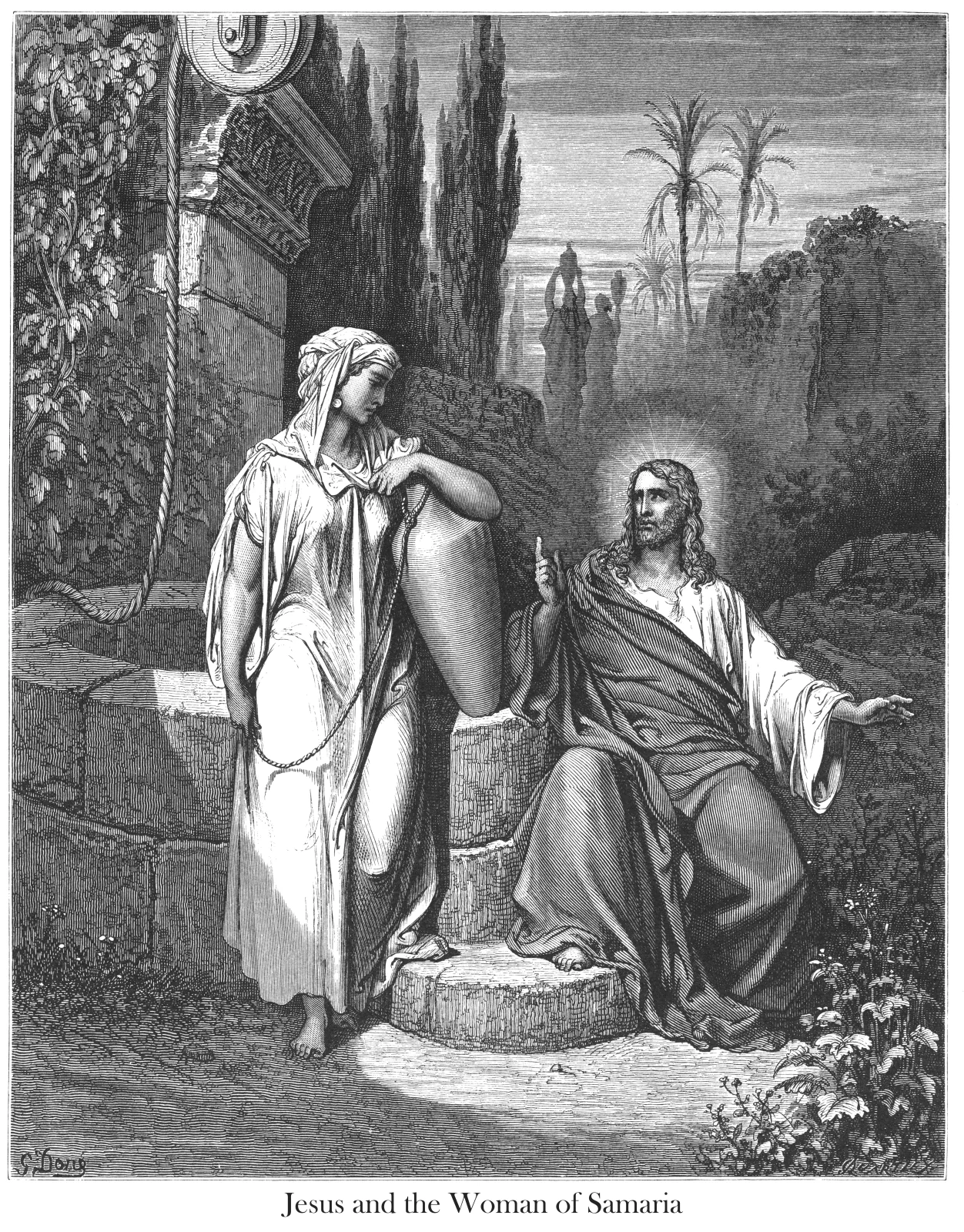
Jesus and the Woman of Samaria
John 4:13-14 · World English Bible (Catholic)
13Jesus answered her, “Everyone who drinks of this water will thirst again,
14but whoever drinks of the water that I will give him will never thirst again; but the water that I will give him will become in him a well of water springing up to eternal life.”
The large jar stands between the two figures. The Samaritan woman rests her arm on it, while Jesus, seated beside the well, raises one finger as he turns toward her. The object that has brought her here occupies almost all the space separating their bodies; yet their gazes meet above it.
Behind the woman, the rope descends along the well structure and reaches its dark opening. The jar, the rope, and the masonry give water a tangible presence without allowing it to be seen. Nothing flows in the engraving. In the distance, on the path, small figures carry vessels too: the act of coming to draw water continues beyond the encounter, in ordinary life.
Jesus speaks precisely of this water, which one must drink again. He sets against the water of the well the water he will give: it will become, in whoever receives it, a spring welling up to eternal life. The woman’s response, in the immediate continuation of the passage, remains grounded in that path: she asks not to be thirsty anymore and not to have to come here to draw water.
The engraving leaves the jar where it is, beneath the Samaritan woman’s arm. It gives no form to the promised spring. The raised finger and the other, open hand accompany words whose content cannot be inferred from the gesture alone. Returning to John, we understand that the water Jesus speaks of shifts the very location of the spring: sought at the bottom of the well, it is promised within the one who receives it. The jar’s proximity makes tangible the distance between what the woman can carry and what Jesus announces.