Gustave Doré · John 2:5-7
The Wedding at Cana
John 2:5-7 · World English Bible (Catholic)
5His mother said to the servants, “Whatever he says to you, do it.”
6Now there were six water pots of stone set there after the Jews’ way of purifying, containing two or three metretes apiece.
7Jesus said to them, “Fill the water pots with water.” So they filled them up to the brim.
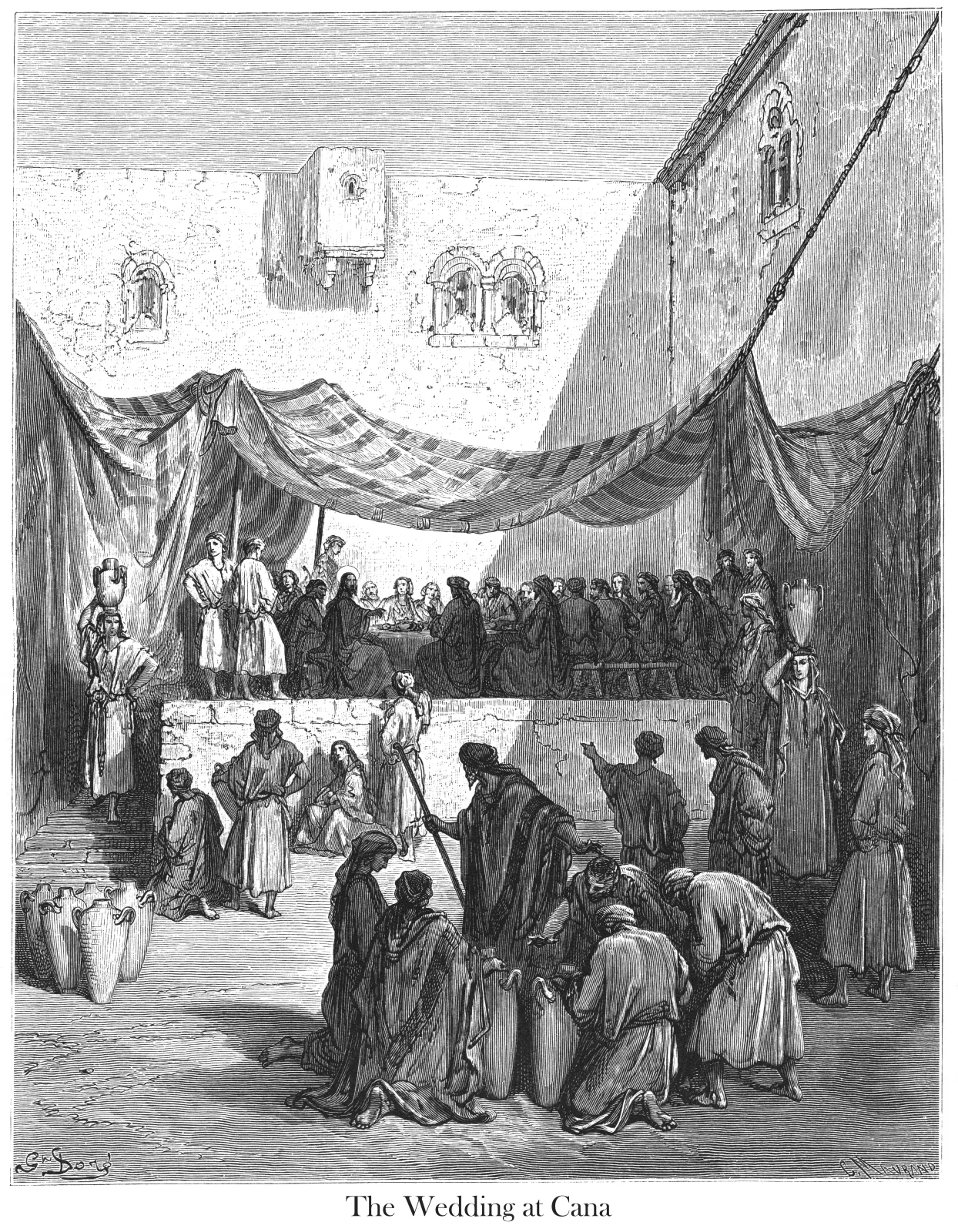
In the foreground, several men lean over large jars. Their bodies partly obscure the openings; their hands reach toward the vessels, but what they contain remains invisible. A standing man, leaning on a staff, stretches out his arm toward the group. Farther away, on either side of the courtyard, two women carry vessels on their heads. In this way, activity is arranged around the jars before the eye moves on to the banquet table.
The table occupies a raised terrace beneath a vast canopy. Jesus, recognizable by his halo, sits among the guests, slightly left of center. The distance separating him from the men busy below gives their work an unexpected prominence: it is not the faces gathered at the table that first hold the attention, but bent backs and vessels.
In John, Jesus’ mother gives the servants a decisive instruction: to do whatever he tells them. Jesus then asks them to fill six stone jars intended for ritual purification with water, and they are filled to the brim. The engraving gives these gestures a breadth that the text recounts in a few words. It places the carriers and the jars in a courtyard that the passage does not describe. The exact number of jars mentioned by John, their material, and how full they are cannot be clearly verified in the image.
The contents of the vessels elude the eye, just as the servants’ work remains at a distance from the table. This separation brings out one feature of the passage: Jesus’ words set ordinary actions in motion, without their significance yet being revealed in the verses illustrated. The jars intended for ritual purification become the focus of an expectation whose outcome the bent men do not disclose.