Gustave Doré · John 11:41-43
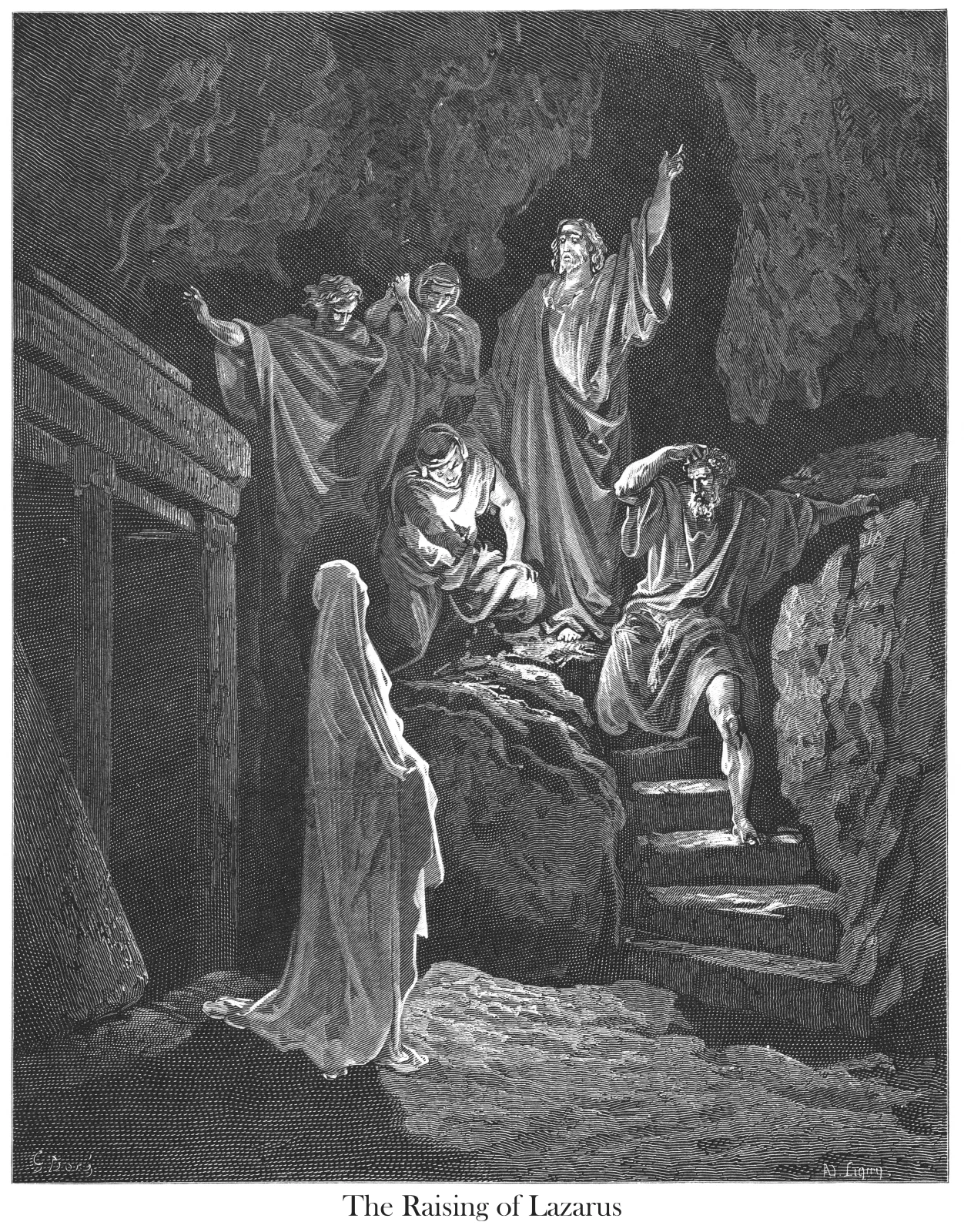
The Raising of Lazarus
John 11:41-43 · World English Bible (Catholic)
41So they took away the stone from the place where the dead man was lying. Jesus lifted up his eyes and said, “Father, I thank you that you listened to me.
42I know that you always listen to me, but because of the multitude standing around I said this, that they may believe that you sent me.”
43When he had said this, he cried with a loud voice, “Lazarus, come out!”
A shrouded figure stands before the dark entrance to the tomb. The cloth falls to the ground and conceals the face. Lazarus has come out, but nothing in his features yet allows us to recognize the one who returns. Between him and the people gathered higher up, a stretch of earth remains clear.
Above this open space, Jesus raises an arm toward heaven. His gesture dominates the scene without eclipsing the reactions around him: on the left, one figure stretches out an arm while another clasps his hands; lower down, a woman leans toward Lazarus. On the right, a man leans against the rock, one hand raised to his forehead. The bodies turn toward the one who has returned or draw back before him. Lazarus, by contrast, remains almost motionless. His tall, veiled form echoes the upright figure of Jesus, but the shroud makes him seem a presence still held by the tomb.
In John’s account, Jesus first gives thanks aloud to the Father, so that the crowd may believe that he sent him. Then he calls Lazarus to come out. The dead man appears in the following verse, his hands and feet bound and his face covered; Jesus then asks that he be unbound. Doré brings these moments together: the raised arm may be associated with the prayer, while Lazarus is already outside the opening. The cry cannot be heard in the engraving, but the distance between the two figures preserves its direction.
The continuous cloth does not show in detail the strips of linen mentioned by John. Yet it makes their effect palpable: Lazarus is present among the living without yet being freed from what wrapped his dead body. The words addressed to the Father and the call to the dead man thus find their visible counterparts in a single image; the gestures of those close to him remind us that this return still has to be received.