Gustave Doré · Daniel 13:36-64
The Vindication of Susanna
Daniel 13:36-64 · World English Bible (Catholic)
36The elders said, “As we walked in the garden alone, this woman came in with two maids, shut the garden doors, and sent the maids away.
37Then a young man who was hidden there came to her and lay with her.
38And we, being in a corner of the garden, saw this wickedness and ran to them.
39And when we saw them together, we couldn’t hold the man; for he was stronger than we, and opened the doors, and leaped out.
40But having taken this woman, we asked who the young man was, but she would not tell us. We testify these things.
41Then the assembly believed them, as those who were elders of the people and judges; so they condemned her to death.
42Then Susanna cried out with a loud voice, and said, “O everlasting God, you know the secrets, and know all things before they happen.
43You know that they have testified falsely against me. Behold, I must die, even though I never did such things as these men have maliciously invented against me.”
44The Lord heard her voice.
45Therefore when she was led away to be put to death, God raised up the holy spirit of a young youth, whose name was Daniel.
46He cried with a loud voice, “I am clear from the blood of this woman!”
47Then all the people turned them toward him, and said, “What do these words that you have spoken mean?”
48So he, standing in the midst of them, said, “Are you all such fools, you sons of Israel, that without examination or knowledge of the truth you have condemned a daughter of Israel?
49Return again to the place of judgment; for these have testified falsely against her.”
50Therefore all the people turned again in haste, and the elders said to him, “Come, sit down among us, and show it to us, seeing God has given you the honor of an elder.”
51Then Daniel said to them, “Put them far apart from each another, and I will examine them.”
52So when they were put apart one from another, he called one of them, and said to him, “O you who have become old in wickedness, now your sins have returned which you have committed before,
53in pronouncing unjust judgment, condemning the innocent, and letting the guilty go free; although the Lord says, ‘You shall not kill the innocent and righteous.’
54Now then, if you saw her, tell me, under which tree did you see them companying together?” He answered, “Under a mastick tree.”
55And Daniel said, “You have certainly lied against your own head; for even now the angel of God has received the sentence of God and will cut you in two.”
56So he put him aside, and commanded to bring the other, and said to him, “O you seed of Canaan, and not of Judah, beauty has deceived you, and lust has perverted your heart.
57Thus you have dealt with the daughters of Israel, and they for fear were intimate with you; but the daughter of Judah would not tolerate your wickedness.
58Now therefore tell me, under which tree did you take them being intimate together?” He answered, “Under an evergreen oak tree.”
59Then Daniel said to him, “You have also certainly lied against your own head; for the angel of God waits with the sword to cut you in two, that he may destroy you.”
60With that, all the assembly cried out with a loud voice, and blessed God, who saves those who hope in him.
61Then they arose against the two elders, for Daniel had convicted them of false testimony out of their own mouth.
62According to the law of Moses they did to them what they maliciously intended to do to their neighbor. They put them to death, and the innocent blood was saved the same day.
63Therefore Helkias and his wife praised God for their daughter Susanna, with Joakim her husband, and all the kindred, because there was no dishonesty found in her.
64And from that day forth, Daniel had a great reputation in the sight of the people.
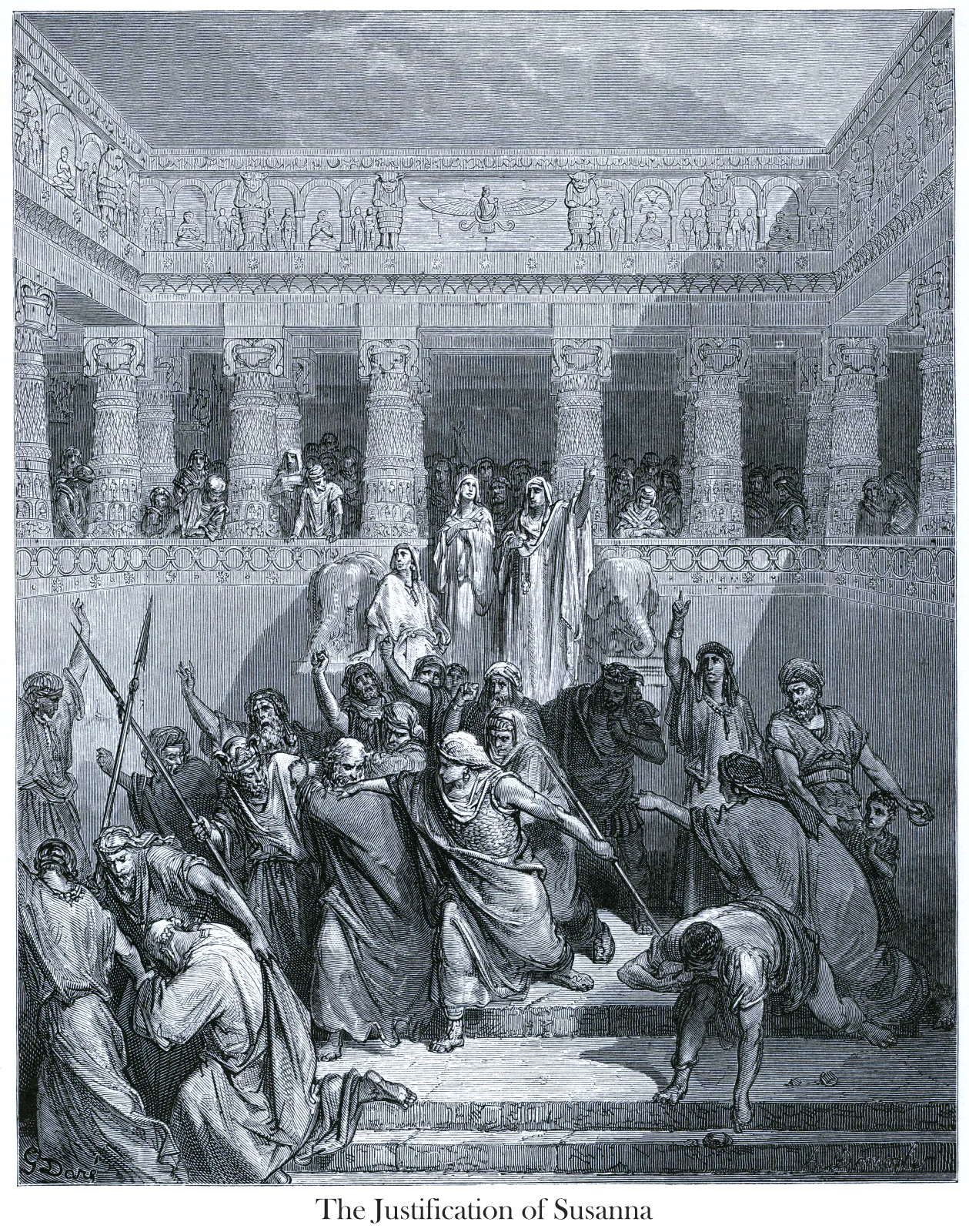
In the foreground, men bend and struggle beneath the hands of those around them. An arm pulls an old man by his clothing; on the right, another man lies on the steps. Gestures intersect, bodies collide. Above this commotion, a woman in a light-colored dress stands with her hands raised to her chest. Her elevated position makes her visible, but also sets her apart from the crowd seizing the accusers.
The title allows us to recognize her as Susanna. Near her, a figure raises an arm; behind the columns, witnesses watch the scene from the gallery. The vast building gives the event a public character: what is taking place before the assembly now concerns the entire community. Yet the eye returns to the steps. The distance between the motionless woman and the men being dragged downward makes the reversal of their positions palpable.
Just moments earlier, according to the text, the two elders had been believed because of their age and standing as judges. Condemned, Susanna had called upon God to witness her innocence. Daniel then has the accusers separated: questioned about the tree beneath which they claim to have surprised her, they give two different answers. Their own words confound them. The assembly turns against them, and the punishment they had intended for Susanna is inflicted upon them.
The engraving concentrates this reversal in the movements of the crowd rather than in the interrogation. The contradictory answers, so decisive in the text, remain invisible; their consequences occupy almost the entire foreground. The young woman remains apart from this violence, even as her innocence is at stake in it.
The story links Susanna’s deliverance to divine attention and to the inquiry Daniel demands. The engraving shows the public cost of this truth recovered: the former judges are now delivered into the hands of those before whom their testimony had carried authority.