Gustave Doré · Daniel 13:1-26
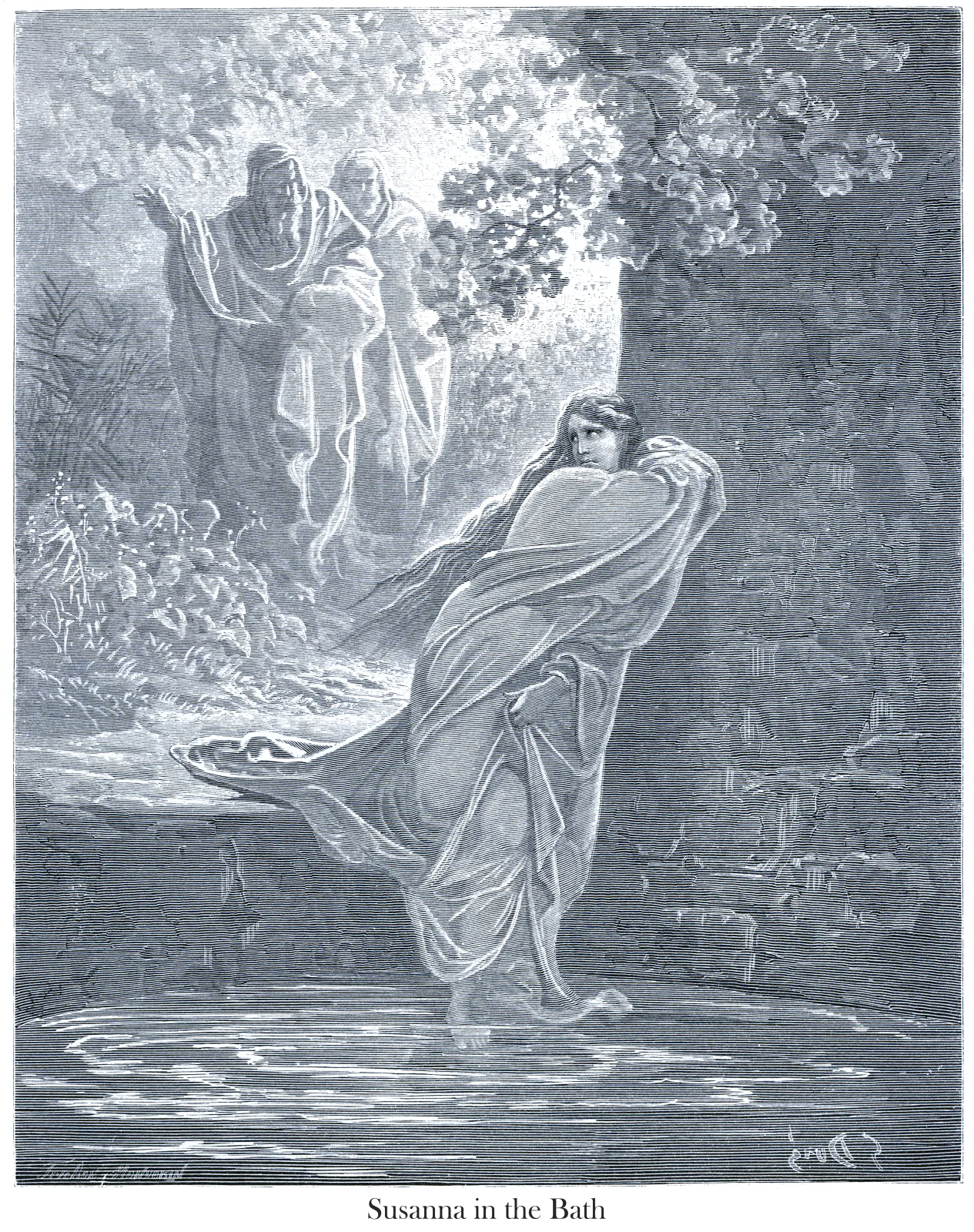
Susanna in the Bath
Daniel 13:1-26 · World English Bible (Catholic)
1A man lived in Babylon, and his name was Joakim.
2He took a wife, whose name was Susanna, the daughter of Helkias, a very fair woman, and one who feared the Lord.
3Her parents were also righteous, and taught their daughter according to the law of Moses.
4Now Joakim was a great rich man, and had a beautiful garden next to his house. The Jews used to come to him, because he was more honorable than all others.
5The same year, two of the elders of the people were appointed to be judges, such as the Lord spoke of, that wickedness came from Babylon from elders who were judges, who were supposed to govern the people.
6These were often at Joakim’s house. All that had any lawsuits came to them.
7When the people departed away at noon, Susanna went into her husband’s garden to walk.
8The two elders saw her going in every day and walking; and they were inflamed with lust for her.
9They perverted their own mind and turned away their eyes, that they might not look to heaven, nor remember just judgments.
10And although they both were wounded with lust for her, yet dared not show the other his grief.
11For they were ashamed to declare their lust, what they desired to do with her.
12Yet they watched eagerly from day to day to see her.
13The one said to the other, “Let’s go home, now; for it is dinner time.”
14So when they had gone out, they parted company, and turning back again, they came to the same place. After they had asked one another the cause, they acknowledged their lust. Then they appointed a time both together, when they might find her alone.
15It happened, as they watched on an opportune day, she went in as before with only two maids, and she desired to wash herself in the garden; for it was hot.
16There was nobody there except the two elders who had hid themselves and watched her.
17Then she said to her maids, “Bring me olive oil and ointment, and shut the garden doors, that I may wash myself.”
18They did as she asked them and shut the garden doors, and went out themselves at the side doors to fetch the things that she had commanded them. They didn’t see the elders, because they were hidden.
19Now when the maids had gone out, the two elders rose up and ran to her, saying,
20“Behold, the garden doors are shut, that no man can see us, and we are in love with you. Therefore consent to us, and lie with us.
21If you will not, we will testify against you, that a young man was with you; therefore you sent your maids away from you.”
22Then Susanna sighed, and said, “I am trapped; for if I do this thing, it is death to me. If I don’t do it, I can’t escape your hands.
23It is better for me to fall into your hands, and not do it, than to sin in the sight of the Lord.”
24With that Susanna cried with a loud voice; and the two elders cried out against her.
25Then one of them ran and opened the garden doors.
26So when the servants of the house heard the cry in the garden, they rushed in at the side door to see what had happened to her.
Susanna turns her head over her shoulder. Her body draws away to the right, while she gathers a broad piece of cloth against herself. On the left, two men stand one behind the other, beyond the plants bordering the pool. One reaches out his hand; the other looks in the same direction. A few steps still separate them from Susanna, but the look she gives them has already broken the solitude of the bath.
The elders’ position gives the distance an unsettling quality. Set higher in the image, they loom over the woman without yet touching her. The dark wall occupying the right side constricts the space around her. The cloth, its folds following the movement of her body, covers her breast and extends her silhouette towards the edge of the pool: Susanna seeks to shield herself from their eyes at the very moment she discovers their presence.
The text recounts a watch prepared long in advance. The two elders, appointed judges, waited until the young women had left the garden; they then offer Susanna a terrible choice: yield to them or face a false accusation. The engraving concentrates this sequence of events in the meeting of glances and gestures. Neither the servants, nor the closed doors, nor the cries that will bring the household’s people running are visible. Yet the threat remains inscribed in the two men’s proximity and in Susanna’s retreat.
The passage specifies that these judges had turned their eyes away from heaven and forgotten God’s judgments. Here, their gazes converge on the woman they had been spying on. Susanna, for her part, will answer their threat by standing before another gaze: that of the Lord. The engraving leaves this response to the biblical text, while her turned face offers an initial sign of the constraint weighing upon her.