Gustave Doré · Daniel 14:1-27
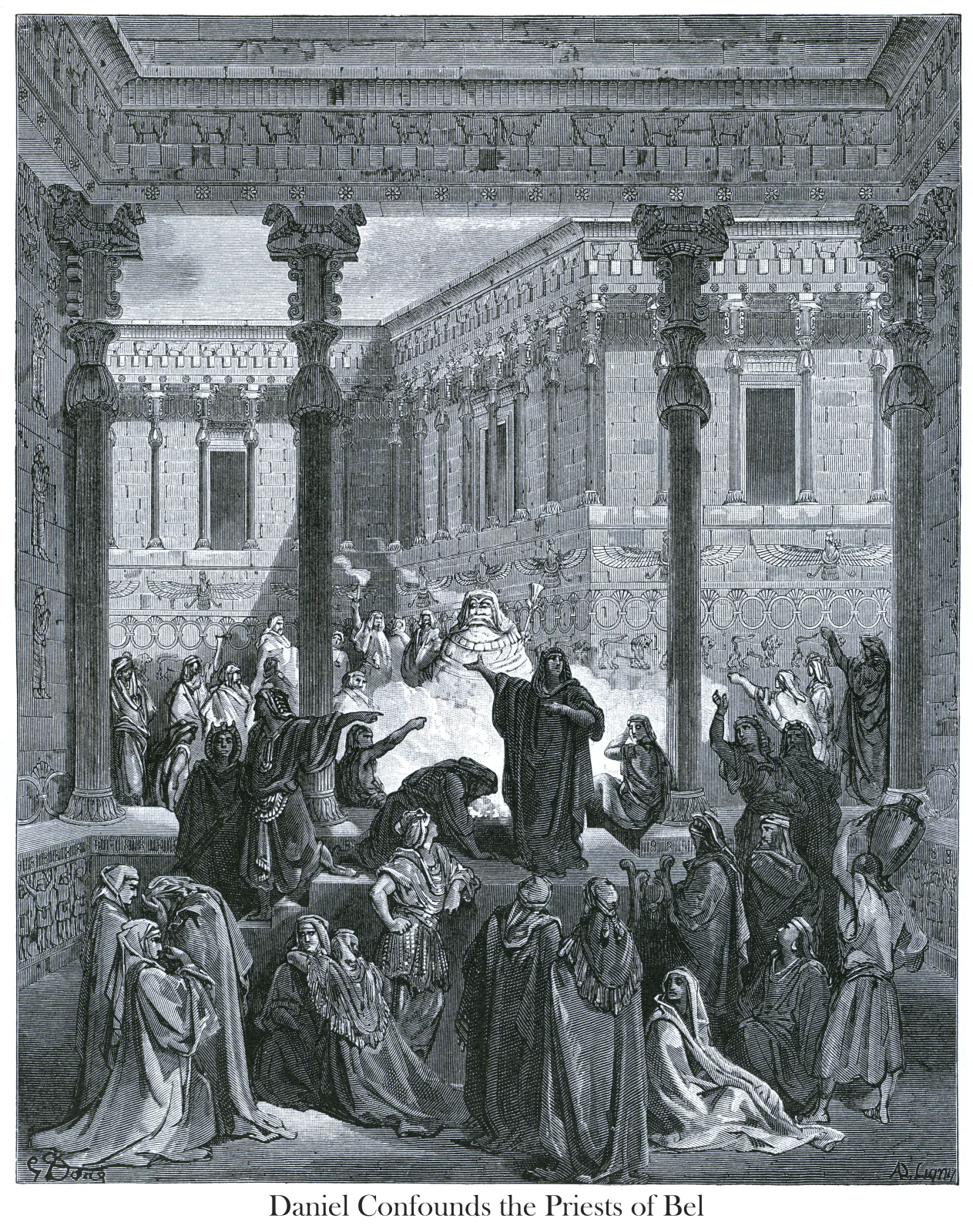
Daniel Confounds the Priests of Bel
Daniel 14:1-27 · World English Bible (Catholic)
1King Astyages was gathered to his fathers, and Cyrus the Persian received his kingdom.
2Daniel lived with the king, and was honored above all his friends.
3Now the Babylonians had an idol called Bel, and every day twelve great measures of fine flour, forty sheep, and six firkins of wine were spent on it.
4The king honored it and went daily to worship it; but Daniel worshiped his own God. The king said to him, “Why don’t you worship Bel?”
5He said, “Because I may not honor idols made with hands, but only the living God, who has created the sky and the earth, and has sovereignty over all flesh.”
6Then the king said to him, “Don’t you think that Bel is a living god? Don’t you see how much he eats and drinks every day?”
7Then Daniel laughed, and said, “O king, don’t be deceived; for this is just clay inside, and brass outside, and never ate or drank anything.”
8So the king was angry, and called for his priests, and said to them, “If you don’t tell me who this is who devours these expenses, you shall die.
9But if you can show me that Bel devours them, then Daniel shall die; for he has spoken blasphemy against Bel.” Daniel said to the king, “Let it be according to your word.”
10Now there were seventy priests of Bel, besides their wives and children. The king went with Daniel into Bel’s temple.
11So Bel’s priests said, “Behold, we will leave; but you, O king, set out the food, and mix the wine and set it out, shut the door securely, and seal it with your own signet.
12When you come in the morning, if you don’t find that Bel has eaten everything, we will suffer death, or else Daniel, who speaks falsely against us.”
13They weren’t concerned, for under the table they had made a secret entrance, by which they entered in continually, and consumed those things.
14It happened, when they had gone out, the king set the food before Bel. Now Daniel had commanded his servants to bring ashes, and they scattered them all over the temple in the presence of the king alone. Then they went out, shut the door, sealed it with the king’s signet, and so departed.
15Now in the night, the priests came with their wives and children, as they usually did, and ate and drank it all.
16In the morning, the king arose, and Daniel with him.
17The king said, “Daniel, are the seals whole?” He said, “Yes, O king, they are whole.”
18And as soon as he had opened the door, the king looked at the table, and cried with a loud voice, “You are great, O Bel, and with you is no deceit at all!”
19Then Daniel laughed, and held the king that he should not go in, and said, “Behold now the pavement, and mark well whose footsteps these are.”
20The king said, “I see the footsteps of men, women, and children.” Then the king was angry,
21and took the priests with their wives and children, who showed him the secret doors, where they came in and consumed the things that were on the table.
22Therefore the king killed them, and delivered Bel into Daniel’s power, who overthrew it and its temple.
23In that same place there was a great dragon which the people of Babylon worshiped.
24The king said to Daniel, “Will you also say that this is of brass? Behold, he lives, eats and drinks. You can’t say that he is no living god. Therefore worship him.”
25Then Daniel said, “I will worship the Lord my God; for he is a living God.
26But allow me, O king, and I will kill this dragon without sword or staff.” The king said, “I allow you.”
27Then Daniel took pitch, fat, and hair, and melted them together, and made lumps of them. He put these in the dragon’s mouth, so the dragon ate and burst apart. Daniel said, “Behold, these are the gods you all worship.”
At the center of the temple, a standing man extends his arm to the left. Around him, gestures answer one another: one figure in turn points toward the center of the scene, while others raise their hands or turn around. In front of the central figure, a man is bent down to the ground. His posture draws the eye toward the paving, while the agitation spreads among the groups arranged on the steps.
Higher up, the great figure of Bel dominates the assembly. It appears amid a bright area, framed by columns and richly ornamented walls. Yet the statue does not command the gaze as an active presence would. Attention is divided between the men, their gestures, and what is unfolding at their feet. The title leads us to recognize in this confrontation Daniel confounding the priests of Bel; the identity of the various secondary figures is less certain.
The text gives the floor decisive importance. Daniel has had ashes spread in the temple before the door is closed and sealed. In the morning, the king sees that the offerings have disappeared and believes he has found proof that Bel has consumed them. Daniel stops him and makes him consider the traces left by the priests and their families. The sign is all the more convincing because the seal has remained intact: the visitors came in through another entrance.
The engraving unfolds this discovery before a large crowd, whereas the passage first recounts an exchange between Daniel and the king. The footprints themselves are not clearly discernible; it is through the figures’ postures and the direction of their gestures that the challenge becomes visible. Bel’s stature and the splendor of his setting remain intact in the image, but they are no longer enough to establish what the king believed he saw. The narrative thus approaches the question of the living God by way of an inquiry into human traces.