Gustave Doré · Daniel 5:5-6
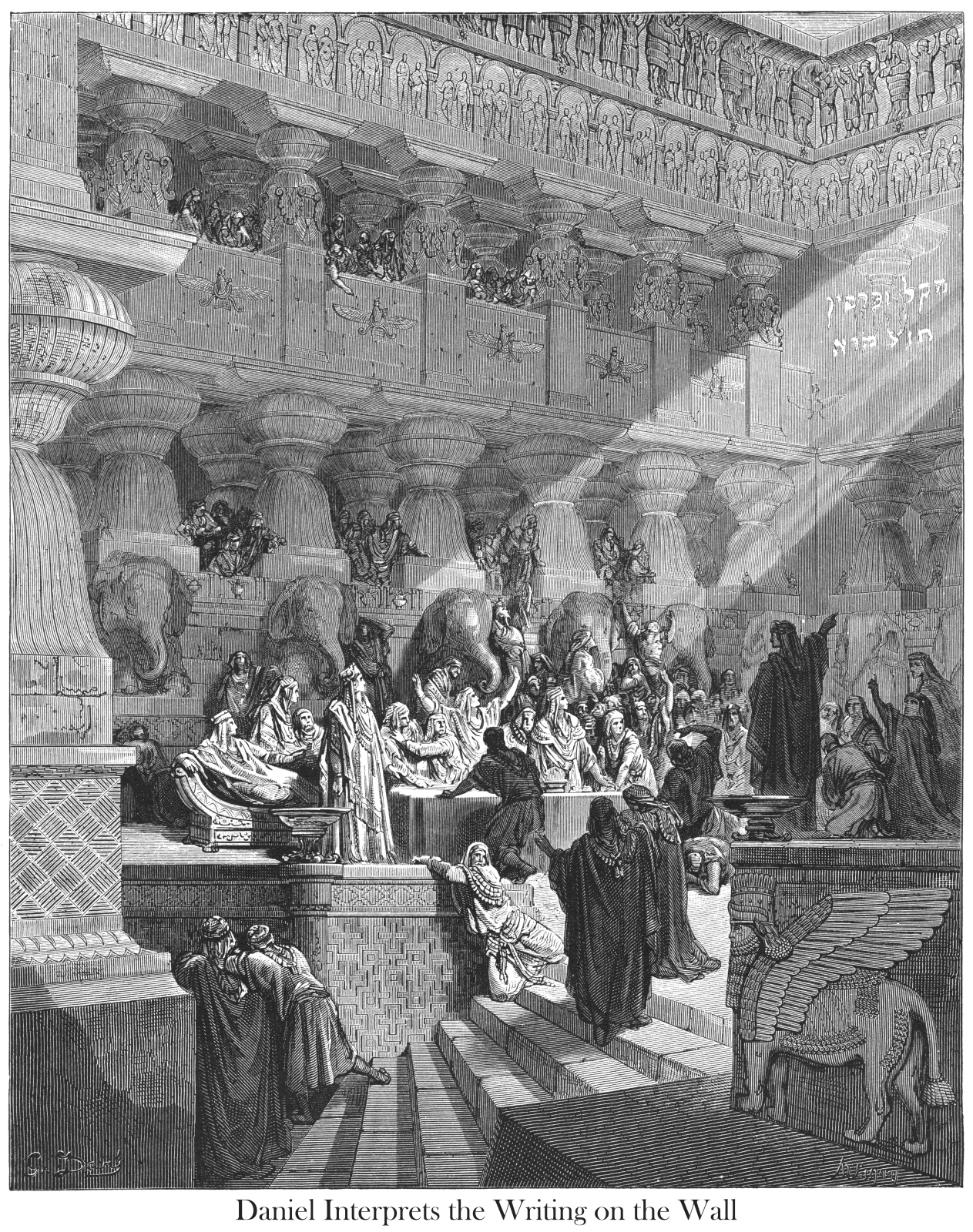
Daniel Interprets the Writing on the Wall
Daniel 5:5-6 · World English Bible (Catholic)
5In the same hour, the fingers of a man’s hand came out and wrote near the lamp stand on the plaster of the wall of the king’s palace. The king saw the part of the hand that wrote.
6Then the king’s face was changed in him, and his thoughts troubled him; and the joints of his thighs were loosened, and his knees struck one against another.
At the very top, on the right, a few bright marks occupy a small section of the wall. They are far from the table, but a beam crosses the room diagonally and leads the eye toward them. Below, a standing man dressed in a dark cloak raises his arm in their direction. His gesture connects the inscription with the guests gathered around the feast.
The height of the palace matters as much as its richness. Massive columns, crowded galleries, and rows of sculpted figures tier the hall above the guests. Yet none of these ornaments draws as much attention as the few letters that have appeared on the wall. At the table, bodies turn and arms are raised; on the steps, one figure clings to the edge while others lean forward or turn away. The disturbance spreads through the entire space.
The passage in Daniel begins with a more closely focused detail: the king sees the fingers of a human hand writing on the plaster, opposite the lampstand. Then fear grips him so that his knees knock together. In the engraving, the writing remains visible, but the hand is not clearly discernible; the reaction, by contrast, spreads among the figures. The king’s bodily distress becomes a collective agitation.
The title also points to Daniel’s interpretation of the writing, an episode that goes beyond the verses cited. The man with his arm raised can thus be read as the figure of the interpreter, standing between the signs and the assembled company. His presence shifts the emphasis: alongside fear at the sight of writing that has appeared without explanation comes the need to receive its meaning. In the passage, the king specifically summons sages and promises a reward to whoever can read and explain the words. Even before it is interpreted, the inscription suspends the palace’s sense of security.