Gustave Doré · Daniel 6:20-21
Daniel in the Lions’ Den
Daniel 6:20-21 · World English Bible (Catholic)
20When he came near to Daniel in the den, he cried with a troubled voice. The king spoke and said to Daniel, “Daniel, servant of the living God, is your God, whom you serve continually, able to deliver you from the lions?”
21Then Daniel said to the king, “O king, live forever!
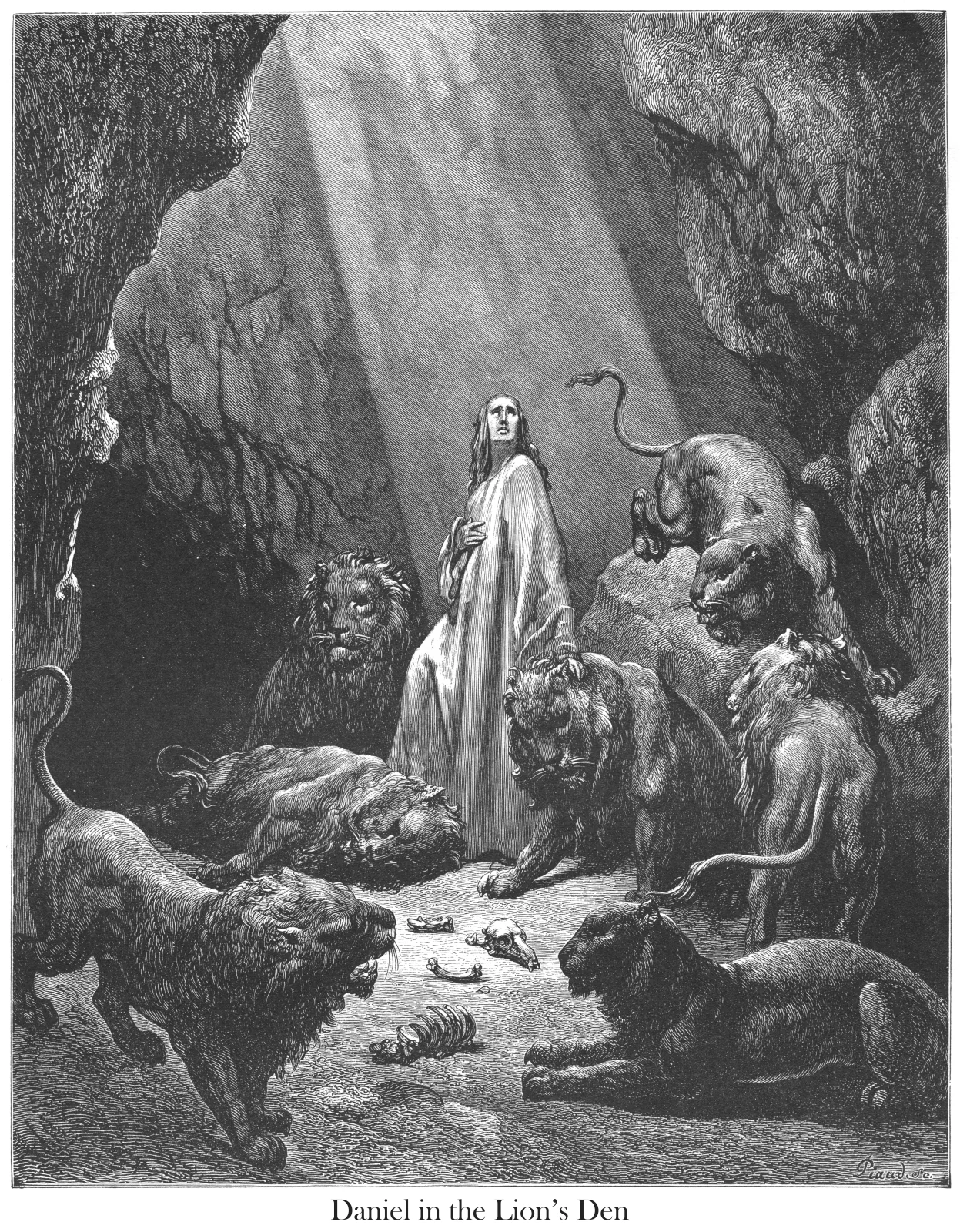
Amid the lions, Daniel raises his face toward the opening of the den. With one hand resting on his chest, he remains standing while the beasts occupy the ground and rocks around him. Light from above reaches his pale garment, leaving the walls and several animals in deep shadow. His gaze follows this upward direction, beyond the frame.
Yet the lions do not form an immobile circle. One comes down from a rock on the right; another advances in the foreground, its mouth slightly open. Near Daniel, a beast lowers its head beneath his hand. Their closeness makes his calm precarious: nothing separates his body from the animals. On the ground, a few bones and a skull make this proximity more unsettling still. The den has not become a refuge; it bears the traces of possible violence.
The passage in Daniel first brings the reader to the king. After a sleepless night, he hurries to the den at dawn and calls to Daniel in a sorrowful voice. His question concerns the power of the living God: has He been able to deliver His servant? Daniel himself answers next. In the engraving, the king remains invisible. We are placed at the bottom of the den, before we can share the king’s question from its edge. Daniel’s upturned gaze may reach the place from which the call comes, though the drawing does not allow us to affirm that he already hears it.
This change of viewpoint gives visible form to what the king seeks to know: Daniel is alive among the lions. But the question is not erased by this sight. The light descending toward him removes neither the beasts nor the bones. It opens the space above the prisoner and lets his gaze travel beyond what confines him. Deliverance appears here not as the disappearance of danger, but as life preserved in its presence.