Gustave Doré · Jeremiah 36:4
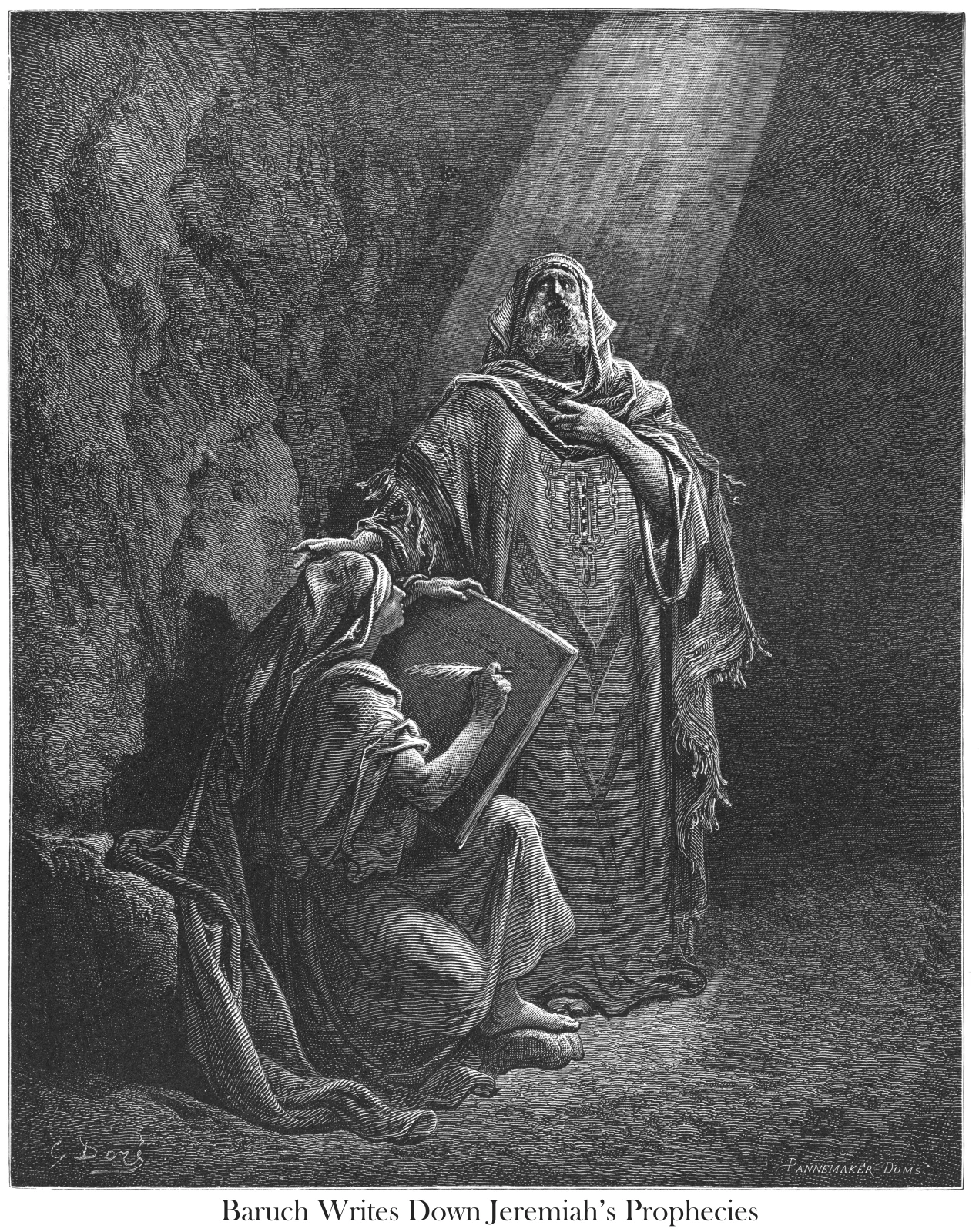
Baruch Writes Down Jeremiah’s Prophecies
Jeremiah 36:4 · World English Bible (Catholic)
4Then Jeremiah called Baruch the son of Neriah; and Baruch wrote from the mouth of Jeremiah all the LORD’s words, which he had spoken to him, on a scroll of a book.
Baruch’s pen pauses over a large sloping surface, whose edge crosses the engraving diagonally. Seated in the foreground, the scribe nevertheless raises his face toward Jeremiah. His hand writes; his gaze listens. Above him, the prophet stands, one hand on his chest and the other extended just above Baruch’s head. The gesture brings the two men close without erasing the difference in their attitudes.
Jeremiah, for his part, turns his face upward. A light from an opening beyond the frame falls behind his head and sets his figure apart against the dark space. The rocky wall on the left constricts the setting; on the right, the background remains almost empty. Nothing distracts from the chain of gazes and gestures: from the prophet turning toward the heights to the scribe receiving his words.
The verse gives this relationship a precise direction. Baruch writes at Jeremiah’s dictation the words that Yahweh spoke to the prophet. The engraving makes the transmission between the two men visible, but the shaft of light also gives form to what precedes their exchange. It does not represent a divine utterance; it gives Jeremiah’s posture a depth that the mere act of dictating would not be enough to suggest.
One detail nevertheless catches the eye: the surface presented by Baruch looks like a large rectangular sheet rather than the scroll mentioned in the text. This upright surface makes the writing almost as prominent as the two figures. It remains silent: no recipient is there to read it. Yet Jeremiah, prevented from going to the house of Yahweh, will charge Baruch with taking these words there. The scribe thus occupies a decisive place: he who listens and writes will then have to make others hear what he has received.