Gustave Doré · Jeremiah 1:14-15
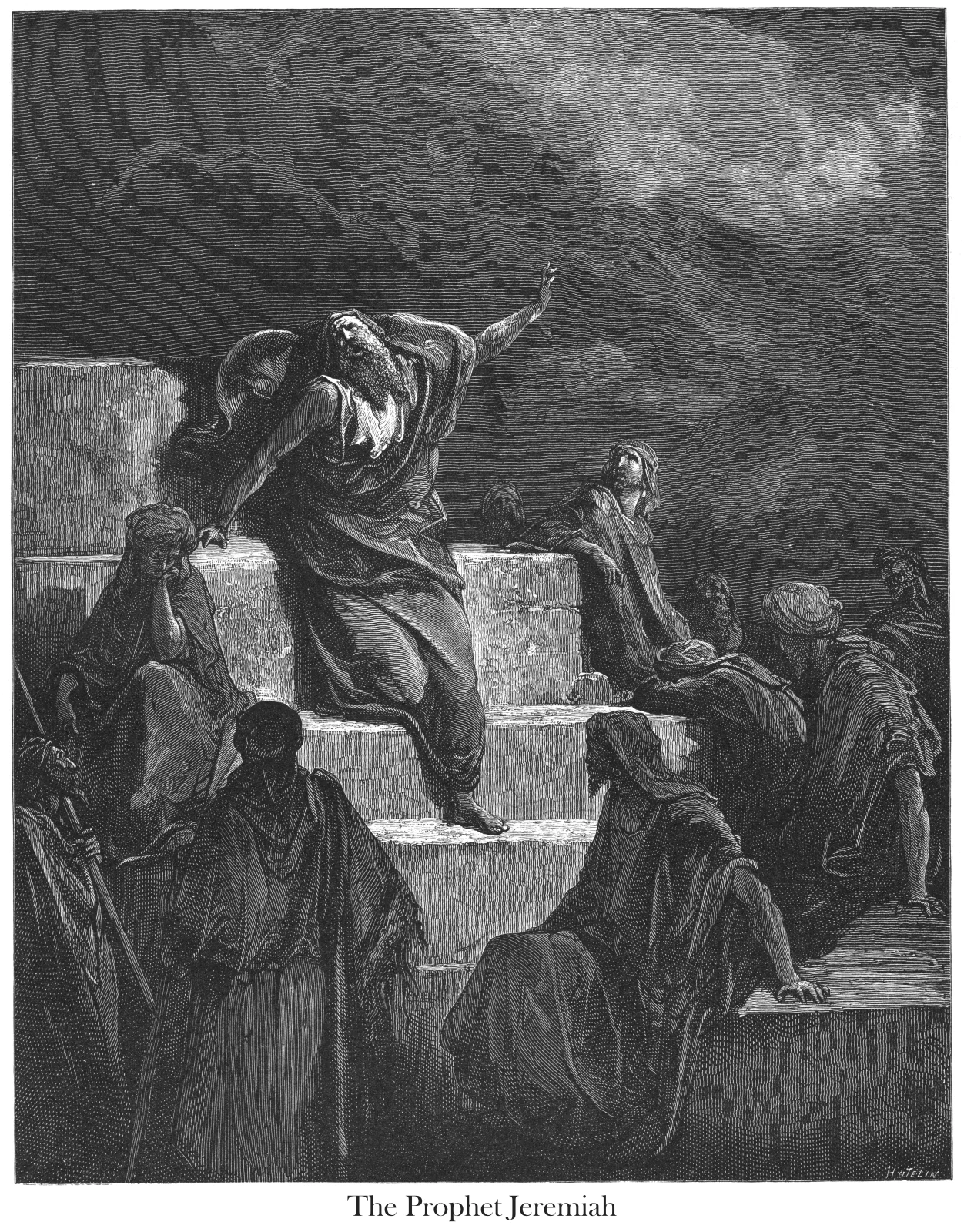
The Prophet Jeremiah
Jeremiah 1:14-15 · World English Bible (Catholic)
14Then the LORD said to me, “Out of the north, evil will break out on all the inhabitants of the land.
15For behold, I will call all the families of the kingdoms of the north,” says the LORD. “They will come, and they will each set his throne at the entrance of the gates of Jerusalem, and against all its walls all around, and against all the cities of Judah.
Jeremiah raises one arm toward the sky while his other hand rests on the stone. His body stretches between these two gestures: with one foot on a step, he leans backward and turns his face toward the bright opening in the clouds. Around him, the figures remain lower. On the left, one holds his head in his hand; on the right, another looks at the prophet. Their attitudes do not echo his upward surge.
The light-colored stone that cuts across the scene gives this difference its full force. It supports Jeremiah and sets him apart from the dark figures gathered at the foot of the steps. Yet his raised hand points to no distinct object. The eye follows his arm, meets the clouded sky, then returns to the faces and bodies around him. What occupies the prophet is not visible to the other figures.
In the Book of Jeremiah, Yahweh asks the prophet what he sees: a boiling pot coming from the north. The oracle then explains its meaning. From that direction disaster will come; the families of the kingdoms of the north will set their thrones before the gates of Jerusalem and around its walls. Neither the pot nor the thrones appear in the engraving. Nor does any detail allow us to recognize a geographical direction in the sky toward which Jeremiah reaches.
The passage conveys a word addressed to Jeremiah and the interpretation of a vision. The engraving places this same prophet among other men, beneath a sky that does not yield its secret. The gesture raised toward the heavens can be read as that of a man seized by a word whose import concerns those who remain near him. The announced disaster is not yet visible: here it lies in the distance between the prophet’s upward surge and the stillness of those around him.