Gustave Doré · Lamentations 1:8
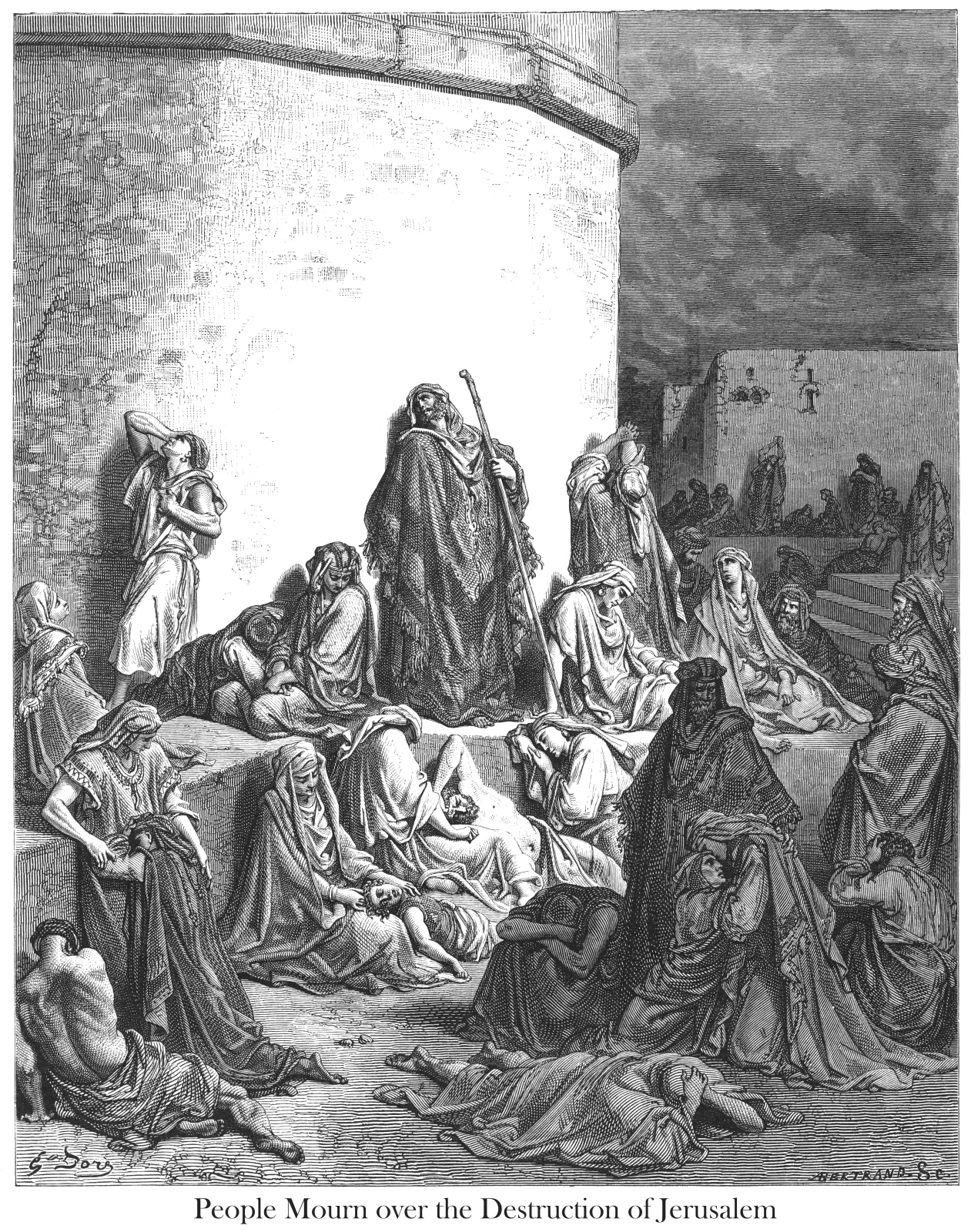
People Mourn over the Destruction of Jerusalem
Lamentations 1:8 · World English Bible (Catholic)
8Jerusalem has grievously sinned. Therefore she has become unclean. All who honored her despise her, because they have seen her nakedness. Yes, she sighs and turns backward.
In the foreground, a body lying outstretched almost blocks the path. The face is hidden beneath a hand; farther away, a seated woman buries her head in her arms. These gestures arrest the eye before it even reaches the back of the scene. Yet other figures stand upright: at the center, a man holds a long staff and looks upward, while on the left a woman throws her head back against the wall. Distress takes different forms, with no single gesture dominating all the others.
The high, pale wall gives this gathering an oppressive scale. It occupies a large part of the engraving, leaving the figures clustered at its foot. On the right, behind them, a passage leads toward other figures and buildings; but no way out commands the eye. The destruction announced by the title is not first seen in ruins. It is measured by these fallen bodies, by this crowd remaining beside the walls.
Lamentations gives Jerusalem the features of a humiliated woman: her nakedness has been seen, those who honored her despise her, and she turns away her face, groaning. The verse explicitly links this condition to her sins. In Doré’s engraving, no single figure sums up the personified city. The movement of the turned-away face is dispersed among the inhabitants, in bowed heads and veiled or hidden faces. The shame exposed to the gaze of others becomes a collective pain whose gestures are visible, but not its fault.
The adjacent text also says that no one consoles Jerusalem. Yet amid the crowd, a woman lays her hand on the head of a child lying beside her. This quiet touch does not dispel the mourning. It nevertheless gives human closeness a face where the biblical lament speaks of abandonment. The humiliated city does not appear alone: her suffering remains shared, at the foot of the wall.