Gustave Doré · Job 1:20-22
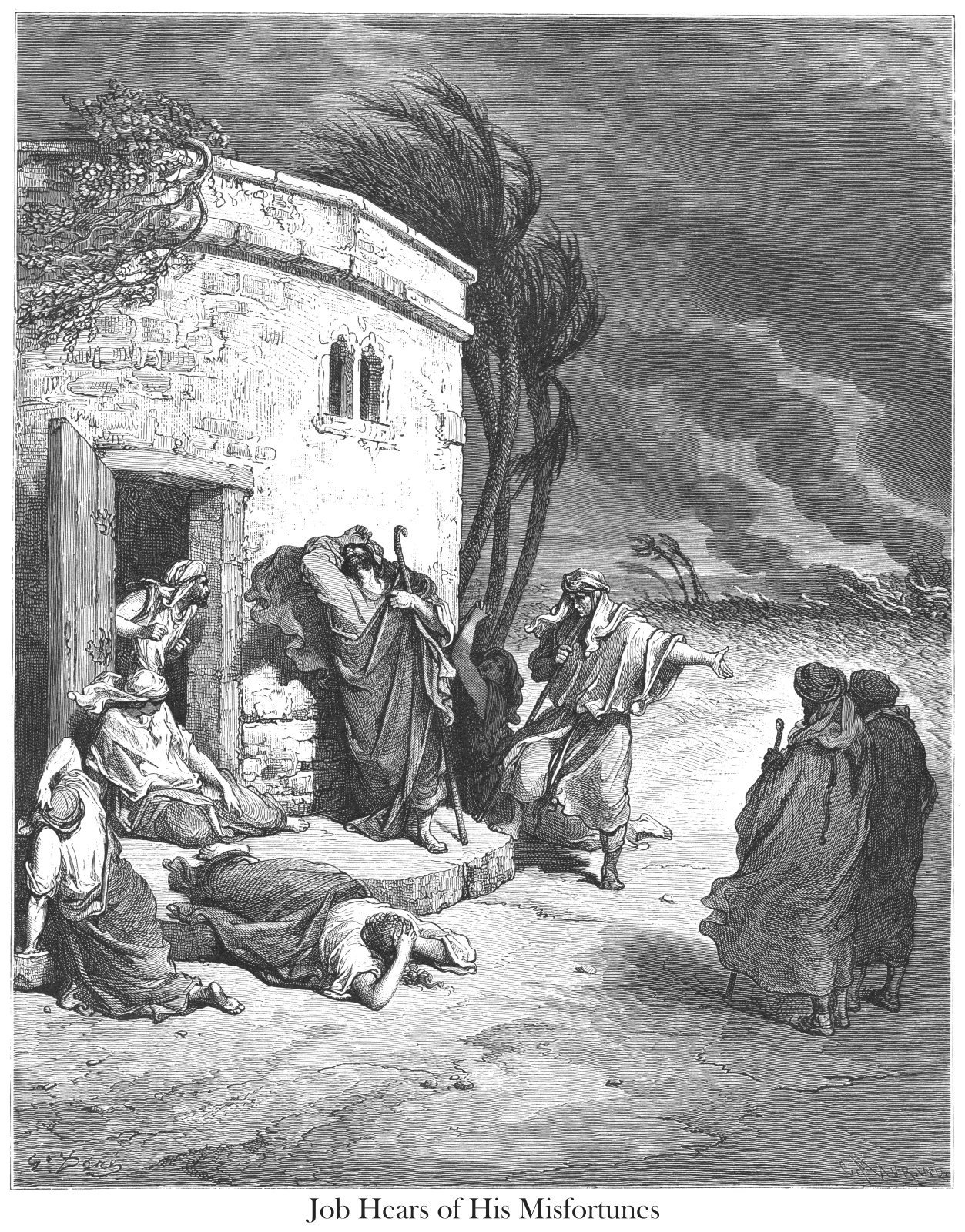
Job Hears of His Misfortunes
Job 1:20-22 · World English Bible (Catholic)
20Then Job arose, and tore his robe, and shaved his head, and fell down on the ground, and worshiped.
21He said, “Naked I came out of my mother’s womb, and naked will I return there. The LORD gave, and the LORD has taken away. Blessed be the LORD’s name.”
22In all this, Job didn’t sin, nor charge God with wrongdoing.
An outstretched arm points to the space beyond the house. The man who speaks stands in the open, facing Job; behind him, the countryside stretches beneath a heavy sky. What he announces remains outside the frame. Yet his gesture connects the people gathered on the threshold to that far-off place from which the news comes.
Job is still standing. Leaning on his staff, he raises one hand to his head; his cloak billows broadly behind him. Around him, several bodies have collapsed: a woman lies in the foreground, her face hidden against her arm, while another figure remains seated near the door. Grief has already entered the house, even as the messenger is still speaking. The threshold, a place of passage, becomes the point where a word from outside reaches those who have remained there.
The bent trees extend this movement. In the immediate context of the passage, the messenger reports that a great wind overturned the house where the young people were. Here, the palms bend behind Job, and the foliage droops in the distance. The catastrophe itself is not depicted; nevertheless, the wind stirring the landscape gives presence to the force invoked by the survivor.
The verses cited lead further: Job tears his cloak, shaves his head, falls to the ground, and worships. The engraving dwells before these gestures. It brings the announcement close to the first onset of mourning, without showing either the shaven head or the act of worship. The body lying in the foreground should not be mistaken for Job: he is the one still standing at the center, his hand on his head. His blessing of God is not depicted; it belongs to the words of the text. This juxtaposition leaves room for the time between the news received and this response, in which grief is not erased but borne before God.