Gustave Doré · Job 2:11-13
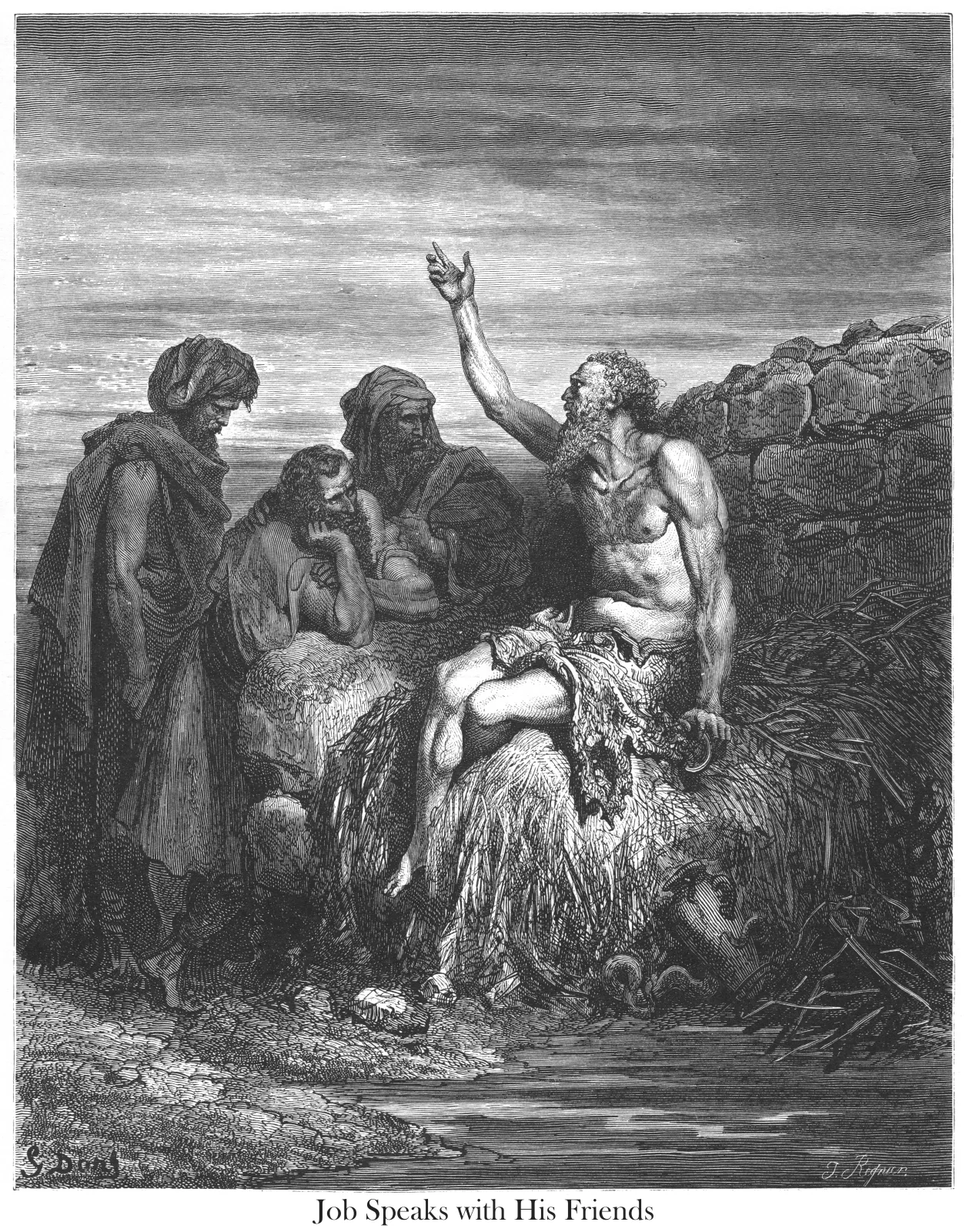
Job Speaks with His Friends
Job 2:11-13 · World English Bible (Catholic)
11Now when Job’s three friends heard of all this evil that had come on him, they each came from his own place: Eliphaz the Temanite, Bildad the Shuhite, and Zophar the Naamathite; and they made an appointment together to come to sympathize with him and to comfort him.
12When they lifted up their eyes from a distance, and didn’t recognize him, they raised their voices, and wept; and they each tore his robe, and sprinkled dust on their heads toward the sky.
13So they sat down with him on the ground seven days and seven nights, and no one spoke a word to him, for they saw that his grief was very great.
Job’s arm stands out against the sky. Raised above the heads, it interrupts the almost continuous line formed by the three friends on the left. Job turns his face toward them, while his hand points to an empty space above. His other arm is braced beside him: his body remains seated, but the gesture carries the gaze far beyond the group.
The visitors are close together, yet do not adopt the same posture. One stands with his head bowed; another, in the foreground, rests his face on his hand. The third looks at Job. Their dark garments bring them together as a mass, against which the sick man’s bare torso stands out. Between the raised gesture and the hand supporting the face, two ways of inhabiting the encounter answer one another: one reaching upward, the other held back close to oneself.
The passage in Job, however, first recounts a visit without conversation. The three men have come from their lands to mourn with and comfort their friend. They did not recognize him from a distance; they wept and tore their robes. Then they sat beside him for seven days and seven nights without saying a word, faced with the excess of his suffering. The duration of this silence cannot be measured in the engraving. The catalogue title, which announces that Job speaks with his friends, and Job’s gesture point instead toward the beginning of a speech.
This shift leaves something of the expectation described in the text intact: none of the friends makes a gesture here comparable to Job’s. Their closeness does not erase the distance between the one who suffers and those who come to join him. The hand reaching toward heaven gives that distance another dimension: suffering stands before the friends, but it also opens onto a question whose setting lies beyond their circle.