Gustave Doré · Isaiah 6:8-9
The Prophet Isaiah
Isaiah 6:8-9 · World English Bible (Catholic)
8I heard the Lord’s voice, saying, “Whom shall I send, and who will go for us?” Then I said, “Here I am. Send me!”
9He said, “Go, and tell this people, ‘You hear indeed, but don’t understand. You see indeed, but don’t perceive.’
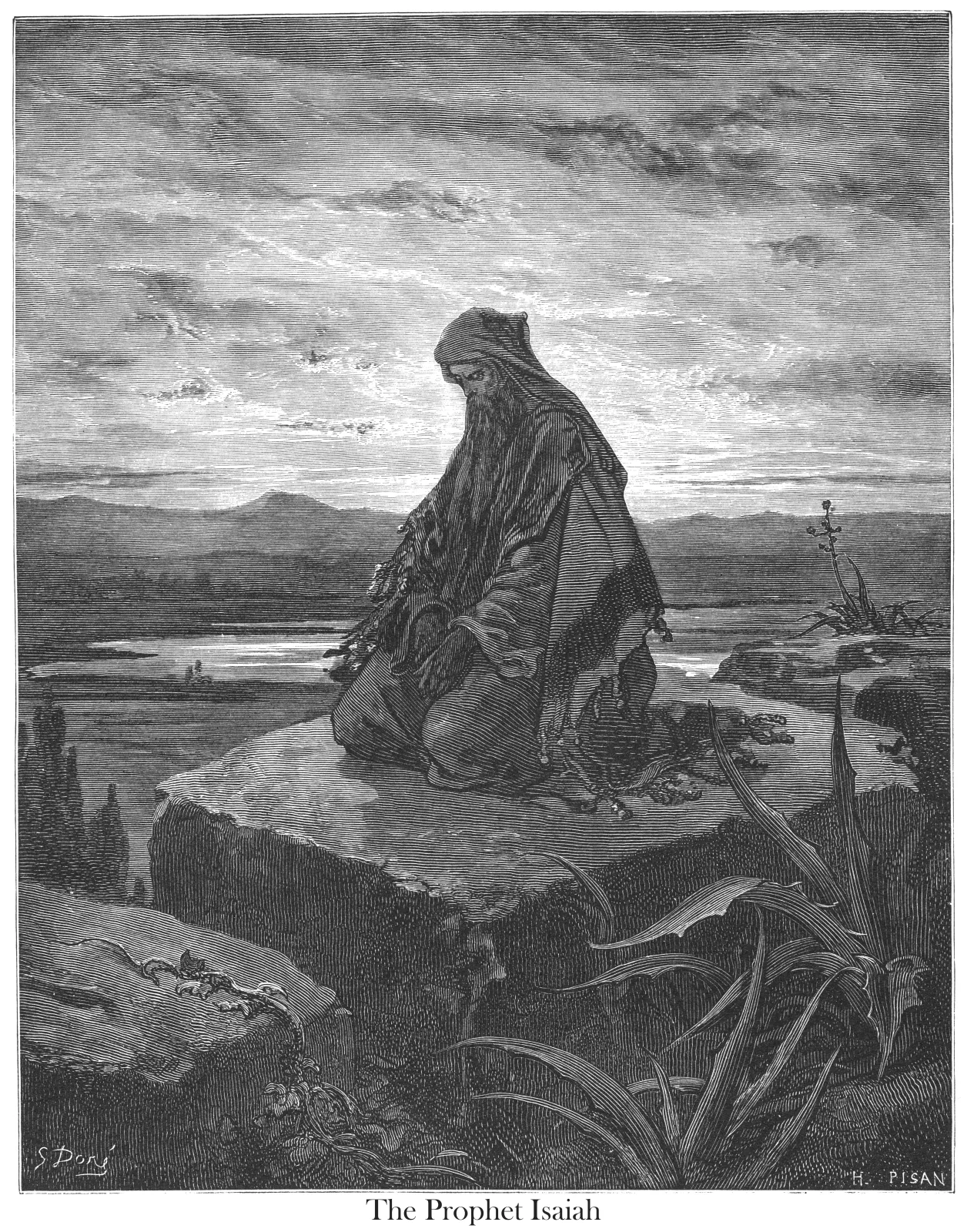
With his head bowed, Isaiah keeps his hands low, close to his knees. His motionless figure occupies the center of the engraving, but his gaze is directed neither toward the sky nor toward the open expanse behind him. He is alone on a broad stone slab, at the edge of ground that slopes down into shadow.
The landscape nevertheless gives this contemplative figure room. A band of clear water crosses the background; beyond it, the dark lines of fields and mountains follow one another. In the foreground, large pointed leaves reach toward the prophet without touching him. The stone supports and separates him: it gives him a place apart, while the land stretches out behind his back.
In Isaiah 6, the word moves differently. The prophet hears the Lord ask whom he should send, then replies, “Here am I; send me.” The commission follows at once: to speak to a people who hear without understanding and see without perceiving. Before this exchange, his mouth has been touched and his guilt taken away. Nothing in the engraving allows these successive moments to be distinguished. The Lord’s voice and the people to whom Isaiah must speak remain outside the frame.
This withdrawal lends weight to the figure’s posture. The mouth to which the text has just given decisive importance is half hidden by the beard; no assembly receives his words. The contrast is particularly sharp for a mission expressed in terms of hearing and seeing: the one who agrees to bear the word appears here silent, his eyes lowered. Without depicting the hardening of the people, Isaiah’s solitude gives a sense of how his willing response precedes words that are difficult to hear.