Gustave Doré · Isaiah 13:20-21
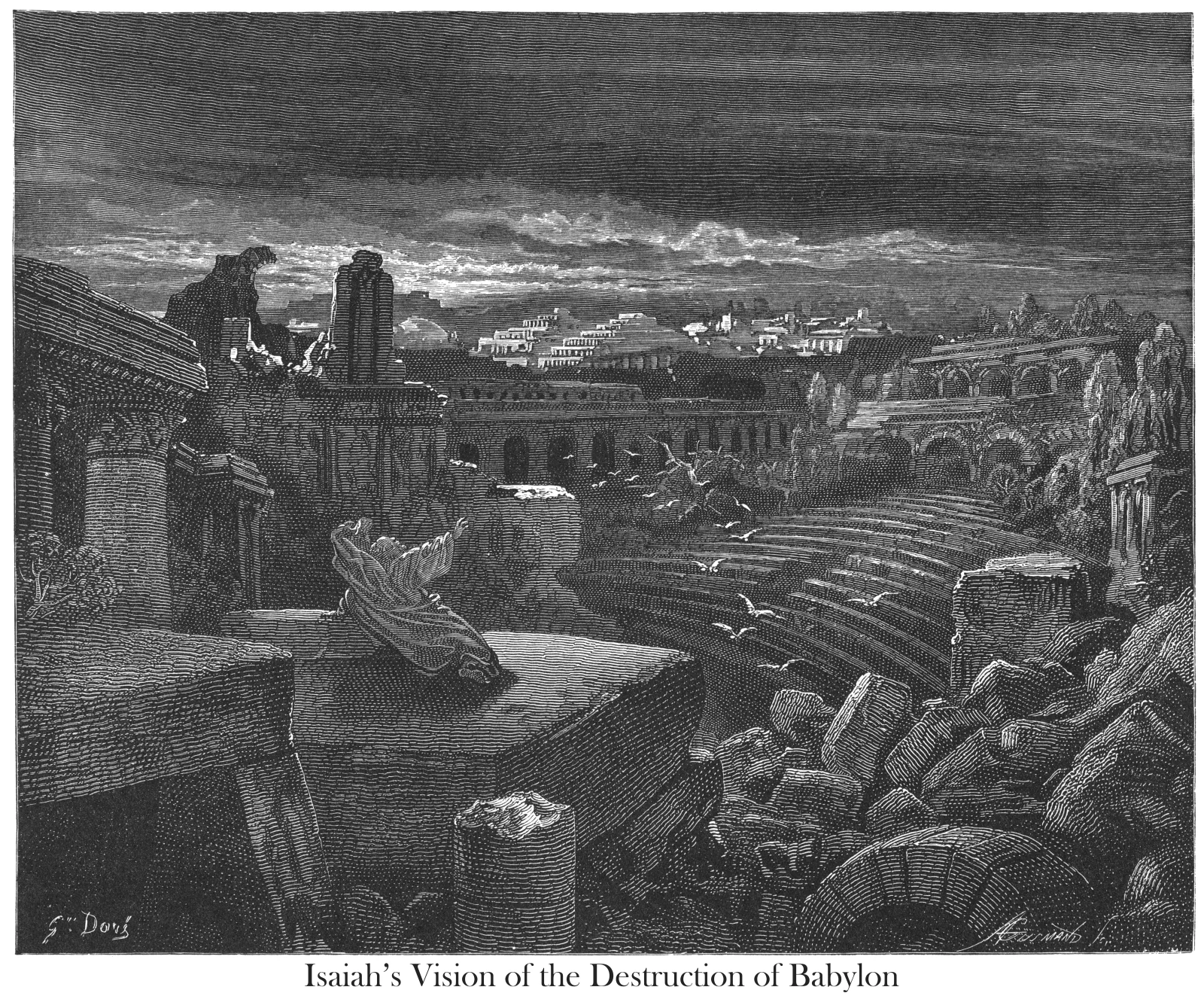
Isaiah's Vision of the Destruction of Babylon
Isaiah 13:20-21 · World English Bible (Catholic)
20It will never be inhabited, neither will it be lived in from generation to generation. The Arabian will not pitch a tent there, neither will shepherds make their flocks lie down there.
21But wild animals of the desert will lie there, and their houses will be full of jackals. Ostriches will dwell there, and wild goats will frolic there.
At the edge of a broken terrace, a man raises his arms toward the city. Seen from behind, his draped figure is small against the expanse of ruins. The title identifies Isaiah: his gesture leads the eye toward Babylon, but no human interlocutor faces him. Before him opens a vast space cut into tiers, across which birds fly.
These tiers are the detail that gives the abandonment its measure. Their curves still outline a place made to accommodate a crowd; they contain none now. In the foreground, large blocks and fragments of architecture make access uncertain. Farther off, arcades, façades, and built masses remain, standing out beneath a band of clear sky. The city did not vanish all at once: its remains still allow its scale to be measured, while their disorder makes it uninhabitable.
The prophecy announces precisely a city in which no one will dwell any longer, where not even a traveller will pitch his tent and where the shepherd will not gather his flock. The inhabitants will be succeeded by the animals of the desert; the text also names owls, ostriches, and a satyr. In the engraving, it is chiefly the birds that occupy the deserted space. Their pale silhouettes pass before the dark tiers: movement remains, but it does not bring the city back to life.
Isaiah's presence nevertheless introduces a human figure into this landscape promised to solitude. It does not necessarily contradict the prophecy: here, the figure belongs to the vision announced by the title, rather than to a population that has returned to inhabit Babylon. From this threshold, his gesture sustains the distance between the one who sees and what he sees. In the passage, ruin overtakes Babylon, once the ornament of kingdoms; the monumental remains give form to this reversal. The city's grandeur is still discernible in what no longer serves any purpose.