Gustave Doré · 2 Maccabees 6:30
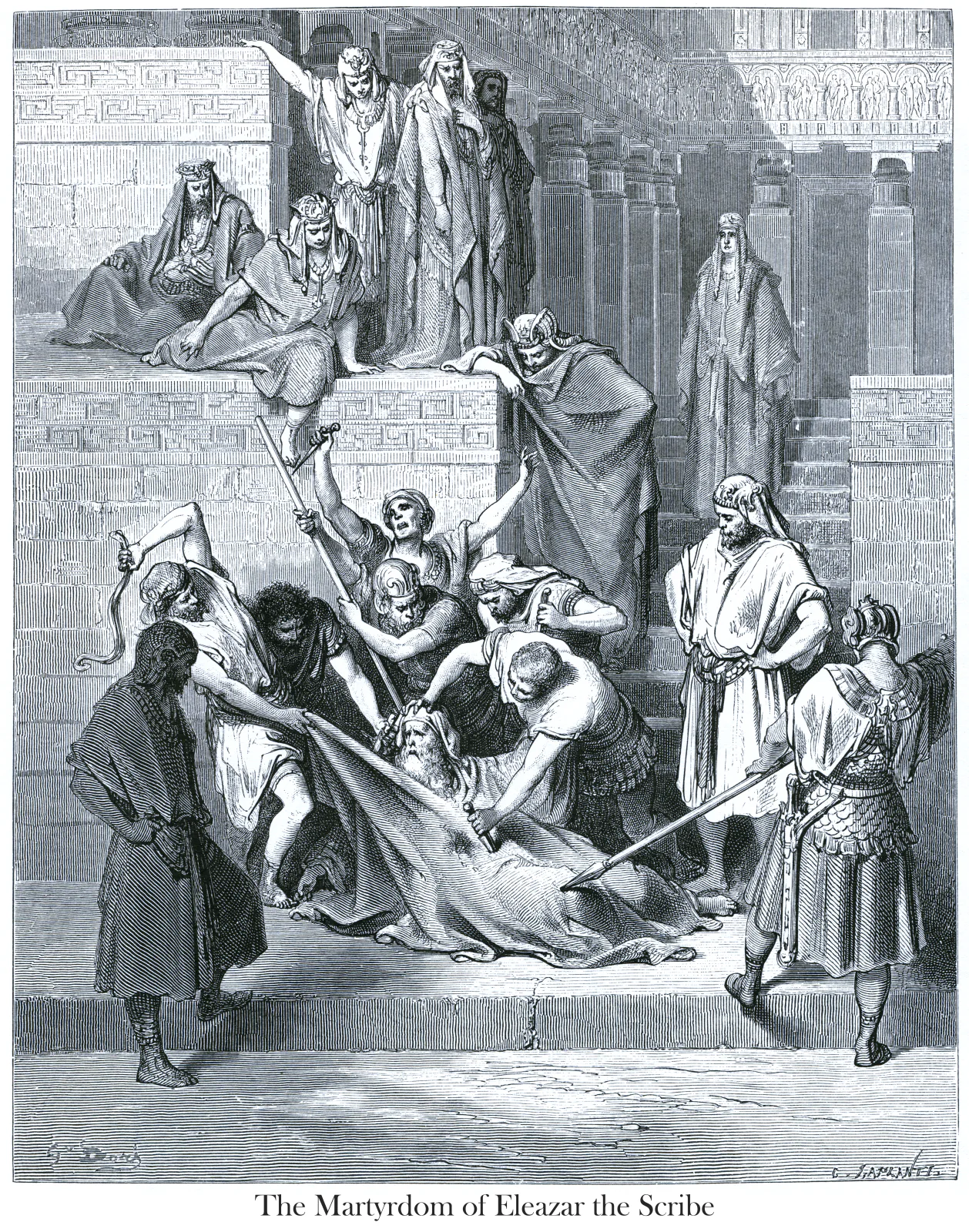
The Martyrdom of Eleazar the Scribe
2 Maccabees 6:30 · World English Bible (Catholic)
30and when he was at the point to die with the blows, he groaned aloud and said, “To the Lord, who has the holy knowledge, it is manifest that, while I might have been delivered from death, I endure severe pains in my body by being scourged; but in soul I gladly suffer these things because of my fear of him.”
A hand presses down on Eleazar’s head. Around the outstretched old man, bodies lean in and arms cross; a rod is raised, while a man pulls at the cloth covering the victim. His bearded face remains visible amid the struggle. Placed very low in the engraving, Eleazar is almost enveloped by those who strike him or hold him down.
Above him, a figure leaning on the terrace looks toward the torture. Others, seated or standing, look down on the scene from this height. Their distance gives the violence a public setting: it unfolds beneath their gaze, before an architectural backdrop and stairways that separate the onlookers from the crowd pressing around the old man. On the right, a standing man, his hands at his waist, is also watching; closer to us, a soldier seen from behind points his lance toward the ground, in the direction of the outstretched body.
The Second Book of Maccabees gives Eleazar words that the engraving cannot make heard. Near death beneath the blows, he acknowledges the cruelty of his suffering and nevertheless declares that he endures it with joy in his soul, out of respect for the Lord. He also says that he could have escaped death. Nothing in the position of his body makes this choice immediately legible: the biblical words offer access to a freedom that the visible coercion seems to have taken away.
The text names God as the one who knows this inward disposition. The engraving instead leaves the old man exposed to human eyes, surrounded by gestures from which he cannot free himself. Between these gazes and the one to which his words attribute the Lord remains a gap: the pain is displayed for all to see, but the joy Eleazar confesses cannot be inferred from his face.