Gustave Doré · 2 Maccabees 3:25-27
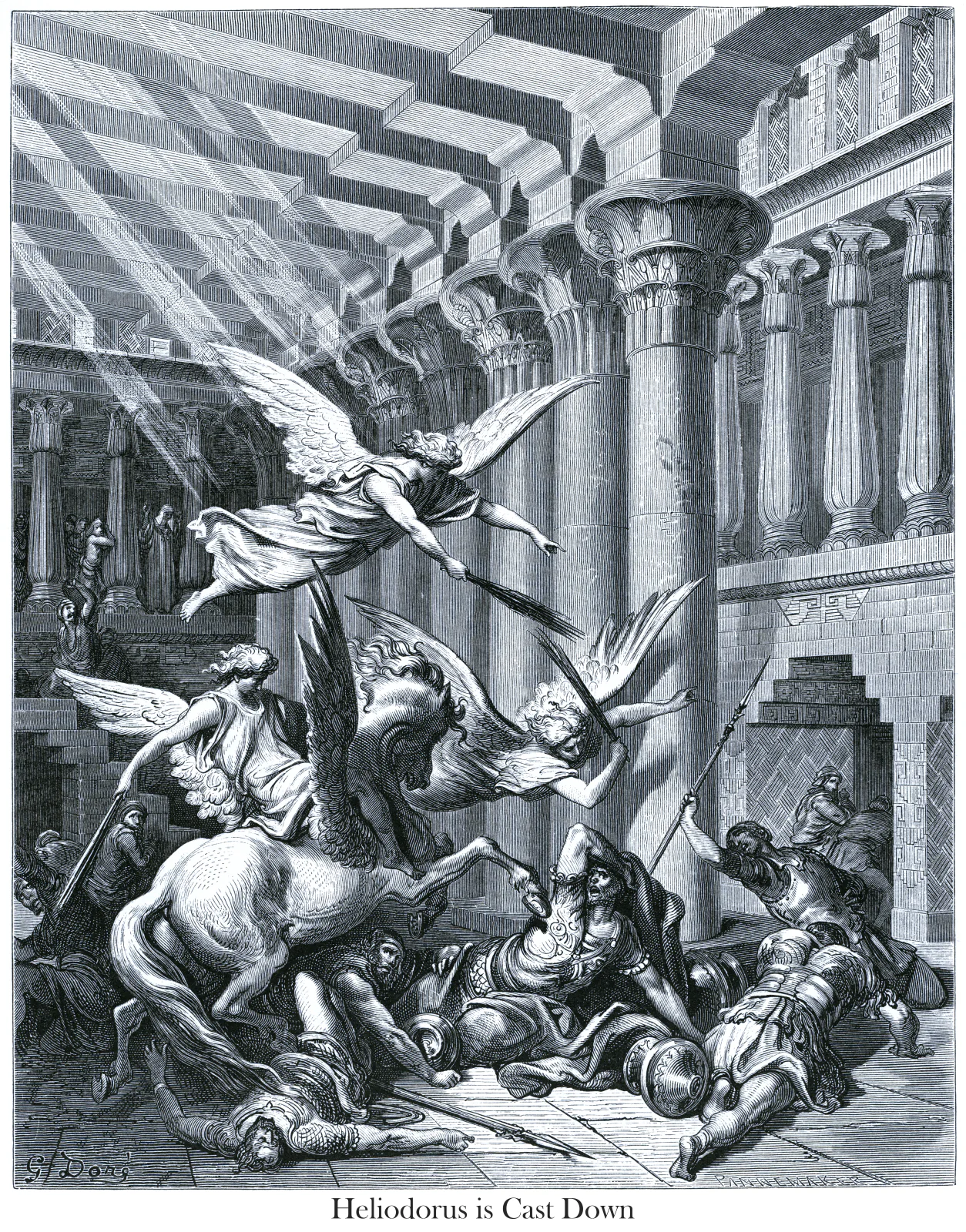
Heliodorus Is Cast Down
2 Maccabees 3:25-27 · World English Bible (Catholic)
25For they saw a horse with a frightening rider, adorned with beautiful trappings, and he rushed fiercely and struck at Heliodorus with his forefeet. It seemed like he who sat on the horse had complete armor of gold.
26Two others also appeared to him, young men notable in their strength, and beautiful in their glory, and splendid in their apparel, who stood by him on either side, and scourged him unceasingly, inflicting on him many sore stripes.
27When he had fallen suddenly to the ground, and great darkness had come over him, his guards picked him up and put him on a stretcher,
The horse’s raised hoof almost reaches the arm Heliodorus holds above his head. On the ground, the man can only shield his face, while his cuirass and weapons clutter the floor. His defensive gesture conveys the distance between the power he had when he entered and the position he now finds himself in.
Around him, the bodies of his retinue lie scattered. On the right, a man still tries to brandish a spear; in the foreground, another lies stretched out at full length. The disorder, then, is not confined to Heliodorus. Yet the lines of the architecture remain firm: the columns rise behind the melee, and their rows extend the depth of the hall. In this monumental space, the fall seems all the more violent because nothing in the structure gives way with the men.
The Second Book of Maccabees describes a horse charging at Heliodorus and two young men striking him from either side. Doré retains the horse, the rider, and the two attackers, but gives them wings; the horse, too, is winged. One of the winged figures crosses the hall high above, holding a bundle of rods. The other bends toward Heliodorus. Their oblique movements converge with the movement of the horse’s legs: several gestures converge on the fallen man.
The text also says that Heliodorus falls surrounded by deep darkness before being carried away on a litter. Here, rays pass through the space above the struggle, and the carrying has not yet taken place. The engraving holds the moment when the attack and the fall merge. In the passage, God’s power renders helpless those who have entered the place where the treasure is kept; on the stone, this helplessness takes the very precise form of an arm raised too late.