Gustave Doré · 1 Maccabees 5:42
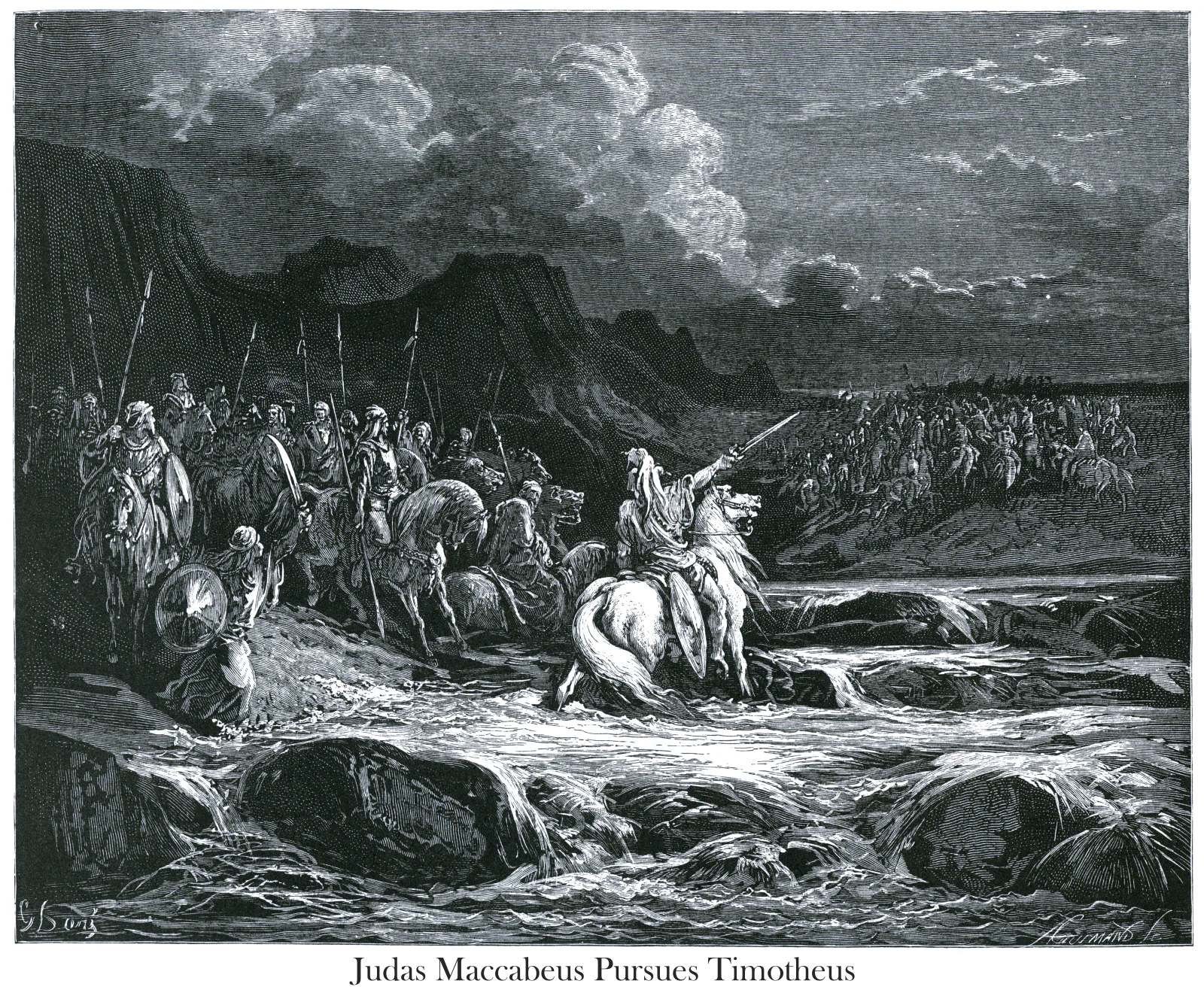
Judas Maccabeus Pursues Timotheus
1 Maccabees 5:42 · World English Bible (Catholic)
42Now when Judas came near to the water brook, he caused the scribes of the people to remain by the brook, and commanded them, saying, “Allow no man to encamp, but let all come to the battle.”
In the middle of the watercourse, a horseman raises his sword toward the opposite bank. His light-colored horse advances among the rocks, while behind him the men and their mounts are still crowding the bank. Over there, a compact troop occupies the rise. The horseman’s gesture links the two groups before the army has crossed the distance between them.
Water occupies much of the foreground. It flows around dark boulders and makes the crossing uneven; the horses cannot enter it as they would open ground. Yet the horseman identified by the title as Judas stands apart from those who follow him. His position in the current gives physical form to the leader’s advance, while the lances raised on the bank extend the troop’s momentum behind him.
The Book of Maccabees places the decision before the crossing. Judas has the army’s scribes halt at the edge and orders them not to let anyone stop. Then he crosses first, followed by all the people. The engraving brings these two moments together: the command becomes an armed gesture, and the first crossing takes place before our eyes. The scribes cannot be recognized among the figures; here the order is conveyed by the direction of the sword and by the arrangement of the men.
This watercourse is also the setting for a calculation reported just beforehand: Timotheus reckons that whoever crosses first will win. The bank is therefore no mere backdrop. In the text as in the engraving, it still separates the adversaries at the moment when the initiative is decided. The account that follows tells of the enemies’ defeat and the destruction of Carnaim; none of this outcome is represented. The gaze remains fixed on an action still unresolved, in which leading the people means venturing into a difficult crossing ahead of them.