Gustave Doré · 1 Maccabees 6:43, 46
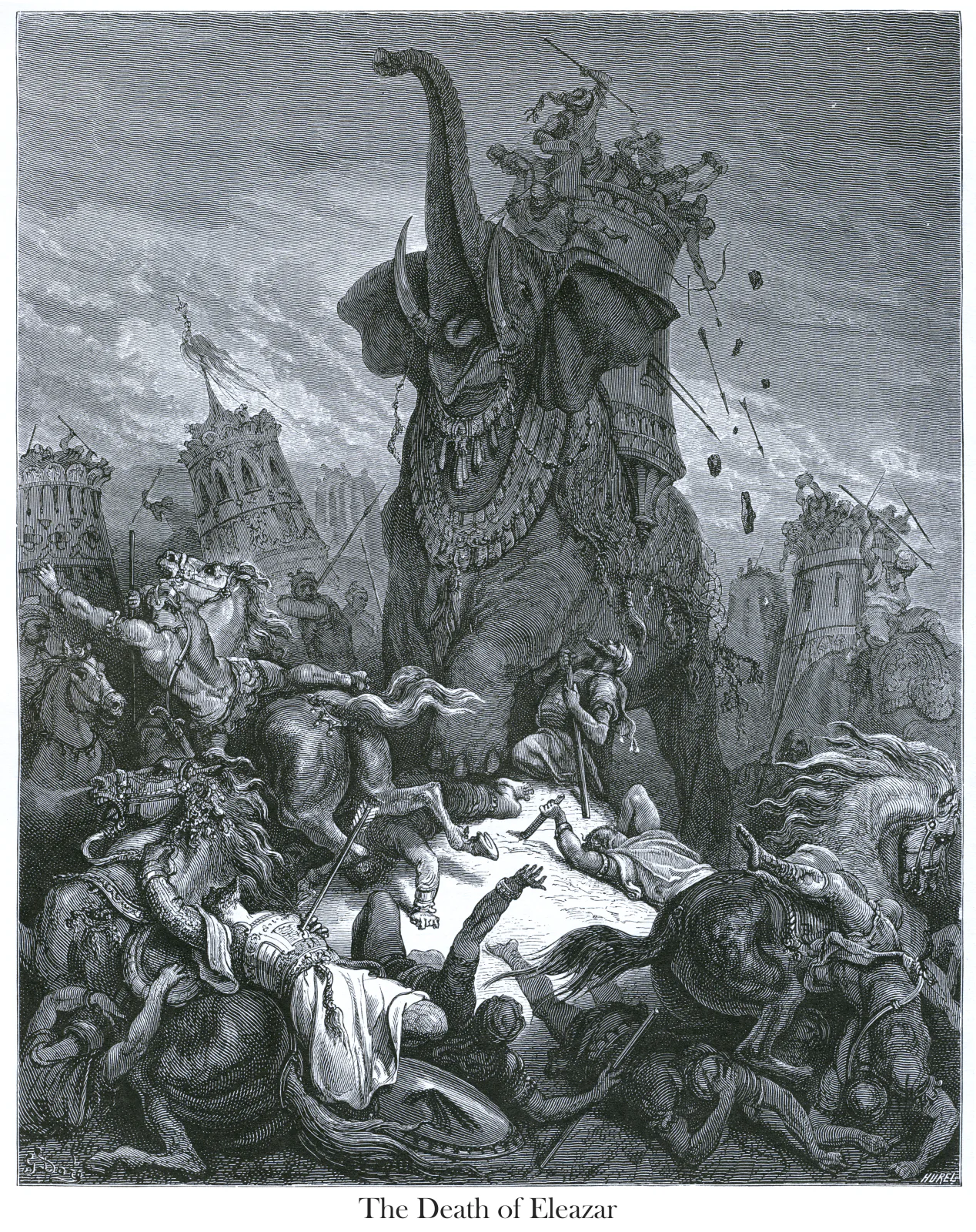
The Death of Eleazar
1 Maccabees 6:43, 46 · World English Bible (Catholic)
43Eleazar, who was called Avaran, saw one of the animals armed with royal breastplates, and it was taller than all the animals, and the king seemed to be on it.
44He gave his life to deliver his people, and to get himself an everlasting name.
45He ran upon him courageously into the midst of the phalanx, and killed on the right hand and on the left, and they parted away from him on this side and on that.
46He crept under the elephant, and stabbed it from beneath, and killed it. The elephant fell to the earth upon him, and he died there.
Beneath the elephant’s belly, a man has crouched down on his knees. His weapon is raised against the animal’s bulk; his head and shoulders almost disappear into the shadow. One must search among the thick legs to make out Eleazar. The title names his death, but the elephant is still standing.
Its raised trunk leads the eye to the top of the engraving. On its back, soldiers crowd into a tower; objects and weapons fall beside them. Ornaments cover the beast’s head and chest. At its feet, fallen horses and combatants clutter the ground, while other towers rise in the distance. The principal animal dominates this disorder, but its towering silhouette is no longer secure: the almost hidden gesture beneath its body reaches the power exposed above it.
The First Book of Maccabees gives this attack a precise motive. Eleazar has noticed an elephant larger than the others, bearing royal trappings. He believes the king is riding it. The tower and ornaments in the engraving bring to life the signs that caught his eye, without making it possible to identify the sovereign among the men above. Scripture attributes to Eleazar the desire to deliver his people and win an immortal name; it does not confirm his supposition that the king is present.
The text then carries the action through to its end: struck beneath the belly, the elephant falls on Eleazar and kills him. Doré holds on to the moment when the man is still beneath the beast. The fall foretold by the account is yet to come, even as the full weight it will bring down already bears upon the kneeling figure. In this interval, the giving of his life for his people appears inseparable from uncertain judgment and an outcome beyond the combatant’s control.