Gustave Doré · Judith 13:8
Judith and Holofernes
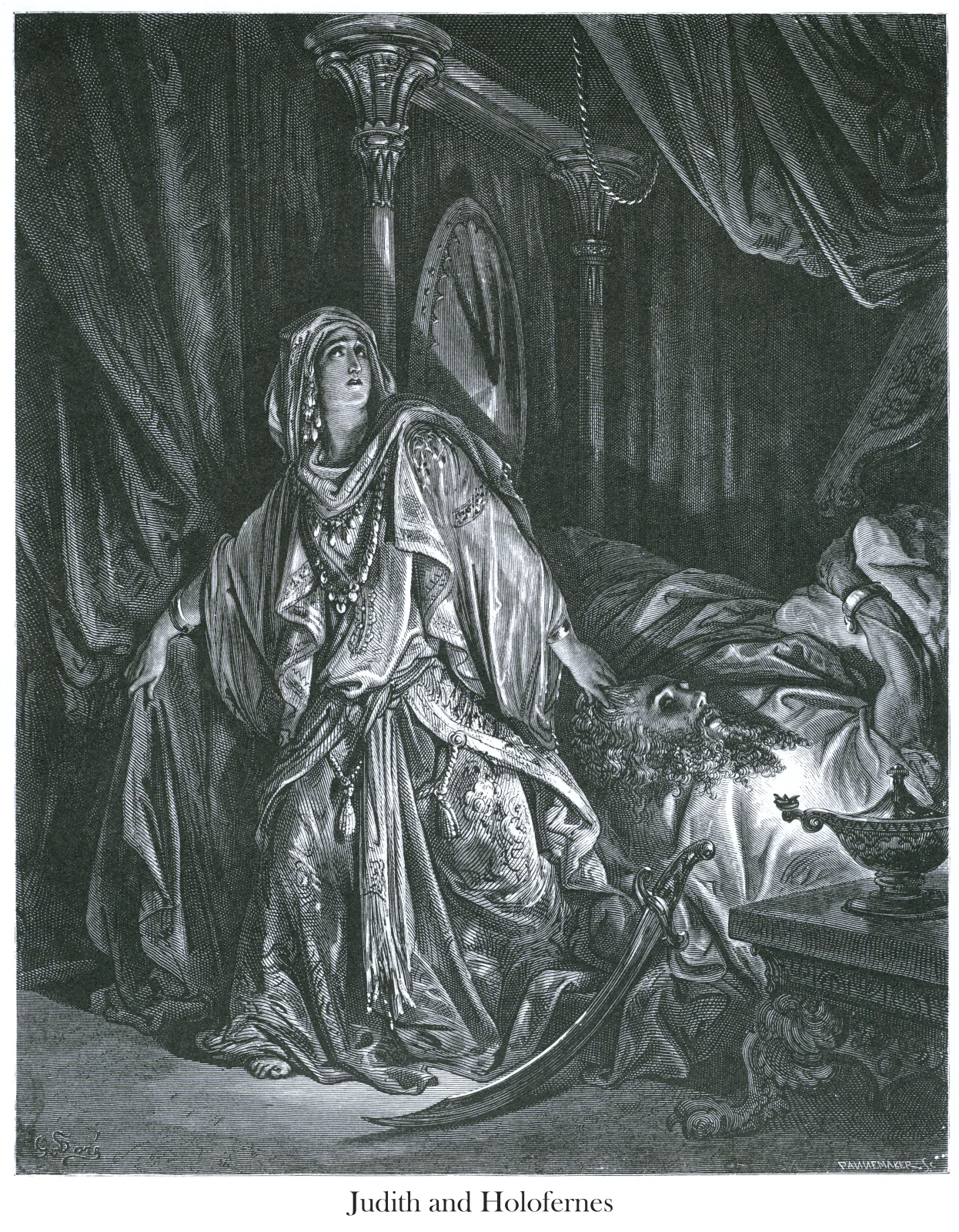
Judith 13:8 · World English Bible (Catholic)
8She struck twice upon his neck with all her might and cut off his head,
Judith holds Holofernes by the hair, but her gaze is directed elsewhere, upward. Her right hand holds a cloth aside from the bed; the other rests very close to the face of the man stretched out. The gesture that binds her to him is firm, while her face remains turned away from this closeness.
Holofernes occupies the bed on the right, his head tilted back toward its edge. Standing, Judith towers over his body without looking at him. Between them, in the foreground, a long, curved blade reaches down to the floor. Its hilt is near the bed, but no hand grasps it. The weapon is visible, within reach, and the blow has not yet been struck. The columns and heavy draperies enclose the two figures in the space of the bed; Judith’s light-colored gown forms a vertical presence there, facing the reclining body.
The verse cited places the scene slightly earlier: Judith approaches the column at the head of the bed and removes Holofernes’ sword from it. The grasping of his hair comes next, after the weapon has been drawn from its sheath. The engraving brings these gestures together without making them coincide exactly with their order: her hand is already in his hair, while the blade rests in the foreground. It also leaves out of view the two blows and the beheading that follow.
The text precedes the action with a silent prayer and places a renewed plea for strength at the moment when Judith grasps the hair. Her upturned face may be associated with this appeal to God, though the precise moment of the prayer cannot be identified with certainty. The engraving thus suspends the act between the hand already resting on Holofernes and the weapon still lying unused. In this interval, the strength Judith asks for remains inseparable from a human gesture whose violence the narrative does not conceal.