Gustave Doré · Ruth 1:16
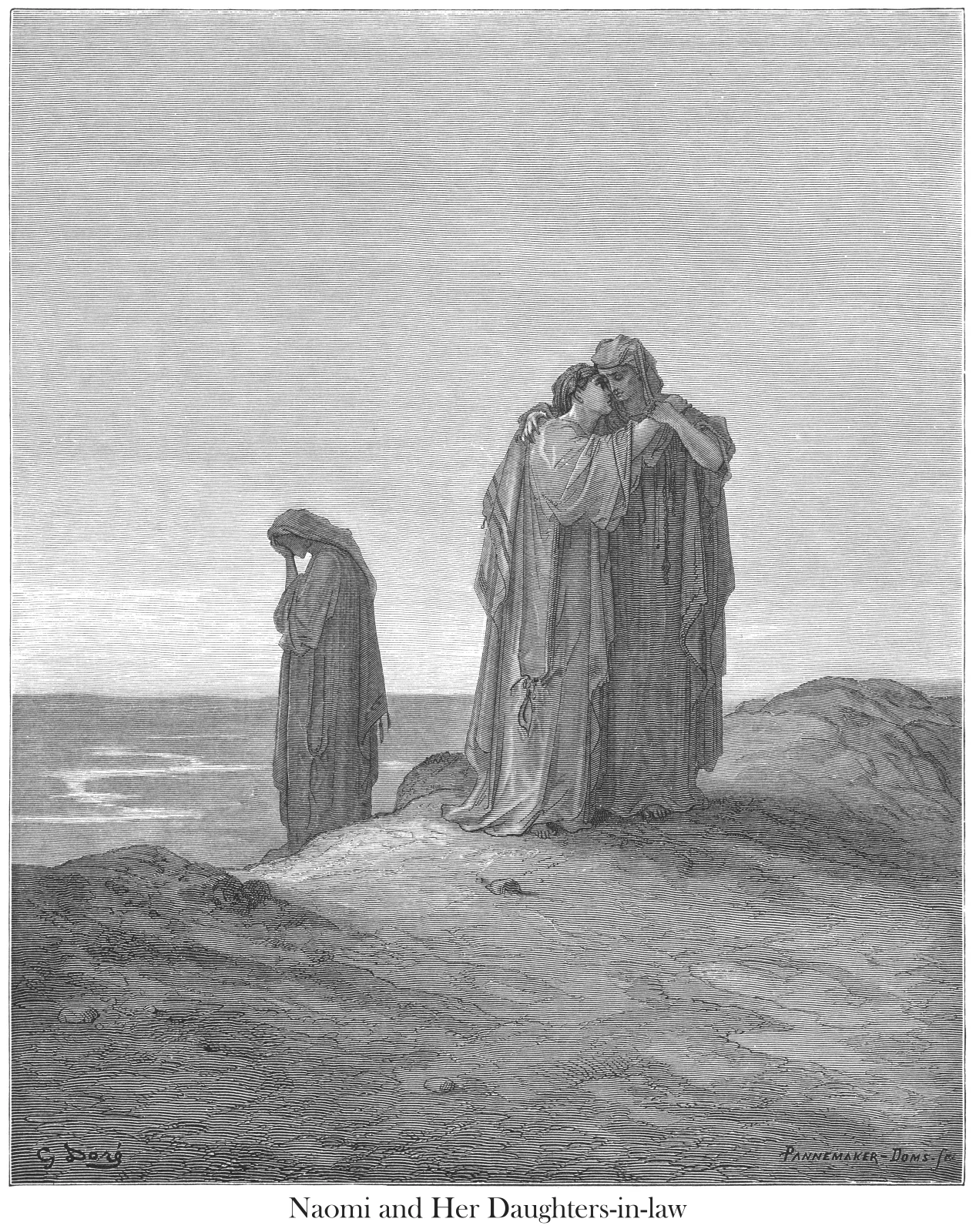
Naomi and Her Daughters-in-Law
Ruth 1:16 · World English Bible (Catholic)
16Ruth said, “Don’t urge me to leave you, and to return from following you, for where you go, I will go; and where you stay, I will stay. Your people will be my people, and your God my God.
On the right, two women stand so close together that their garments seem to form a single mass. The younger woman’s face touches her companion’s; their arms pass around each other’s shoulders. A few paces away, a third woman lowers her head and raises a hand to her face. The space separating her from the group is small, but it is enough to distinguish two gestures: staying beside the other or moving away.
The passage gives names to this separation. Orpah kissed Naomi before turning back; Ruth, by contrast, clung to her mother-in-law. The solitary woman can thus be identified as Orpah, and the embracing pair as Ruth and Naomi. Yet Orpah has not quite walked out of the image. Her bowed head and hand near her eyes continue the weeping evoked just before their parting. Her departure does not erase her grief.
Ruth, by contrast, is turned wholly toward Naomi. In her reply, she refuses to leave her and makes their closeness a promise for the future: she will go and remain wherever Naomi goes and remains. The embrace gives this commitment a present form, while the broad sky and nearly bare ground offer few landmarks by which to imagine the road opening before them.
Ruth’s words go beyond the visible gesture: she joins Naomi also in her people and in her God, and then, in the following verse, even in death and burial. The engraving captures the contact of their bodies at the threshold of this shared existence. It leaves the biblical words to name what an embrace cannot contain: the choice of a people and the acceptance of its God.