Gustave Doré · Judges 21:12
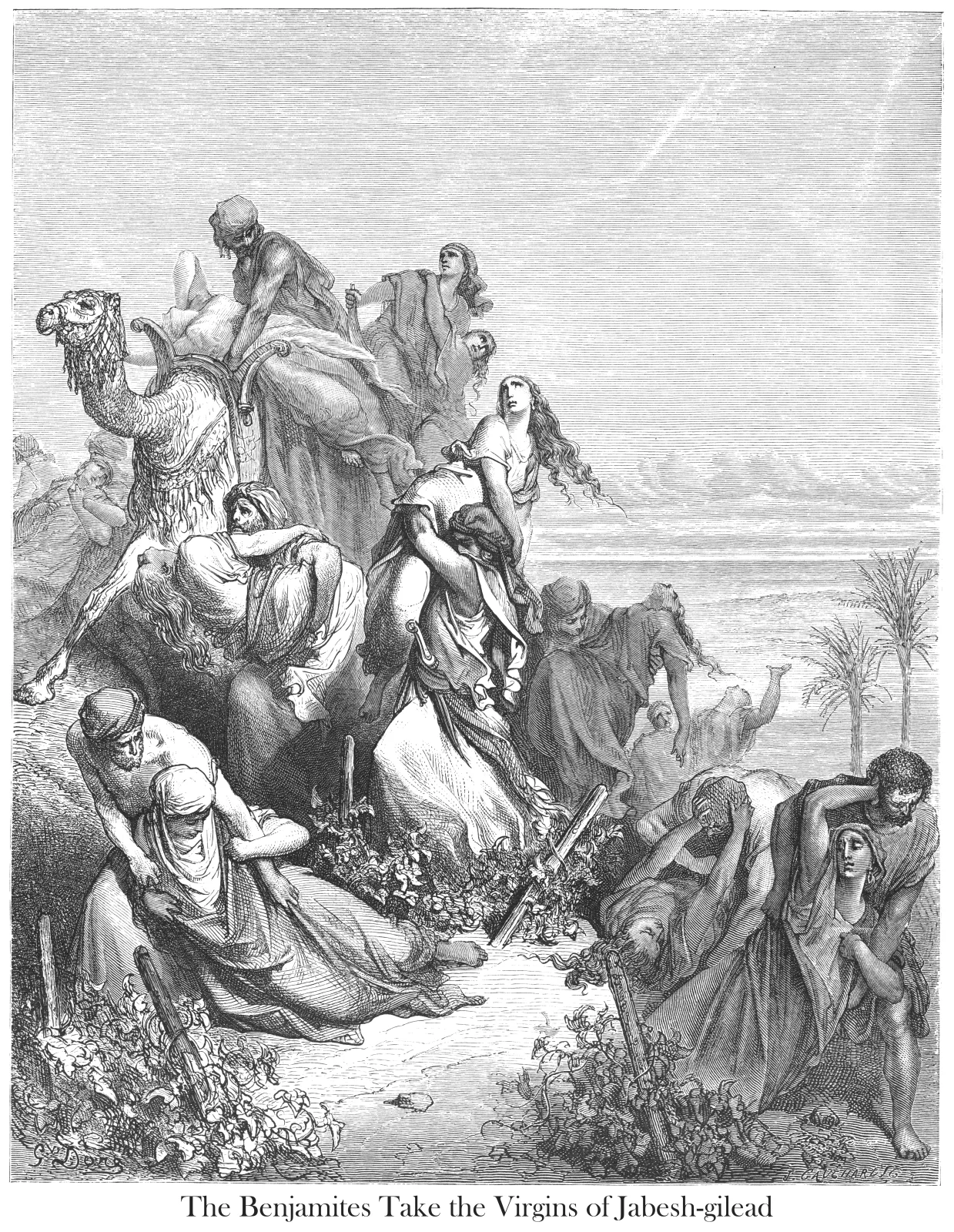
The Benjaminites Take the Virgins of Jabesh-gilead
Judges 21:12 · World English Bible (Catholic)
12They found among the inhabitants of Jabesh Gilead four hundred young virgins who had not known man by lying with him; and they brought them to the camp to Shiloh, which is in the land of Canaan.
At the center, a young woman is carried on a man’s shoulder. Her body tilts, but her face turns upward; her hair follows the motion of the flight. Around her, other men carry or drag women. On the right, one of them is held from behind, her arm raised above her head. Their gestures make it impossible to see this movement as a simple walk: the bodies are seized, lifted, torn from the ground.
A laden camel towers over the group on the left. Lower down, the figures crowd into a passage bordered by vegetation and leaning stakes. Beyond it stretches an almost empty space, with a few palm trees and a horizon line. This opening offers the women no escape: it makes more visible the mass carrying them away.
The cited verse reports that four hundred young women of Jabesh-gilead are led to the camp at Shiloh. It comes after the order to strike the inhabitants of the city and leave alive only the women who had known no man. The engraving focuses on the survivors and their displacement; neither the massacre nor the camp can be identified in the space depicted. It does, however, give gestures and faces to those whom the text counts collectively.
The title attributes the capture to the Benjaminites. Yet, in the passage provided, it is first the men sent by the assembly who lead the young women to Shiloh; the Benjaminites receive the survivors only after their return. The engraving leaves these stages difficult to distinguish and concentrates the viewer’s attention on the force used against the women.
The peace promised to the Benjaminites thus belongs to the same story as their receiving the survivors. The arms that carry or hold them give particular weight to this juxtaposition: here, the restoration of a group comes through lives whose words the text does not report.