Gustave Doré · Judges 19:30
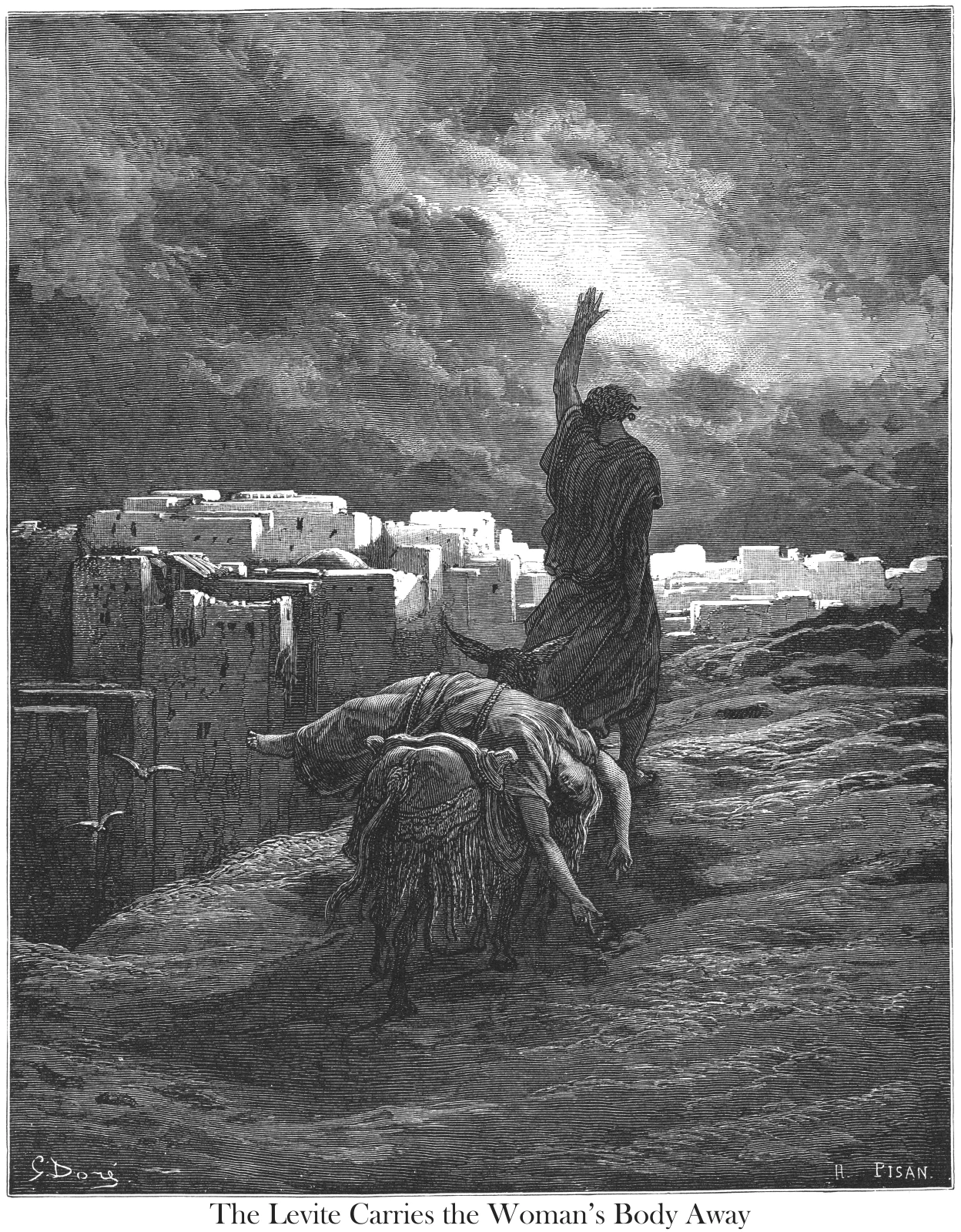
The Levite Carries Away the Woman’s Body
Judges 19:30 · World English Bible (Catholic)
30It was so, that all who saw it said, “Such a deed has not been done or seen from the day that the children of Israel came up out of the land of Egypt to this day! Consider it, take counsel, and speak.”
One hand hangs almost to the ground. The woman's body lies across the donkey, her head and arms hanging down on one side, her legs on the other. Above her, the Levite raises an arm toward a bright opening in the clouds. His gesture dominates the scene, but it is the inert body that occupies the foreground and blocks the way.
The man has his back turned. His face is hidden from view, and nothing allows us to determine with certainty what his raised hand means: a call, a lament, or a gesture of protest. The woman, for her part, makes no movement in response. The account says that before setting out, her husband ordered her to get up; no one answered. The engraving gives this silence an almost material form in the weight of the body borne by the animal.
The city stretches out behind them, lit here and there beneath a heavy sky. No crowd appears on the road. Yet the reference given leads beyond this solitary departure: in verse 30, those who have seen the pieces of the body sent throughout Israel question one another and ask that a decision be made. Between the journey depicted and this collective speech comes the husband's act: on arriving home, he cuts up his concubine and sends her limbs throughout the territory.
Doré thus captures a moment before the verse cited. The body is still whole; it has not yet become what everyone will see. The raised arm may first draw the eye, but what follows in the text prevents us from reducing the man to this gesture alone. The violence he will inflict on the woman also belongs to the story that calls Israel to deliberate. From the woman's unanswered silence to the words of those who witness the horror, the passage leaves open a question of justice: how does a community respond to what has been done to a person who can no longer speak?