Gustave Doré · Judges 19:25-27
The Levite Finds the Woman Dead
Judges 19:25-27 · World English Bible (Catholic)
25But the men wouldn’t listen to him; so the man grabbed his concubine, and brought her out to them; and they had sex with her, and abused her all night until the morning. When the day began to dawn, they let her go.
26Then the woman came in the dawning of the day, and fell down at the door of the man’s house where her lord was, until it was light.
27Her lord rose up in the morning and opened the doors of the house, and went out to go his way; and behold, the woman his concubine had fallen down at the door of the house, with her hands on the threshold.
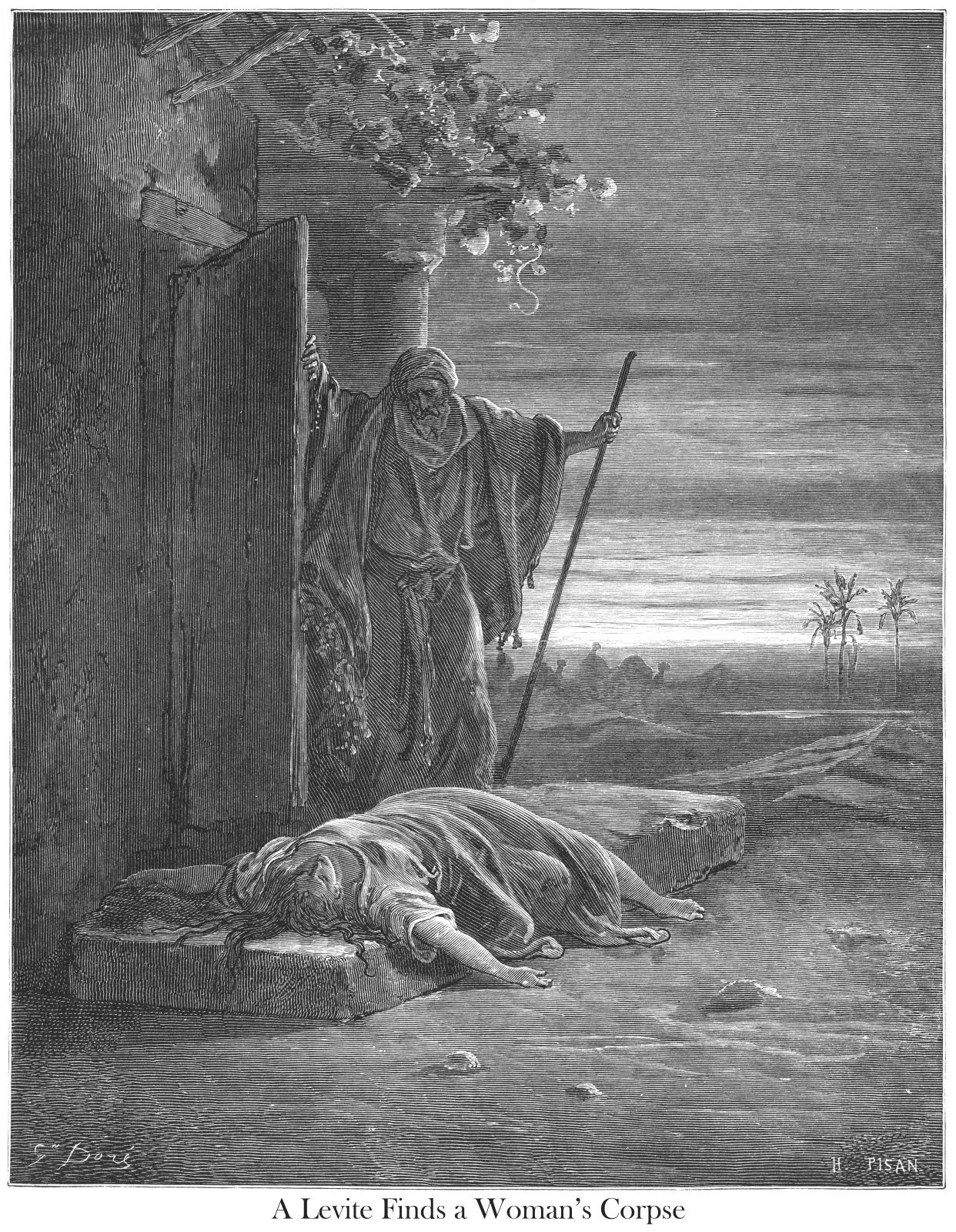
The woman occupies almost the entire width of the threshold. Her face is turned toward the stone, her hair spread out before her; one arm stretches toward the ground. Behind her outstretched body, the man remains standing in the doorway. He holds his staff and looks down. Between them, there is no gesture of aid: the space is short enough to cross, yet the engraving leaves it open.
The door is pushed outward. The man, who was preparing to leave, still holds it with one hand. The staff, upright beside him, belongs to this interrupted departure. In the distance, the sky is growing brighter and the road leads away from the house; in the foreground, the body blocks the exit. The morning light reveals not an open road, but the woman who has fallen there before daybreak.
The Book of Judges gives this encounter a harshness that the man's posture alone cannot convey. He is the one who handed his concubine over to the men who came to besiege the house. They abused her through the night; released at dawn, she returned to the entrance. When he opens the door, he finds her lying there, her hands on the threshold. In the engraving, one hand rests beyond the stone: her body reaches the house, though the door has not been opened to her.
The catalogue title speaks of a corpse. The verses provided first describe a motionless woman; at her husband's command, the next line specifies that no one answers. Doré fixes the moment before those words. The violence of the night remains outside the frame, but the proximity of the body and the door preserves its visible consequence. The threshold, a place where one would expect welcome and protection, becomes the point at which their failure can be read. This stone gives a precise location to the question the text leaves before the house: what hospitality was offered to the woman handed over outside?