Gustave Doré · Judges 16:30
The Death of Samson
Judges 16:30 · World English Bible (Catholic)
30Samson said, “Let me die with the Philistines!” He bowed himself with all his might; and the house fell on the lords, and on all the people who were in it. So the dead that he killed at his death were more than those who he killed in his life.
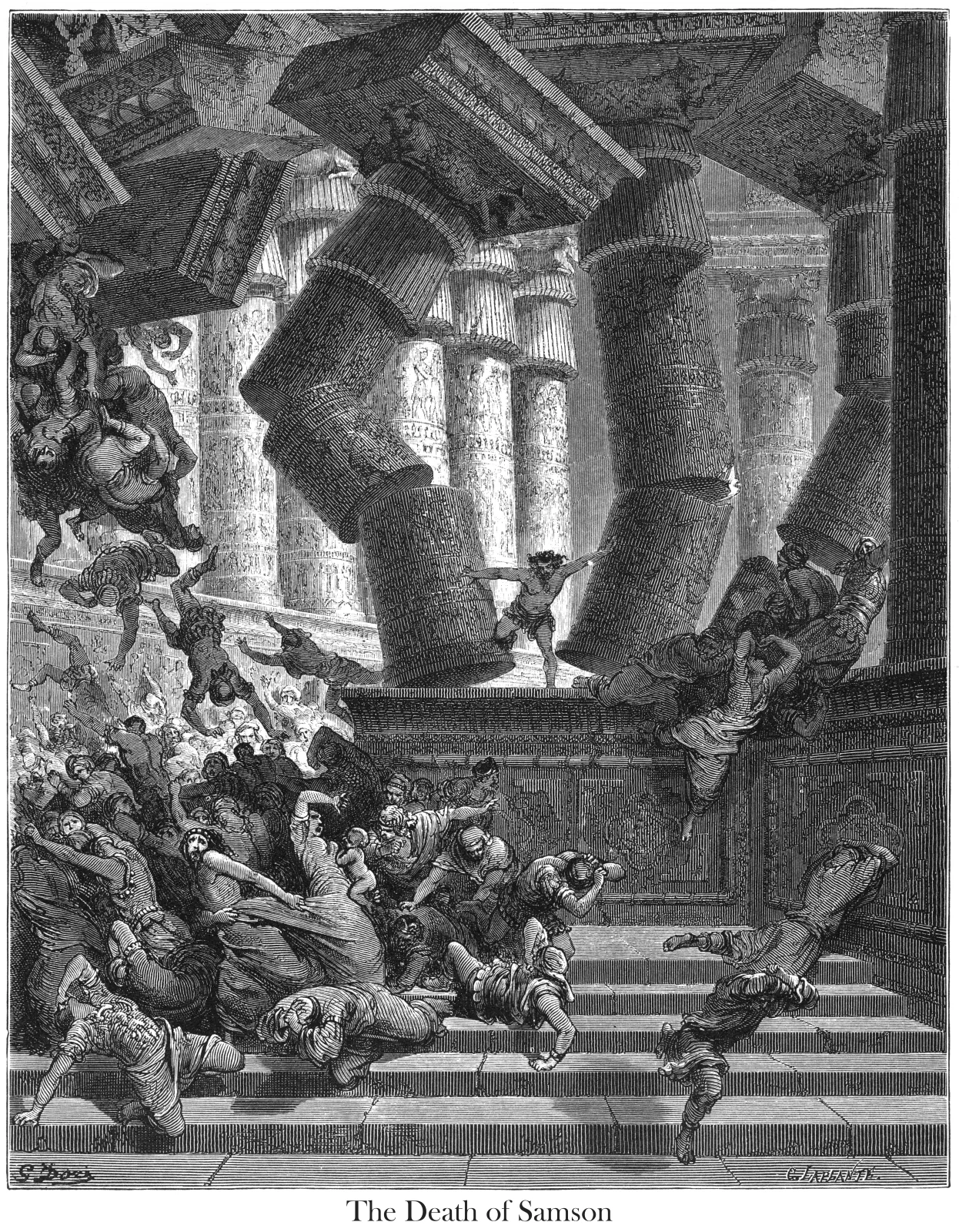
Samson’s arms stretch between two columns already broken. His body, upright on a platform at the center of the engraving, appears slender beside the blocks tipping above him. The enormous shafts do not fall in one piece: their sections come apart, bringing down the masses of the roof. The space still surrounding Samson is the space that the fall will soon close off.
Below, the crowd presses toward the steps. Some cover their heads, others lose their footing; at the sides, bodies are hurled down with the debris. The distance between the central gesture and these figures gives Samson’s strength a visible reach: it extends through the entire building. Yet the columns still standing at the rear and the staircase, clear in places, hold the scene at an intermediate moment. The house is collapsing, but the death announced by the title is not yet shown as an accomplished fact.
The Book of Judges gives voice to this moment. Samson asks to die with the Philistines, then bends with all his might; the text goes on to count the dead, more numerous than at any time in his life. The engraving suspends this reckoning to unfold the violence of the fall. It also leaves out of sight the prayer that precedes the gesture: Samson asks God for the strength to avenge his two eyes.
This return to the prayer changes how we read the body with outstretched arms. The text does not present his strength as something simply possessed: it is asked of God for an act in which vengeance and the death of the one who strikes are bound together. On the platform, Samson is still standing; around him, stones and bodies have already begun to fall.