Gustave Doré · Ruth 2:22-23
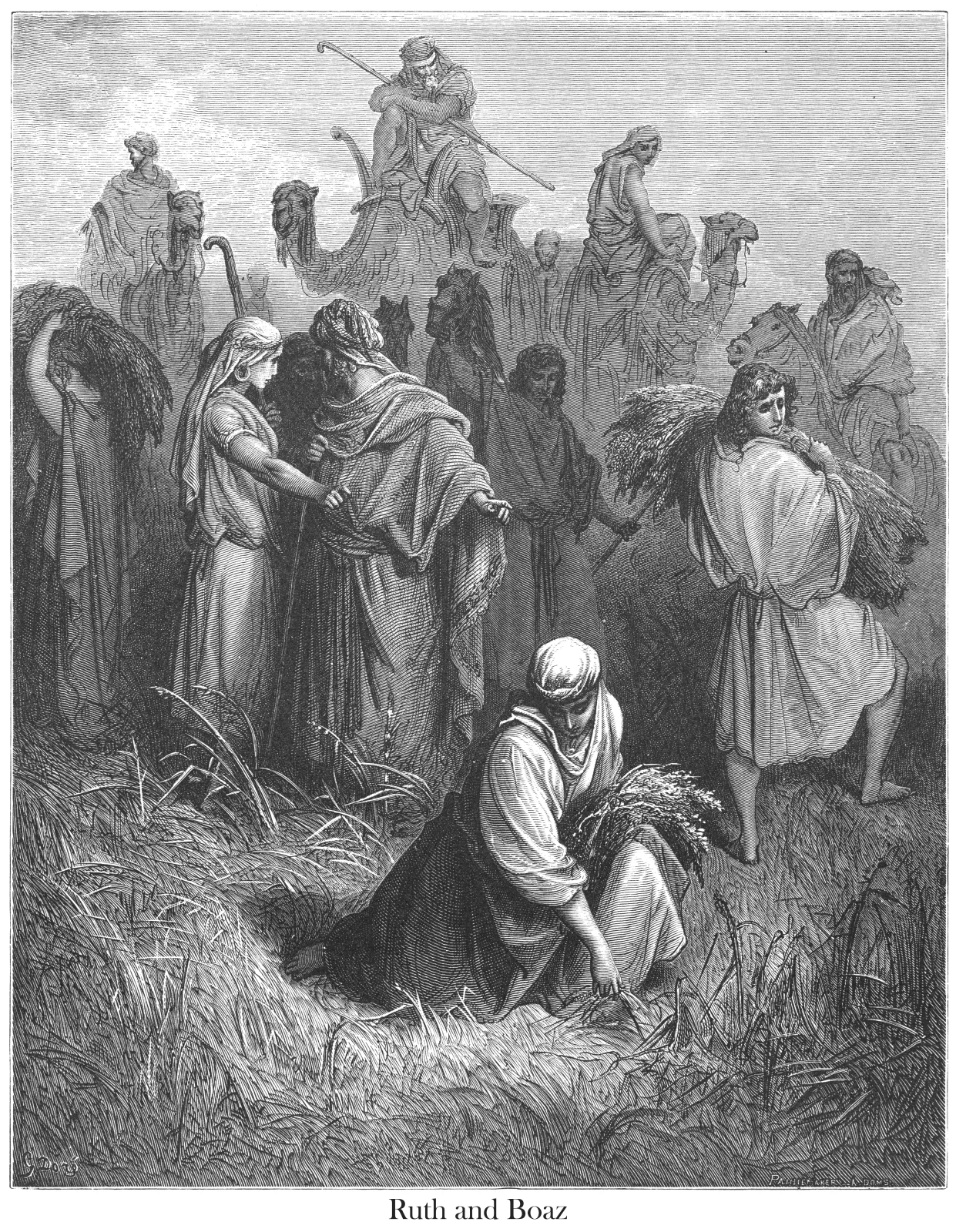
Ruth and Boaz
Ruth 2:22-23 · World English Bible (Catholic)
22Naomi said to Ruth her daughter-in-law, “It is good, my daughter, that you go out with his maidens, and that they not harm you in any other field.”
23So she stayed close to the maidens of Boaz, to glean to the end of barley harvest and of wheat harvest; and she lived with her mother-in-law.
In the foreground, a woman kneels to gather ears of grain. Her hand reaches almost to the ground, while a sheaf rests on her knee. Behind her, a reaper carries a much larger load on his shoulder. The difference between the two gestures gives a measure of gleaning: one must bend down to gather what remains after the harvest.
Higher up, on the left, a standing woman and a turbaned man face each other. The woman reaches out her arm; the man opens one hand toward the field. The title associates Ruth and Boaz, but the presence of several women engaged in the harvest makes it difficult to identify each one with certainty. Their gestures, however, place the encounter within collective labor. The sheaf-bearers pass near the group; in the background, men mounted on camels overlook the scene. The field is populated, crossed by movements that continue around the figures gathered close together.
The verses in Ruth 2:22–23 do not recount an encounter between Ruth and Boaz. First, they report Naomi’s advice to her daughter-in-law: to stay with Boaz’s servant women so as not to be mistreated elsewhere. Then they extend this stay across two harvests, that of barley and that of wheat, recalling that Ruth remains with Naomi. By contrast, the engraving brings the work together in a single visible space. Neither Naomi’s words nor the shared household appear there.
This shift gives weight to what the text states in a few words: to remain among the others in the field. The bent woman works very close to the sheaf-bearers, without her gesture merging with theirs. The proximity makes tangible the protection Naomi seeks, but also the particular condition of the woman who gleans. In this reading, care for a vulnerable person takes the concrete form of a place left open among the workers.