Gustave Doré · Joshua 5:9-15
An Angel Appears to the Israelites
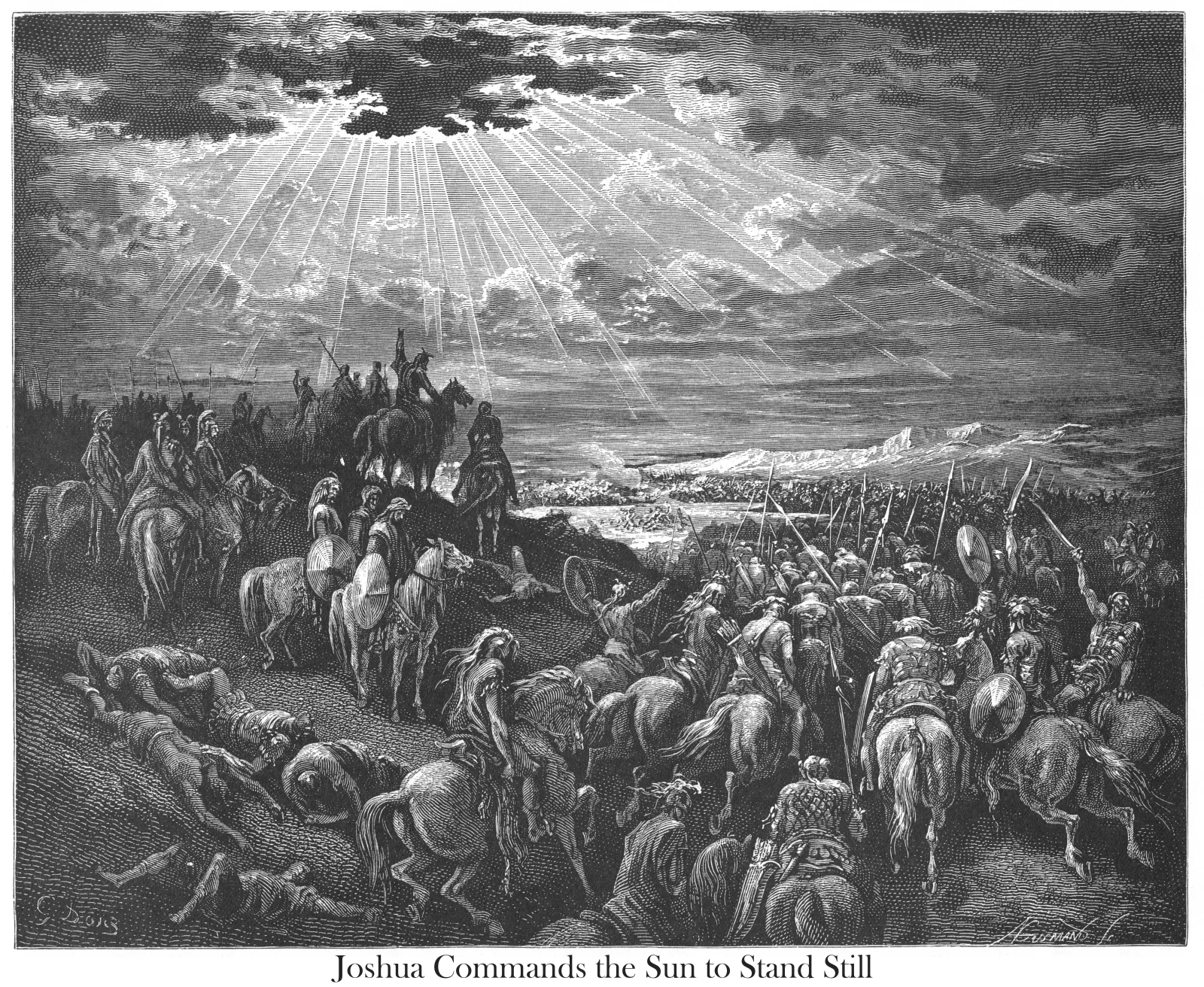
Joshua 5:9-15 · World English Bible (Catholic)
9The LORD said to Joshua, “Today I have rolled away the reproach of Egypt from you.” Therefore the name of that place was called Gilgal to this day.
10The children of Israel encamped in Gilgal. They kept the Passover on the fourteenth day of the month at evening in the plains of Jericho.
11They ate unleavened cakes and parched grain of the produce of the land on the next day after the Passover, in the same day.
12The manna ceased on the next day, after they had eaten of the produce of the land. The children of Israel didn’t have manna any more, but they ate of the fruit of the land of Canaan that year.
13When Joshua was by Jericho, he lifted up his eyes and looked, and behold, a man stood in front of him with his sword drawn in his hand. Joshua went to him and said to him, “Are you for us, or for our enemies?”
14He said, “No; but I have come now as commander of the LORD’s army.” Joshua fell on his face to the earth, and worshiped, and asked him, “What does my lord say to his servant?”
15The prince of the LORD’s army said to Joshua, “Take off your sandals, for the place on which you stand is holy.” Joshua did so.
Long shafts of light descend through a break in the clouds. Beneath them, on high ground to the left, a horseman reaches his arm toward the sky. Lower down, soldiers and their mounts occupy almost the entire field; in the foreground, several bodies lie apart from the troop. The raised gesture dominates the turmoil without bringing it to a halt.
The light draws the eye beyond the combatants, toward a plain where the ranks extend as far as the mountains. Yet it points to no distinct celestial figure. The raised weapons and closely packed horses give the scene its scale. The caption printed beneath the image identifies the subject as Joshua commanding the sun to stand still. It corresponds neither to the supplied catalogue title, which announces the appearance of an angel to the Israelites, nor to the encounter recounted in Joshua 5:13–15.
Near Jericho, according to this passage, Joshua sees a man standing with his sword drawn. He asks which side the man is on; his interlocutor identifies himself as the commander of the army of the LORD. Joshua then falls face down and is ordered to remove his sandal, for the place is holy. None of these actions can be identified with certainty in the engraving as transmitted. The text also mentions Passover at Gilgal and the end of the manna, both absent from this battle scene.
The discrepancy matters for the reading: in the passage, the stranger’s sword precedes words that shift the question of allegiance to a camp. Here, swords and spears multiply among the combatants, while the horseman’s gesture is directed toward the sky. Before drawing the two scenes into closer comparison, the association of the engraving, its title, and its reference must be verified.