Gustave Doré · Joshua 10:13
Joshua Commands the Sun to Stand Still
Joshua 10:13 · World English Bible (Catholic)
13The sun stood still, and the moon stayed, until the nation had avenged themselves of their enemies. Isn’t this written in the book of Jashar? The sun stayed in the middle of the sky, and didn’t hurry to go down about a whole day.
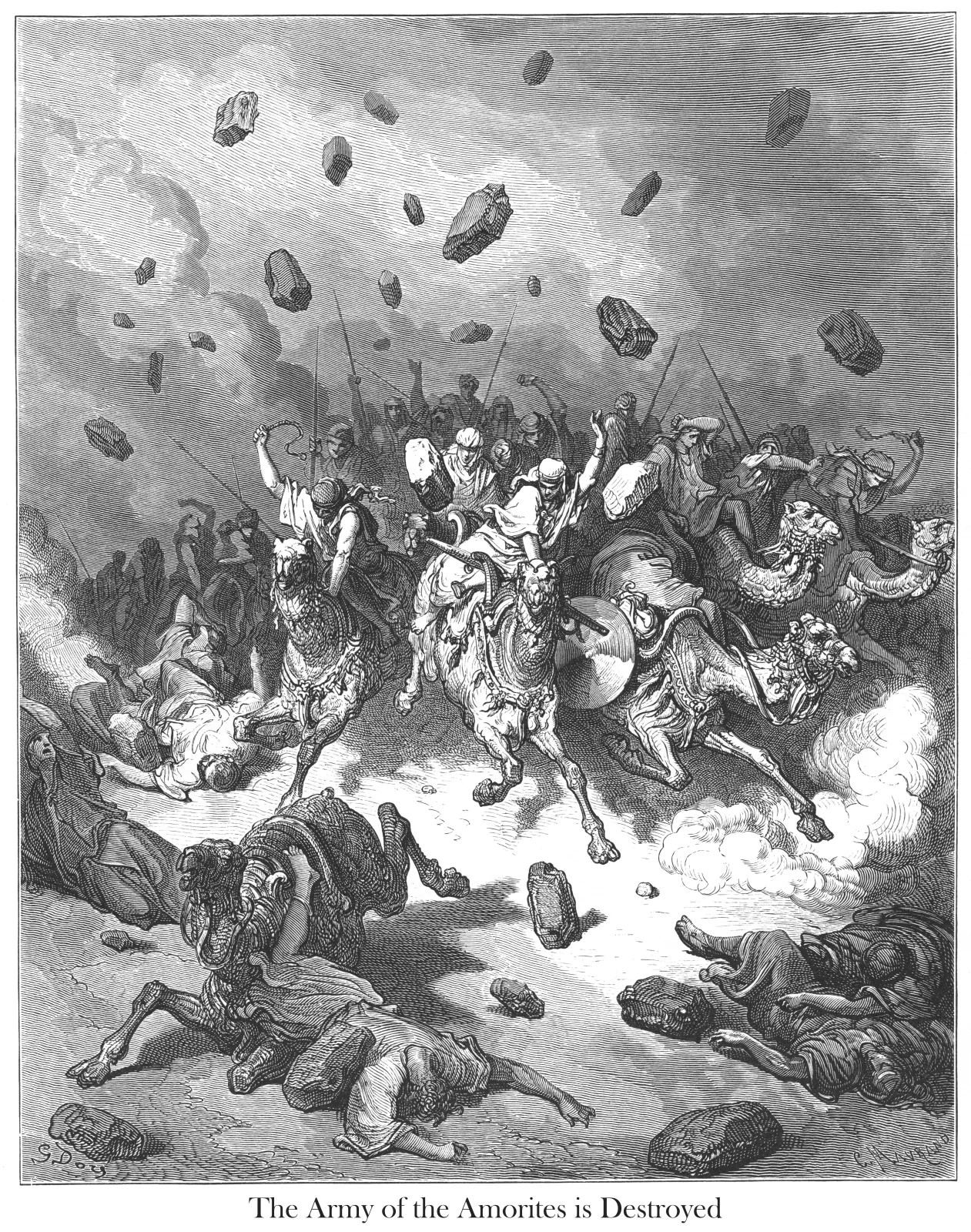
A large block crosses the sky above the horsemen. Others have already fallen among the bodies and mounts; several remain suspended in the space of the engraving. Their scattering leads the eye from the top of the page down to the ground, where a man lies face down. At the center, the animals rear or continue their course while their riders raise their arms and try to protect themselves.
What falls from the sky throws the entire troop into disarray. The lances raised in the background no longer form a battle line: they are lost among the stones. In the foreground, the outstretched bodies convey the measure of their violence. The caption printed beneath the engraving identifies the destruction of the army of the Amorites; it does not name Joshua.
Yet the associated passage recounts, in verse 13, the halting of the sun and moon. Joshua has earlier asked that the sun remain over Gibeon and the moon over the Valley of Aijalon; the day is prolonged until the defeat of Israel’s enemies. Here, no heavenly body is distinctly represented, and no figure can be identified with certainty as Joshua. The blocks instead refer to verse 11: Yahweh causes large stones to fall upon the fleeing Amorites, and the hail kills more men than the sword.
The difference changes the point of entry into the narrative. Rather than giving form to the exceptional length of the day, the engraving arrests the fall itself: the stones seem suspended just before they strike. The text attributes both the hail and the prolonged day to God, and specifies that he was fighting for Israel. On the page, this action is seen from the camp of those who suffer it: the gestures of protection and the bodies on the ground give the victory being recounted its weight of destruction.