Gustave Doré · Joshua 10:11
The Army of the Amorites Is Destroyed
Joshua 10:11 · World English Bible (Catholic)
11As they fled from before Israel, while they were at the descent of Beth Horon, the LORD hurled down great stones from the sky on them to Azekah, and they died. There were more who died from the hailstones than those whom the children of Israel killed with the sword.
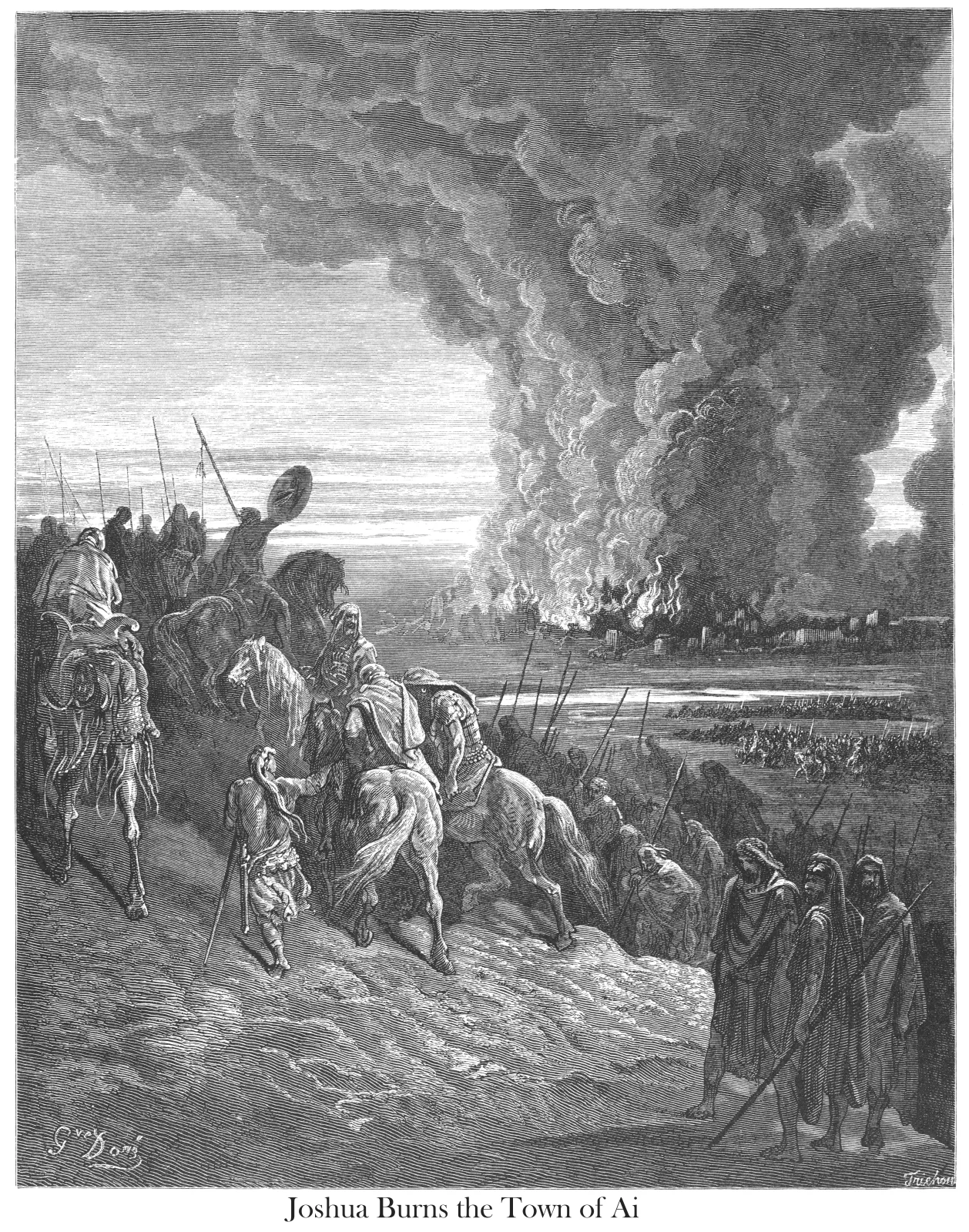
Beyond the horsemen gathered on the slope, a city is burning. The flames remain low, almost contained by the line of buildings; the smoke, by contrast, rises and fills a large part of the sky. Its dark mass gives the fire a scale that the distant buildings alone could not suggest.
In the foreground, the horses and men form a tightly packed group. One figure raises his shield, while several standing figures to the right keep apart. Between this slope and the city, ranks of combatants cross the plain. Distance matters: the fire is seen from the heights, behind figures whose bodies and spears partly block the view of the landscape.
Yet the caption printed beneath the engraving names another episode: “Joshua Burns the Town of Ai,” Joshua burning the city of Ai. It corresponds neither to the catalogue title provided, which concerns the destruction of the Amorite army, nor to the verse in Joshua 10:11. That verse places the deaths on the road to Beth-horon and attributes them to hailstones falling from the sky. Nothing in this view of the fire allows us to identify that fall of stones with confidence.
The comparison remains instructive, nevertheless, if its limits are kept in view. In the text, the defeat is attributed to the action of Yahweh, distinct from the blows struck by Israel: the stones kill more than the sword. Before the burning city, the armed groups and the plume of smoke make destruction palpable, but do not allow its cause to be attributed to the phenomenon described in this verse. Before any more precise theological reading, the identification of the engraving and its passage must therefore be verified.