Gustave Doré · Exodus 19:18
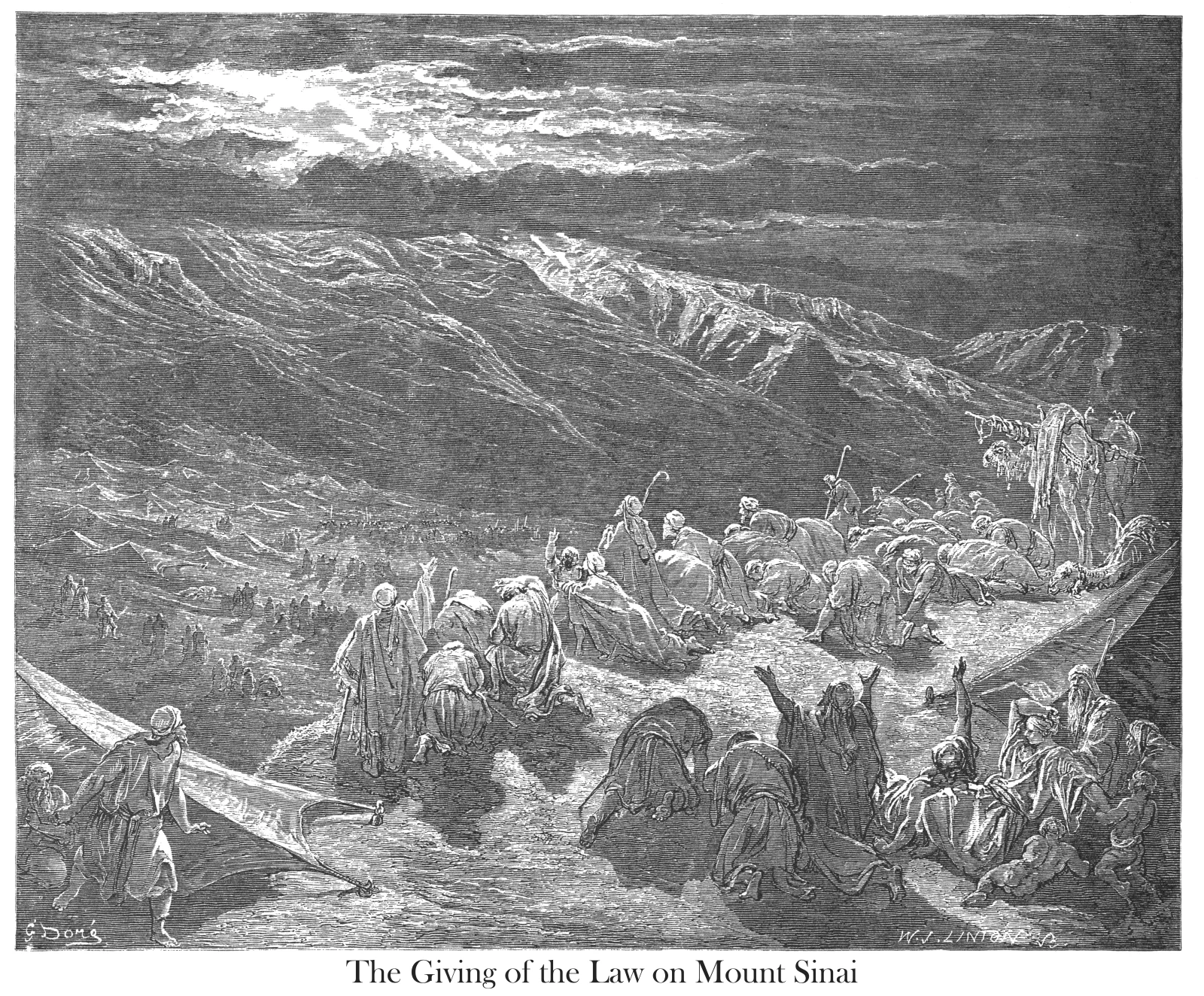
The Giving of the Law on Mount Sinai
Exodus 19:18 · World English Bible (Catholic)
18All of Mount Sinai smoked, because the LORD descended on it in fire; and its smoke ascended like the smoke of a furnace, and the whole mountain quaked greatly.
In the foreground, bodies are bent down to the ground. Other figures raise their arms toward the mountain; on the left, a standing man reaches out his hand in its direction. These gestures do not converge on a visible figure, but on a distant brightness above the ridges. Between it and the group stretches a vast valley, where the tents and silhouettes grow tiny.
The distance gives the scene its scale. The mountain does not rise alone, immediately behind the people: its lines extend into a range that blocks almost the entire engraving. Above, a dark band of clouds separates the peaks from the luminous sky. The brightness does not dispel their density; on the contrary, it seems to emphasize it. Below, the prostrate figures occupy nearby ground, while the camp is scattered through the hollow of the valley. The event thus reaches a multitude of whom only a few faces and gestures can be distinguished.
Exodus says that Sinai was entirely enveloped in smoke, because Yahweh had descended upon it amid fire. The text makes the mountain itself tremble; it also recounts the thunder, lightning, and sound of the trumpet, then the voice answering Moses. The engraving gives considerable space to the cloud-laden sky and the brightness of the heights, but fire and smoke are not set apart in it as distinctly as they are in the words. As for the noise and trembling, they are accessible only indirectly, through the posture of the bodies.
The title announces the giving of the Law; the passage chosen ends with God’s descent and the call addressed to Moses. No tablet occupies the center of the scene here, and Moses cannot be identified with certainty among the figures. The encounter precedes the formulation of the Law. In the space left between the people and the heights, the divine presence makes itself known through its signs, without taking visible form itself.