Gustave Doré · Exodus 12:29-30
The Firstborn of Egypt Are Slain
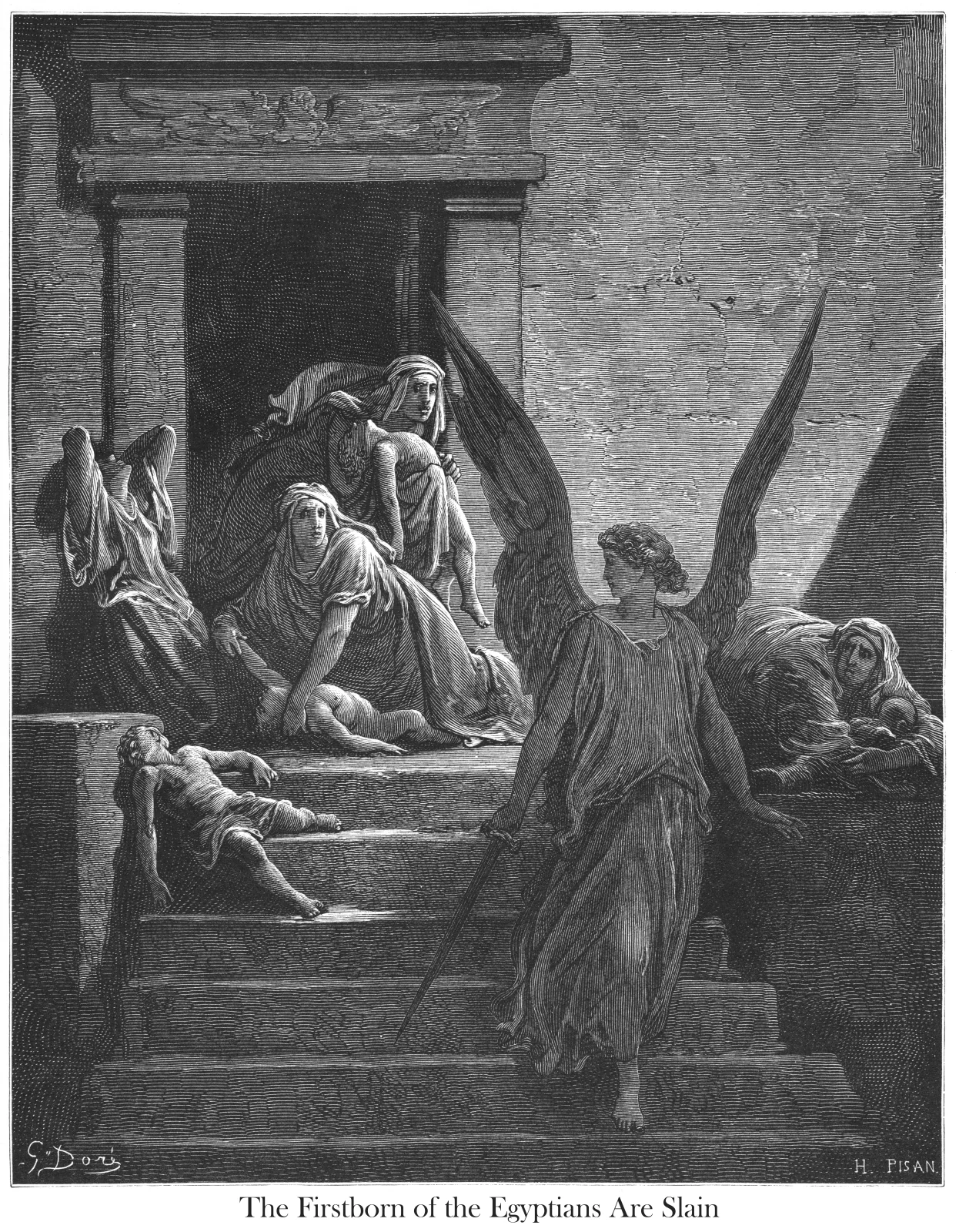
Exodus 12:29-30 · World English Bible (Catholic)
29At midnight, the LORD struck all the firstborn in the land of Egypt, from the firstborn of Pharaoh who sat on his throne to the firstborn of the captive who was in the dungeon, and all the firstborn of livestock.
30Pharaoh rose up in the night, he, and all his servants, and all the Egyptians; and there was a great cry in Egypt, for there was not a house where there was not one dead.
The sword points downward. The winged figure descending the steps does not strike before our eyes; behind it, the bodies of children already lie on the threshold and the staircase. It turns its head toward the people gathered at the entrance, while its foot advances toward the lower edge of the engraving. The movement leads out of the house, but the gaze remains fixed on what has just taken place there.
On the landing, a woman bends over a child lying prone; higher up, another carries a body whose legs hang down. To the left, a figure has raised its arms to its head. To the right of the winged being, a woman embraces a small body. These gestures fill the space between the wings and the monumental doorframe. The staircase, which might lead to a dwelling, becomes the place where the dead and those who remain are exposed together.
Exodus relates that in the middle of the night Yahweh strikes the firstborn throughout the land of Egypt, from Pharaoh’s house to the captive in his prison, as well as the firstborn of the animals. Then a great cry rises: no house is spared by death. Doré narrows this expanse to an entrance and a few figures. The cry has no voice here; it takes shape in the raised arms and in the gestures bent over the children.
The verses attribute the blow to Yahweh without describing a messenger. The armed, winged figure gives this passage a visible presence, distinct from the people struck down. Its lowered sword draws the gaze less toward the act than toward its aftermath. In the text, this night precedes the order given by Pharaoh to the children of Israel to depart. On the steps, the deliverance still to come remains bound to a loss whose weight the families already bear.