Gustave Doré · Exodus 10:22
The Ninth Plague: Darkness
Exodus 10:22 · World English Bible (Catholic)
22Moses stretched out his hand toward the sky, and there was a thick darkness in all the land of Egypt for three days.
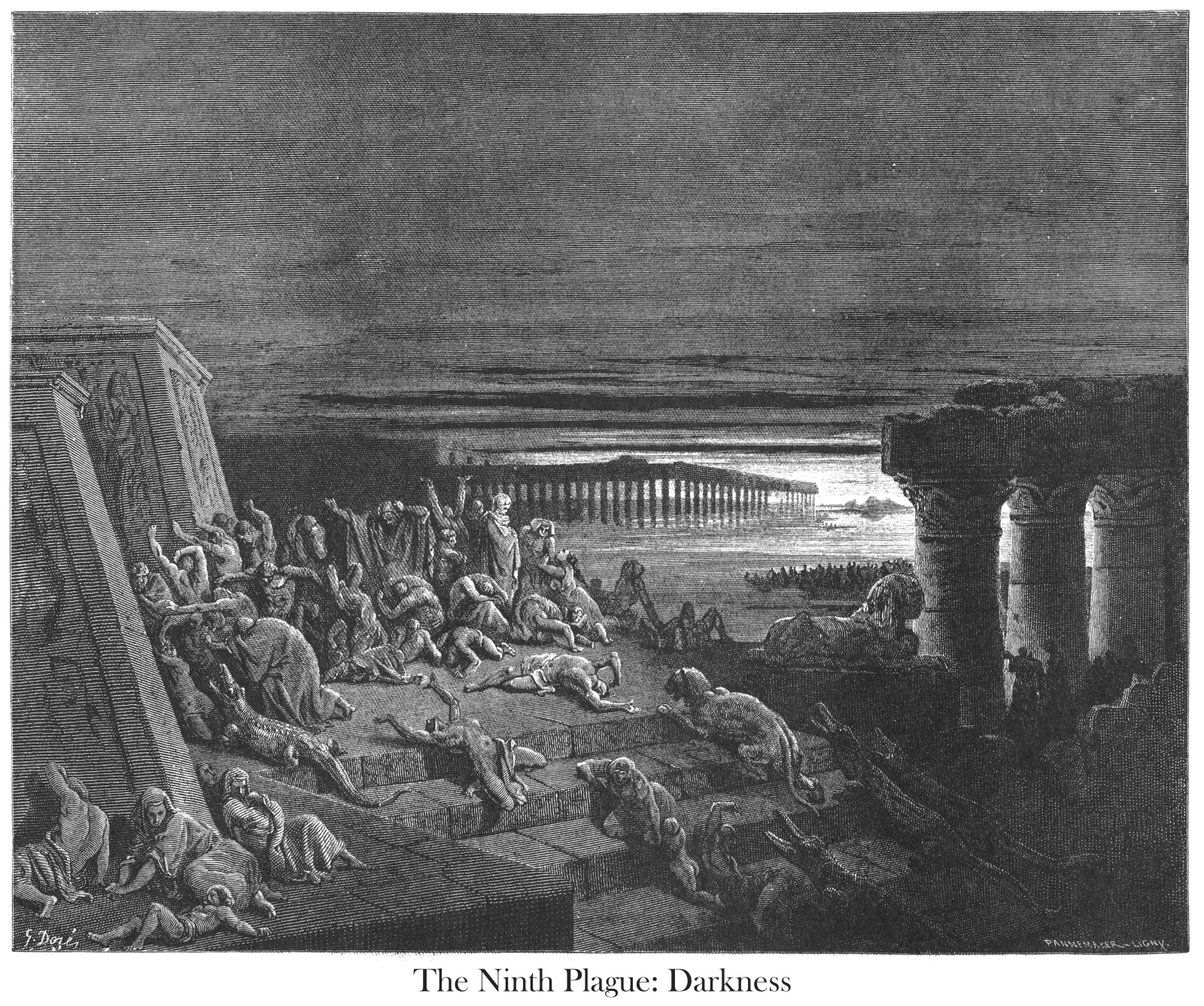
On the steps, a body lies outstretched, one arm extended toward the void. Higher up, other figures bend over, cover their faces, or raise their hands. The gestures multiply, but none seems to lead away from the terrace. The nearness of the bodies is not enough to form a group capable of guiding itself.
Above them, the sky occupies almost half the engraving. Its long horizontal streaks weigh upon the buildings and the crowd. On the right, the massive columns and the sphinx are barely distinguishable from the darkness; in the distance, however, a bright strip outlines the colonnade. This brightness does not necessarily point to the dwelling place of the Israelites. Above all, it makes it possible to discern the expanse of the landscape and, by contrast, the confusion of the figures in the foreground. The land remains visible in the engraving even as its inhabitants seem deprived of sight.
Moses’ gesture, extending his hand toward the sky in Exodus, cannot be identified with certainty among the gestures of the crowd. Doré gives central place to the bodies subjected to darkness rather than to the gesture that brings it down. The text specifies that the Egyptians could no longer see one another and that no one left his place for three days. The raised arms and collapsed bodies make this immobility palpable without turning it into an absence of movement: one can still struggle where one is.
The three days’ duration cannot be measured on the steps. It remains in the text, along with this other detail: the children of Israel had light in their homes. The engraving concentrates the gaze on those for whom familiar space has become impassable. The plague thus strikes the most immediate relation to the world and to others: being very close no longer means being able to see one another.