Gustave Doré · Exodus 9:2-3
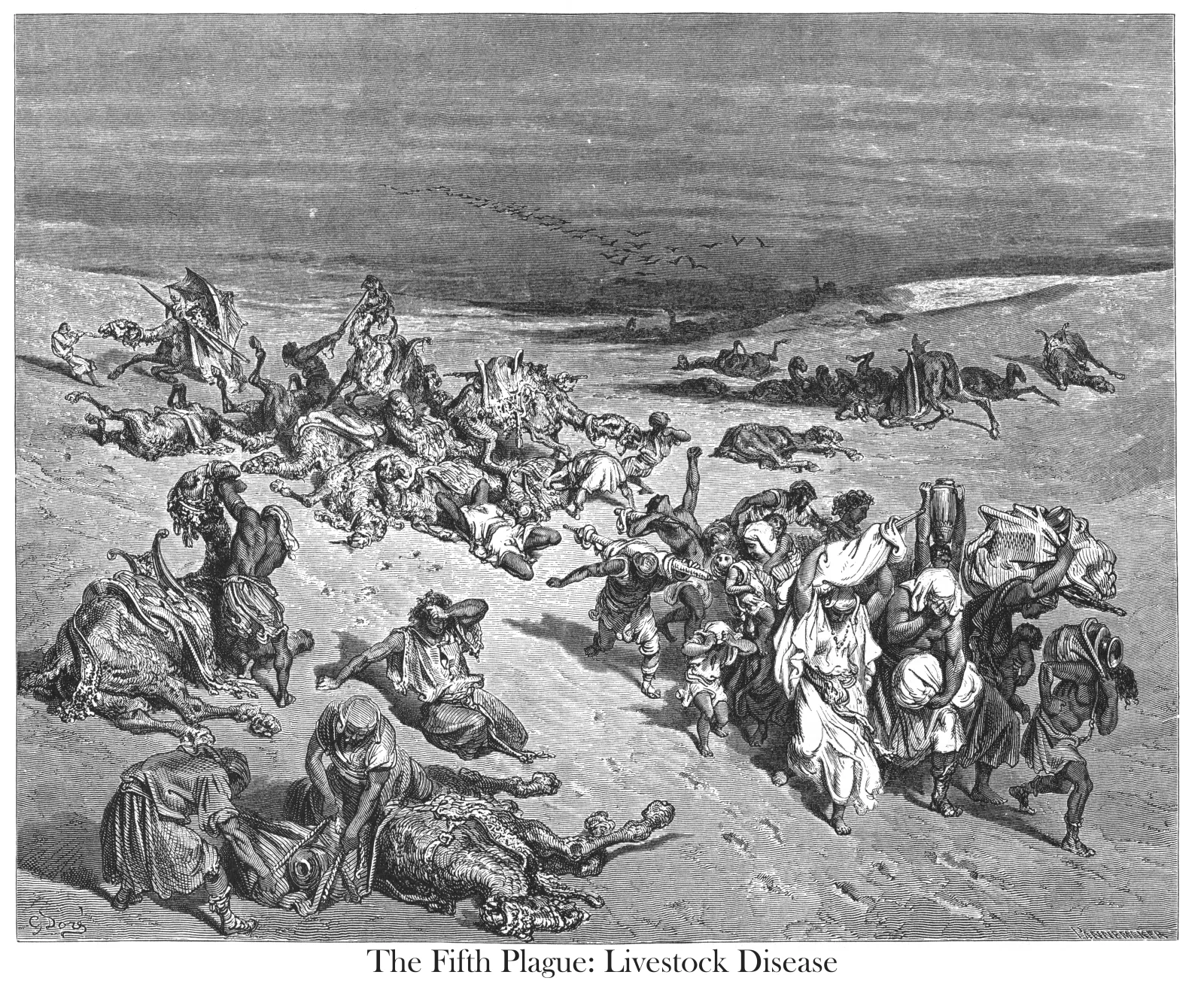
The Fifth Plague: Livestock Disease
Exodus 9:2-3 · World English Bible (Catholic)
2For if you refuse to let them go, and hold them still,
3behold, the LORD’s hand is on your livestock which are in the field, on the horses, on the donkeys, on the camels, on the herds, and on the flocks with a very grievous pestilence.
In the foreground, two men bend over the load of a slaughtered animal. Beside them, a beast lies with its legs outstretched; farther off, other bodies block the path. The objects these animals carried draw the eye almost as much as their carcasses. The plague strikes beasts engaged in work and transport: with them, human activity is brought to a halt.
Yet on the right, a group is still moving forward. Adults carry children or belongings; a small figure walks with hands near the face. This tightly packed procession follows the expanse of bodies stretching to the left and receding into the distance. The path remains open, but it has become difficult to distinguish the road from the site of disaster. Beneath the vast, streaked sky, a flock of birds crosses the horizon above the plain.
The message conveyed to Moses foretold to Pharaoh a plague striking the herds in the fields if he persisted in keeping the people back. It named several species; Doré gives this threat the form of fallen beasts and abandoned loads. The designated verses still state a condition and a prediction. The engraving, by contrast, places their consequences before us. The people’s gestures beside the animals, their progress, and their burdens are not described in these verses: they give a human measure to the loss of livestock, though their identity cannot be established from the image.
The biblical context adds a decisive distinction: the herds of Israel will be spared. Nothing in the engraving allows this separation to be recognized with certainty. The gaze remains with the afflicted beasts and the men struggling among them. The threat addressed to the ruler thus takes shape far from him, in the ordinary bonds between people, their animals, and what they carry.