Gustave Doré · Exodus 2:6
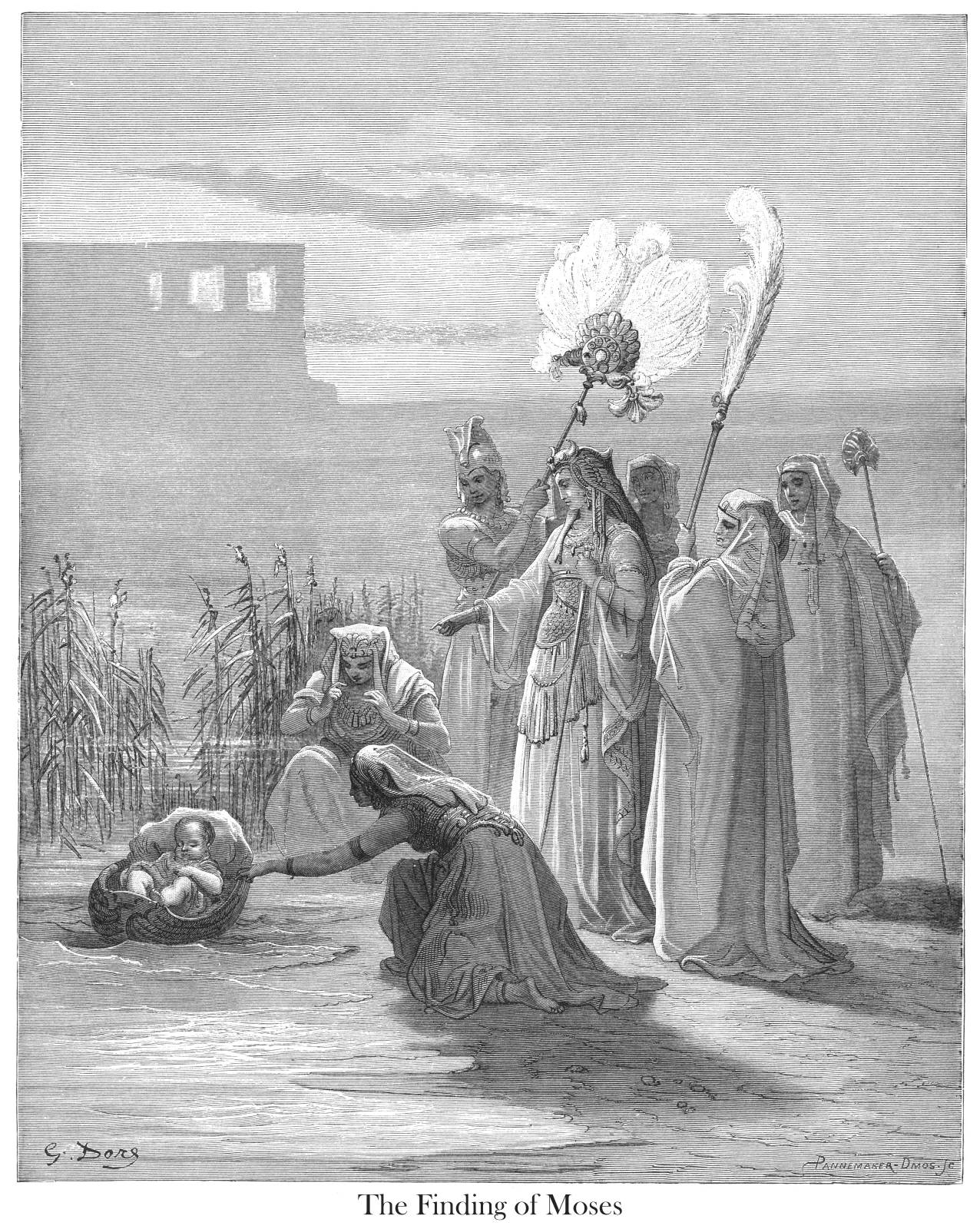
The Finding of Moses
Exodus 2:6 · World English Bible (Catholic)
6She opened it, and saw the child, and behold, the baby cried. She had compassion on him, and said, “This is one of the Hebrews’ children.”
A hand touches the edge of the basket. The kneeling woman reaches toward the child, while behind her another woman, seated beside the reeds, brings her hands to her chest. Farther away, the richly dressed figure who points to the little one remains standing, surrounded by her companions. The gesture of pointing and the one that reaches the basket are not made by the same person: the whole scene rests in this interval.
The child still lies at the water’s edge, apart from the group. His open basket is small beside the robes filling the bank and the great feather fans rising above the procession. Yet the lines of the arms and the inclined faces lead back to him. The reeds behind his shelter keep visible the place where he was found; the woman who reaches him forms a passage between this riverbank and the group gathered on dry land.
Exodus gives Pharaoh’s daughter a more direct role: after sending her maidservant to fetch the basket, she opens it, sees the boy crying, and recognizes him as a Hebrew child. The engraving distributes the discovery among several gestures. The basket is already open, but has not yet left the water; the princess’s words and the pity the text attributes to her remain beyond the reach of the line. As for the child’s sister, whom the passage first places at a distance before she intervenes, there is nothing that allows her to be identified with certainty among the figures represented.
The distance maintained between the woman who points to the child and the one who touches him gives the encounter concrete form: a little stranger enters the sphere of a princely household through the attention and hands of several women. In the text, recognition of his Hebrew origin does not bring the encounter to an end; it accompanies the pity that makes it possible.