Gustave Doré · Exodus 2:3
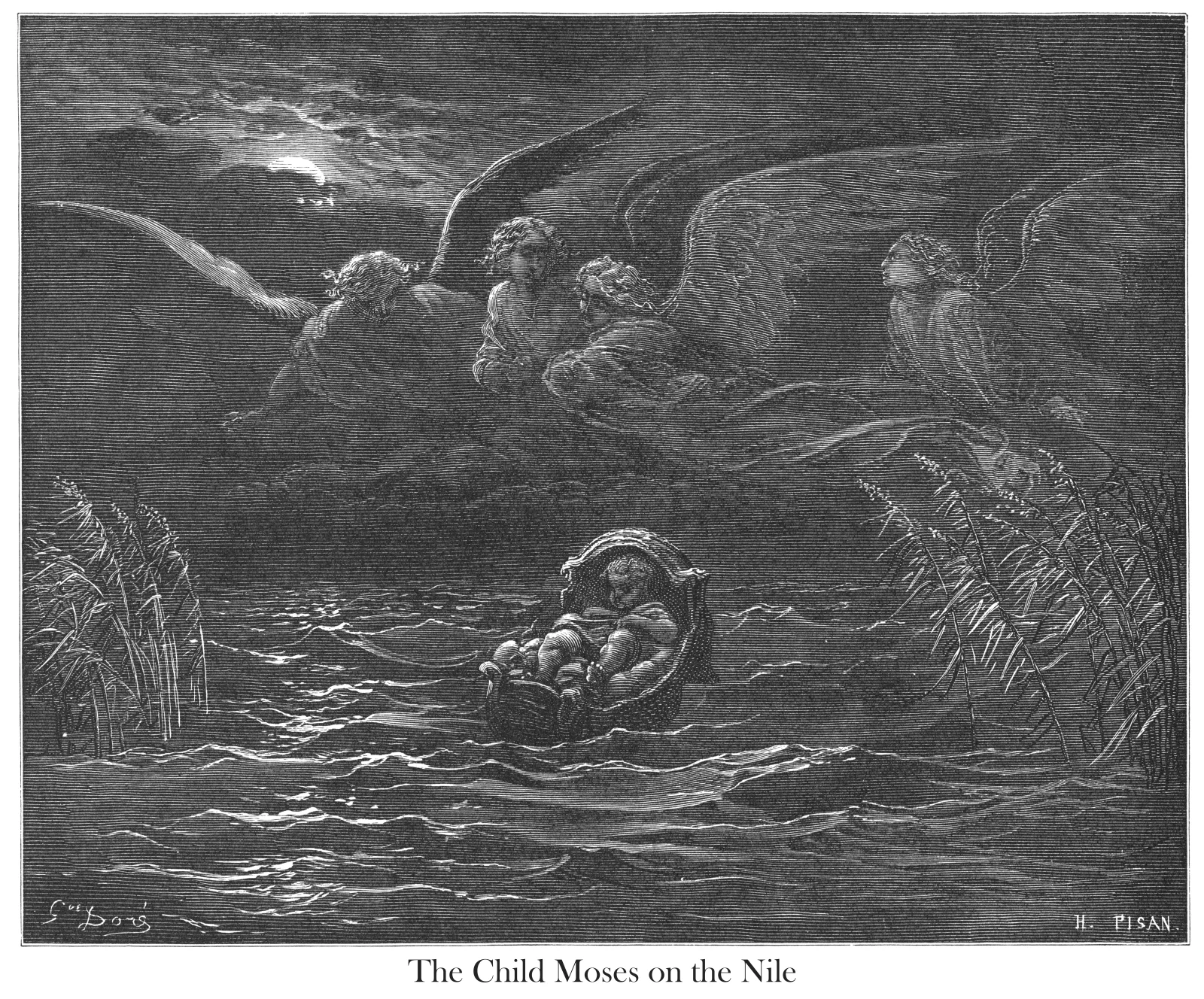
The Infant Moses on the Nile
Exodus 2:3 · World English Bible (Catholic)
3When she could no longer hide him, she took a papyrus basket for him, and coated it with tar and with pitch. She put the child in it, and laid it in the reeds by the river’s bank.
The small basket floats at the center of water crossed by bright ripples. Its raised rim surrounds the child, whose head rests under shelter, while his legs occupy almost all the space available. Reeds rise on either side without reaching him. Between them and the cradle, the river remains open.
Above Moses, great winged figures bend over him in the night. Their outspread wings cover a large part of the sky, but no arm lifts the basket. One of the figures turns its face upward; the others stand close beside it, above the child. This presence changes the scale of the scene: the frail vessel seems even more isolated on the water, even as an assembly keeps watch in the air.
The Book of Exodus first recounts a mother’s act. After hiding her son for three months, she prepares a basket of bulrushes, coats it with bitumen and pitch, and then places it among the reeds at the river’s edge. His sister stays at a distance; Pharaoh’s daughter will later see the basket and have it brought to her. In the engraving, neither these women nor their actions are visible. The gaze fixes on the interval in which the child, entrusted to his vessel, is still on the water.
The basket rendered by the engraving’s strokes is not hidden among the reeds as it is in the text: it stands out in the middle of the current. The winged figures, absent from the passage cited, give visible form to a protection that the account does not name here. One may read in them a care from heaven, without the image erasing the precariousness of the means chosen by the mother. The child remains in a basket small enough to leave the water all around him.