Gustave Doré · Genesis 46:5
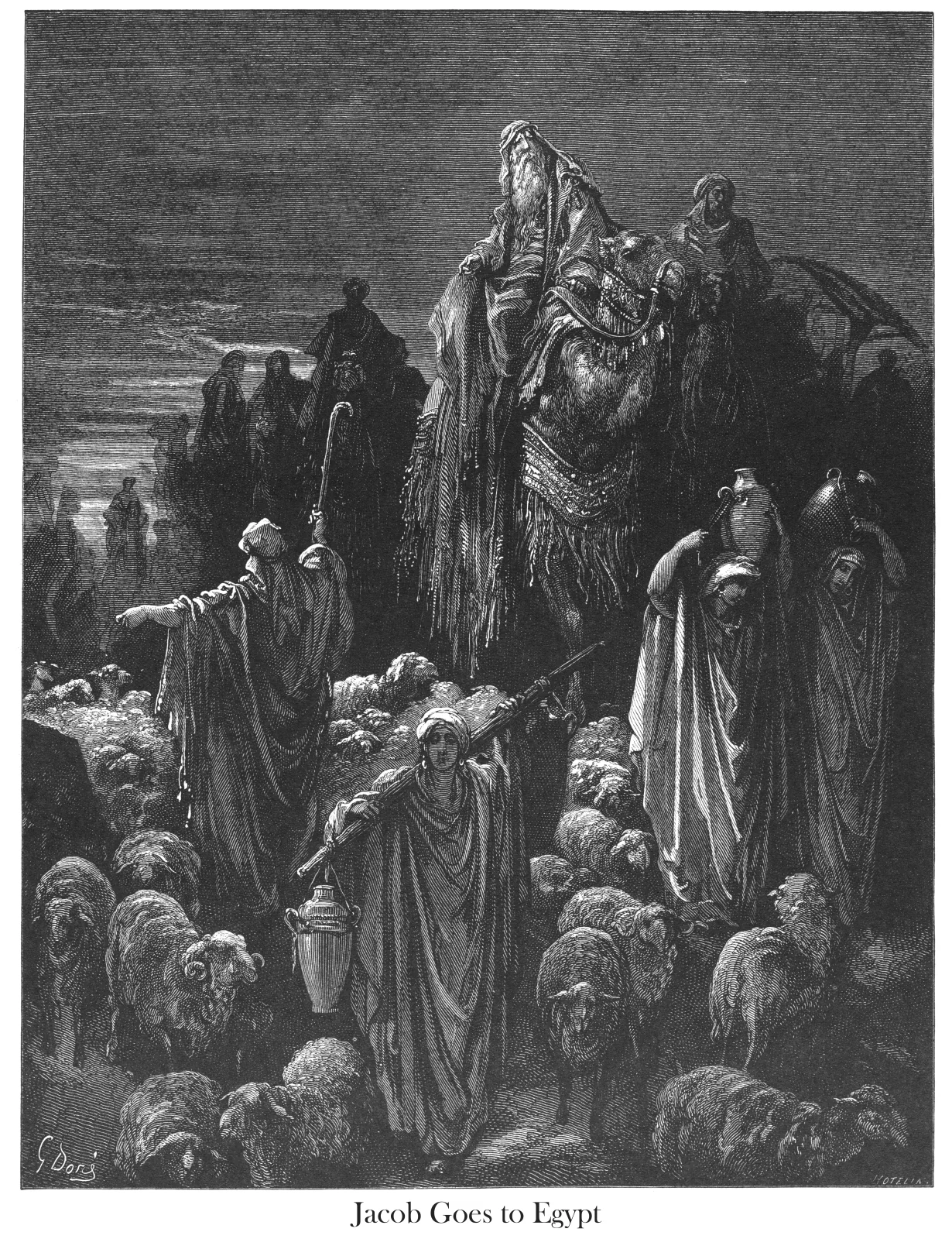
Jacob Goes to Egypt
Genesis 46:5 · World English Bible (Catholic)
5Jacob rose up from Beersheba, and the sons of Israel carried Jacob, their father, their little ones, and their wives, in the wagons which Pharaoh had sent to carry him.
In the foreground, a woman walks with a long pole across her shoulder, from which a vessel hangs. Around her, sheep fill almost the entire width of the path. Farther up, Jacob presides over the procession, seated on a richly harnessed camel. His beard and light-colored clothing set him apart against the dark sky, while his companions gradually merge into the mass of the caravan.
The patriarch is placed at the center, but his journey is not reduced to his person. Below him, the animals and bearers give the departure its material weight. On the right, two women carry vessels; on the left, a man stretches his arm above the flock. Behind them, other figures extend the march toward the horizon. The family and its possessions do not form an immobile group gathered around a leader: they move forward, scattered through the depth of the image.
Genesis specifies, however, that the sons of Israel placed their father, their wives, and their children on the wagons sent by Pharaoh. Here, Jacob is borne by a camel. A covered vehicle appears in the background, but it is not what carries the patriarch in the viewer’s sight. The movement sets Jacob’s aged figure apart above the crowd, while allowing the flocks and possessions mentioned in the following verses to be seen.
Before the departure, God promises Jacob that He will go down with him to Egypt and make him a great nation there. Nothing in the engraving gives visible form to this promise. Yet it accompanies the reading of the procession: the promise concerns descendants, and the journey takes shape in these people, animals, and loads, from which Jacob cannot be separated.