Gustave Doré · Revelation 12:1-3
The Virgin Crowned
Revelation 12:1-3 · World English Bible (Catholic)
1A great sign was seen in heaven: a woman clothed with the sun, and the moon under her feet, and on her head a crown of twelve stars.
2She was with child. She cried out in pain, laboring to give birth.
3Another sign was seen in heaven. Behold, a great red dragon, having seven heads and ten horns, and on his heads seven crowns.
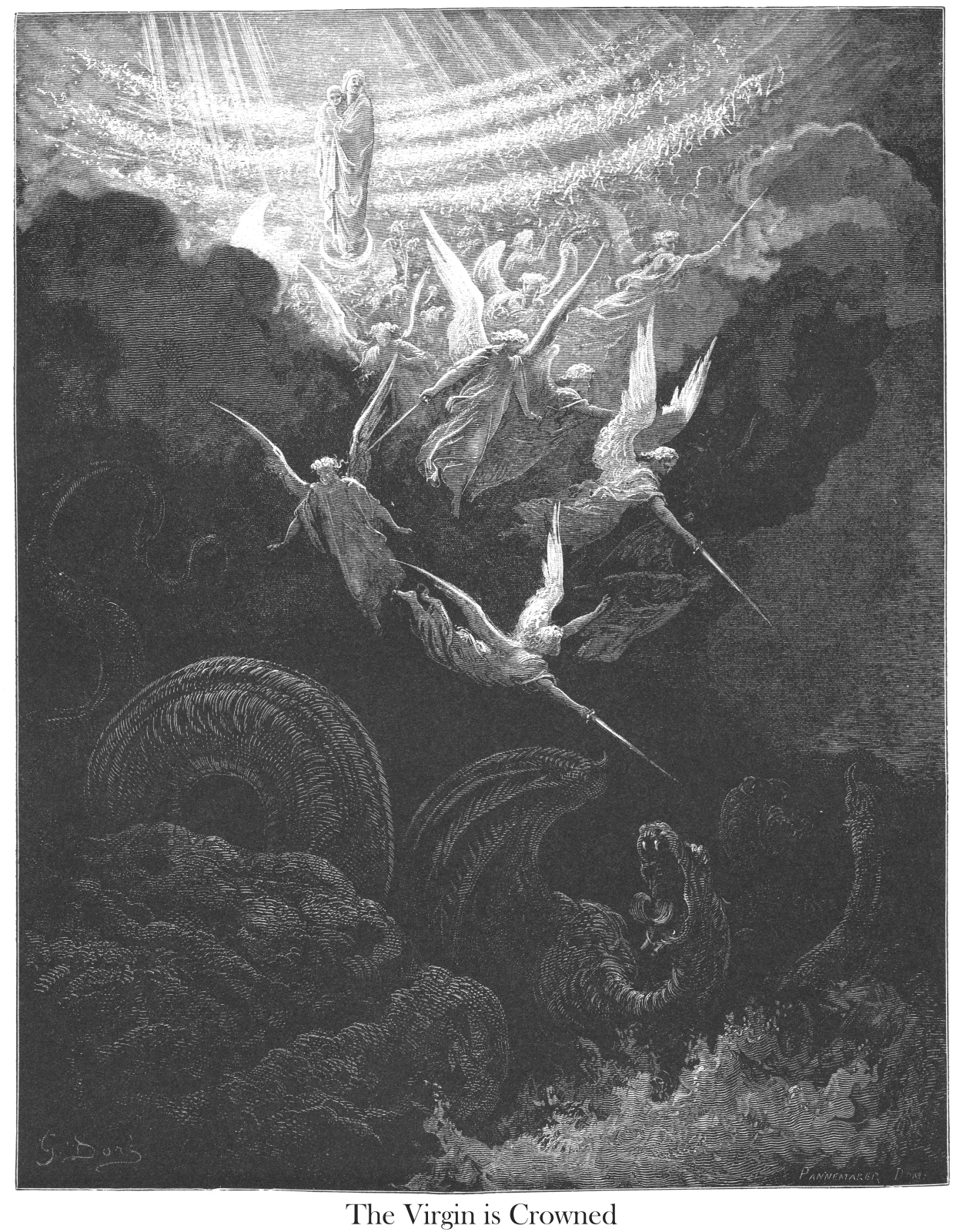
A slender crescent supports the woman’s feet, high at the top of the engraving. She holds a child close against her and remains almost motionless in the radiance that crosses the sky. At their feet, armed angels descend toward the dragon’s shadowy forms. The space between the mother and the monster is filled by their wings and the diagonals of their swords.
The eye might rest on the luminous figure, small despite her elevated position. But the immense body coiling below gives her measure. Jaws and upraised necks emerge from this dark mass; the angels move toward them, though the battle is not yet decided. The crescent beneath the woman’s feet thus becomes more than a celestial attribute: it marks the height at which she stands, above a confrontation that fills almost the entire page.
The Book of Revelation shows a woman in heaven, clothed with the sun, the moon under her feet and twelve stars on her head. She cries out in the pains of childbirth; a seven-headed dragon appears next. The passage specifies that it stands before her, ready to devour her child as soon as it is born. Here, the child is already held in his mother’s arms. Neither her cry nor the labour of childbirth is visible. The light, the crescent and the dragon remain, but their encounter takes on a different duration: instead of the imminence of the threatened birth, the engraving unfolds a battle between the angels and the monster.
The title names the woman “Virgin.” This Marian identification gives a face to the figure in the sign without exhausting the text of Revelation, which does not name her as such in the verses provided. The child held close against her makes motherhood legible through his already-given presence, while the raised weapons remind us that the threat has not disappeared.