Gustave Doré · Revelation 6:7-8
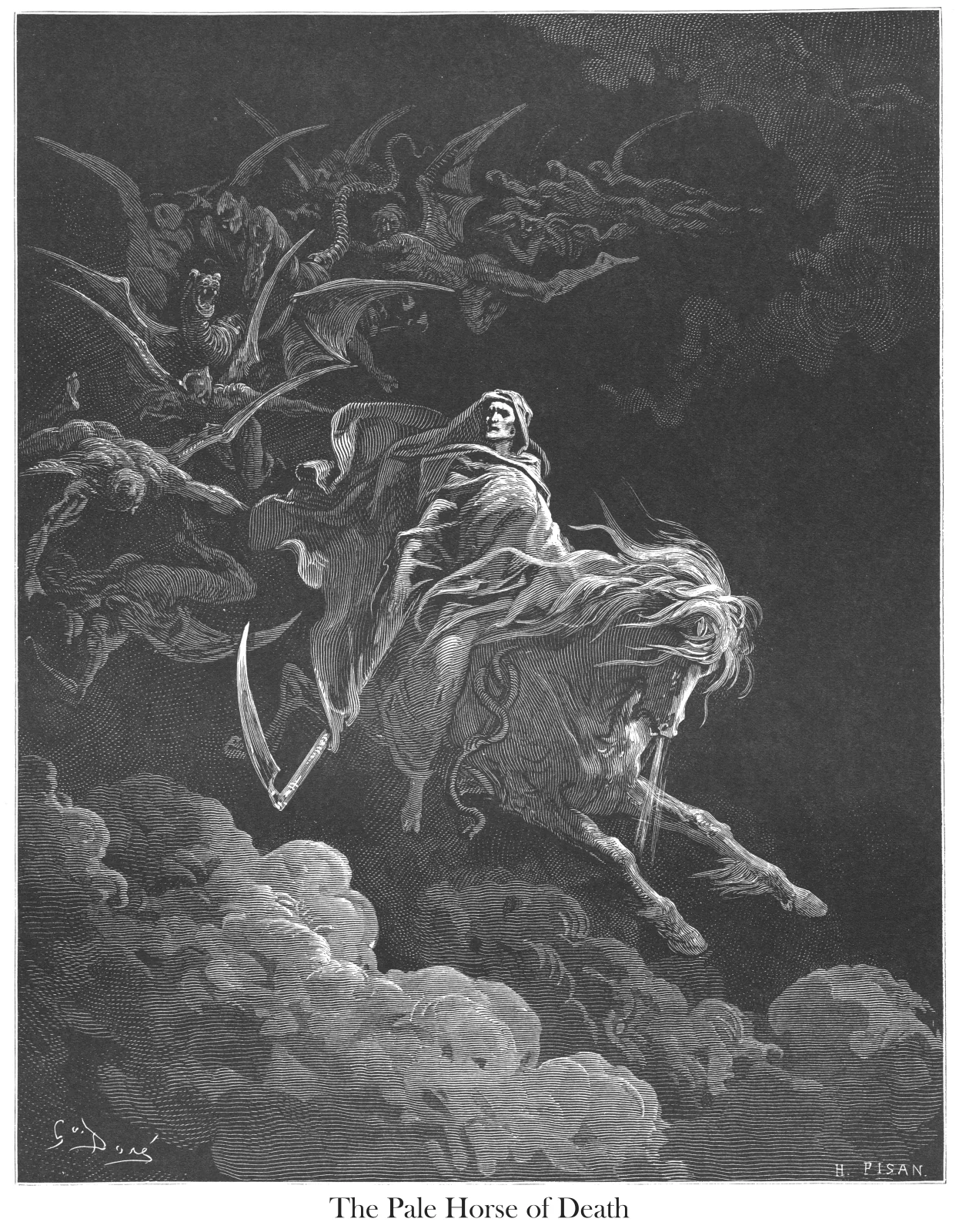
The Pale Horse of Death
Revelation 6:7-8 · World English Bible (Catholic)
7When he opened the fourth seal, I heard the fourth living creature saying, “Come and see!”
8And behold, a pale horse, and the name of he who sat on it was Death. Hades followed with him. Authority over one fourth of the earth, to kill with the sword, with famine, with death, and by the wild animals of the earth was given to him.
The horse’s legs stretch into the void, above the clouds. Its head lowers, its mane comes loose in long locks, while the rider remains almost upright. The movement carries the mount to the right; behind it, Death’s cloak and the bodies pressing in its wake stretch the scene in the opposite direction. The rider has not yet set foot on the earth: he threatens it from the air.
A scythe hangs at his side. Its bright blade describes an arc beneath the garment’s dark folds. The text of Revelation names the rider, but does not give him this attribute. In the engraving, the instrument makes Death recognizable even before his emaciated face can be discerned. It remains lowered; its presence alone lends the ride a sense of menace.
On the left, winged forms and grimacing figures become entangled behind the rider. One of them stretches a long arm into the black space. Revelation says that Hades followed Death, without describing such a retinue. Doré gives substance to this train: it fills the background, but leaves a vast dark space in front of the horse. This void gives the ride a direction and makes the group’s advance more perceptible.
Yet the passage specifies that the power granted to Death and Hades extends over a quarter of the earth. Nothing in the engraving’s open sky allows this limit to be measured. Nor are the means of killing listed in the text arranged in distinct scenes; no earthly victim is identified. The vision focuses the gaze on the approach, not on its consequences.
In Revelation, this apparition comes after the opening of the fourth seal and the call of the fourth living creature. The engraving isolates the rider’s sudden appearance from this sequence. The immensity he traverses might make one forget the measure assigned to him by the biblical word: his power is granted and bounded.