Gustave Doré · John 19:15
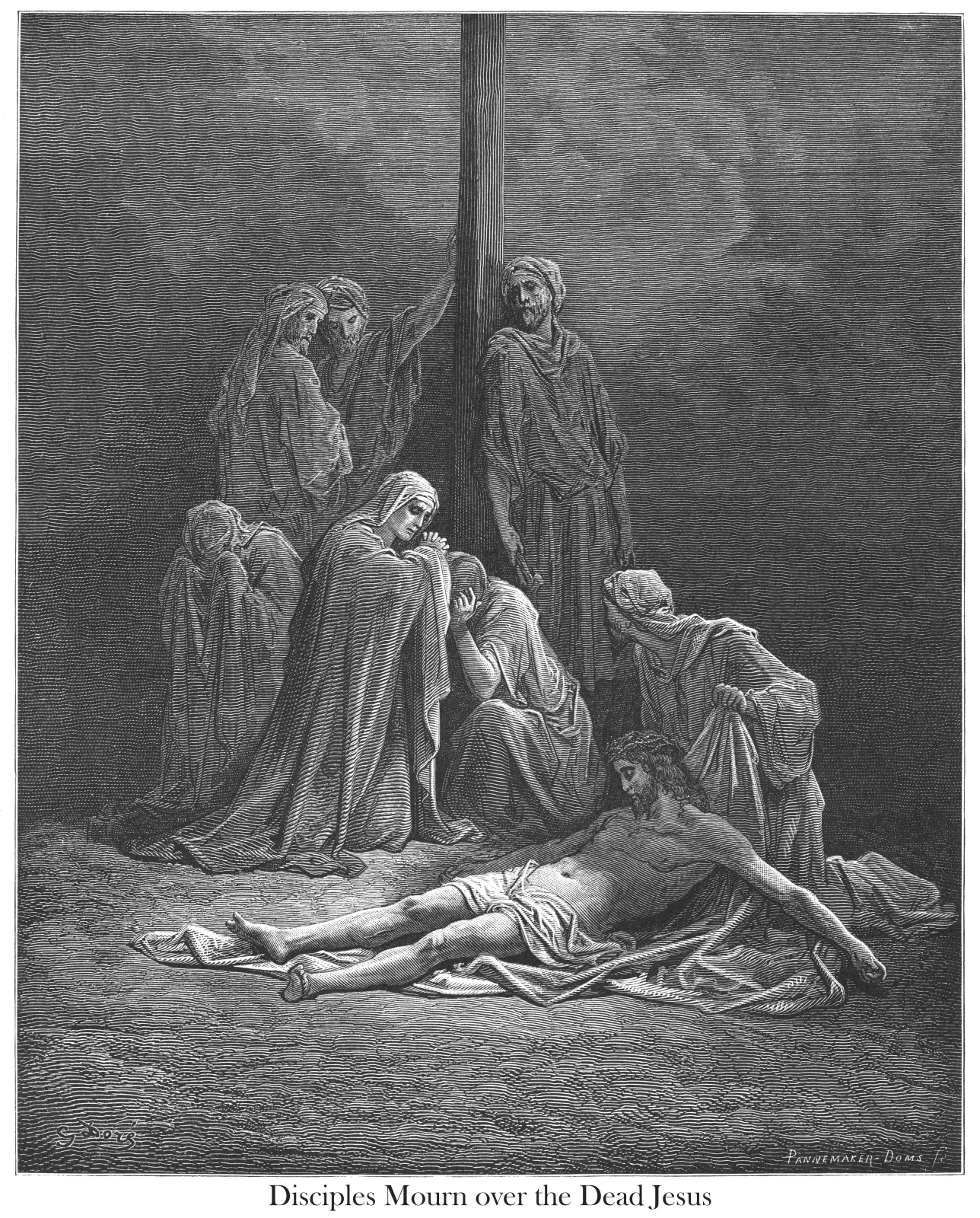
The Disciples Mourn the Dead Christ
John 19:15 · World English Bible (Catholic)
15They cried out, “Away with him! Away with him! Crucify him!” Pilate said to them, “Shall I crucify your King?” The chief priests answered, “We have no king but Caesar!”
Jesus’s body occupies almost the entire width of the foreground. Stretched out on a cloth, his arms open, he remains apart from the close-knit group behind him. His bowed head, still crowned with thorns, rests near a figure holding a piece of fabric. The light cast on the body sets it apart from the dark clothing and the densely marked background.
At the center, a wooden upright rises to the upper edge of the engraving. A man leans his arm against it; lower down, two women stand very close to one another, one leaning toward her companion, who hides her face. The wood connects these figures with the body, though no one is suspended from it. It remains as the vertical trace of an event from which Jesus has been taken down. At his feet, the gestures of mourning do not form a closed circle: a space remains open around the dead man.
The reference provided, John 19:15, nevertheless leads to an earlier moment. Before Pilate, the crowd cries out for crucifixion; when asked about their king, the chief priests answer that they have no king but Caesar. The transmitted text continues as far as Jesus’s departure, carrying his cross toward Golgotha. It tells neither of his death nor of the lamentation shown in the engraving. The catalogue title, too, places the scene beside the dead Jesus: the reference therefore needs to be checked.
This chronological discrepancy nevertheless makes the force of the word “king” in the confrontation with the passage perceptible. The public declaration that rejects Jesus is answered here, without words, by the presence of those who remain near his body. The crown of thorns remains, but no tribunal is visible. The kingship evoked before Pilate is thus brought close to a body given over and to the silent fidelity of those close to him.