Gustave Doré · John 19:18-19
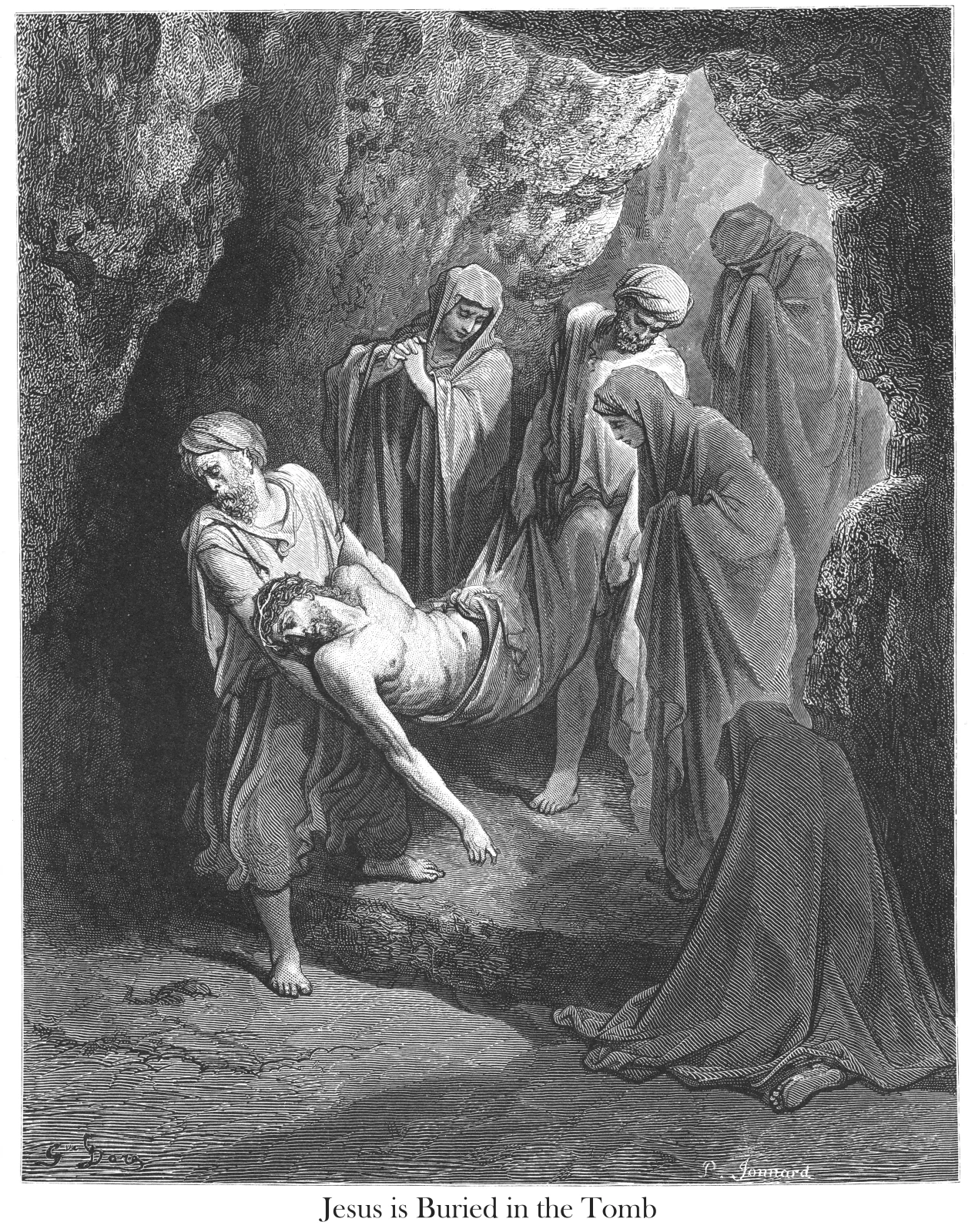
Jesus Is Buried in the Tomb
John 19:18-19 · World English Bible (Catholic)
18where they crucified him, and with him two others, on either side one, and Jesus in the middle.
19Pilate wrote a title also, and put it on the cross. There was written, “JESUS OF NAZARETH, THE KING OF THE JEWS.”
Jesus’s arm hangs freely down toward the stone. Nothing holds it at the wrist; the full weight of the body rests on those carrying him. On the left, a man supports his upper body against himself. Farther away, another carries the cloth gathered beneath his legs. Between their hands, the body forms a curve, still suspended above the ground.
The tomb is a confined space. The rocky vault occupies almost the entire upper part of the engraving, while a bright opening is visible behind the figures. Beneath this entrance, a man raises his hand to his face; one woman bends toward Jesus, another clasps her hands. In the foreground, a kneeling figure, seen from behind, partly blocks access to the scene. The postures remain distinct: carrying, bending, remaining on one’s knees. They surround the body without interrupting its passage toward the stone.
The reference provided, John 19:18–19, nevertheless leads to a different moment. It places Jesus crucified between two other men and recounts the inscription Pilate placed on his cross. Neither the three crosses nor the inscription appears here. The catalogue title, by contrast, does indeed identify the burial: there is therefore a discrepancy between the engraving and the associated verses, which calls for verification rather than a forced explanation.
This juxtaposition nonetheless retains significance. In John, Jesus’s place among the two crucified men is specified; in the engraving, his body still occupies the centre, but is now carried by those close to him, whose gestures answer to his death. The abandoned arm gives this presence its measure: before the repose of the tomb, the body must be received by others.