Gustave Doré · Luke 7:36-50
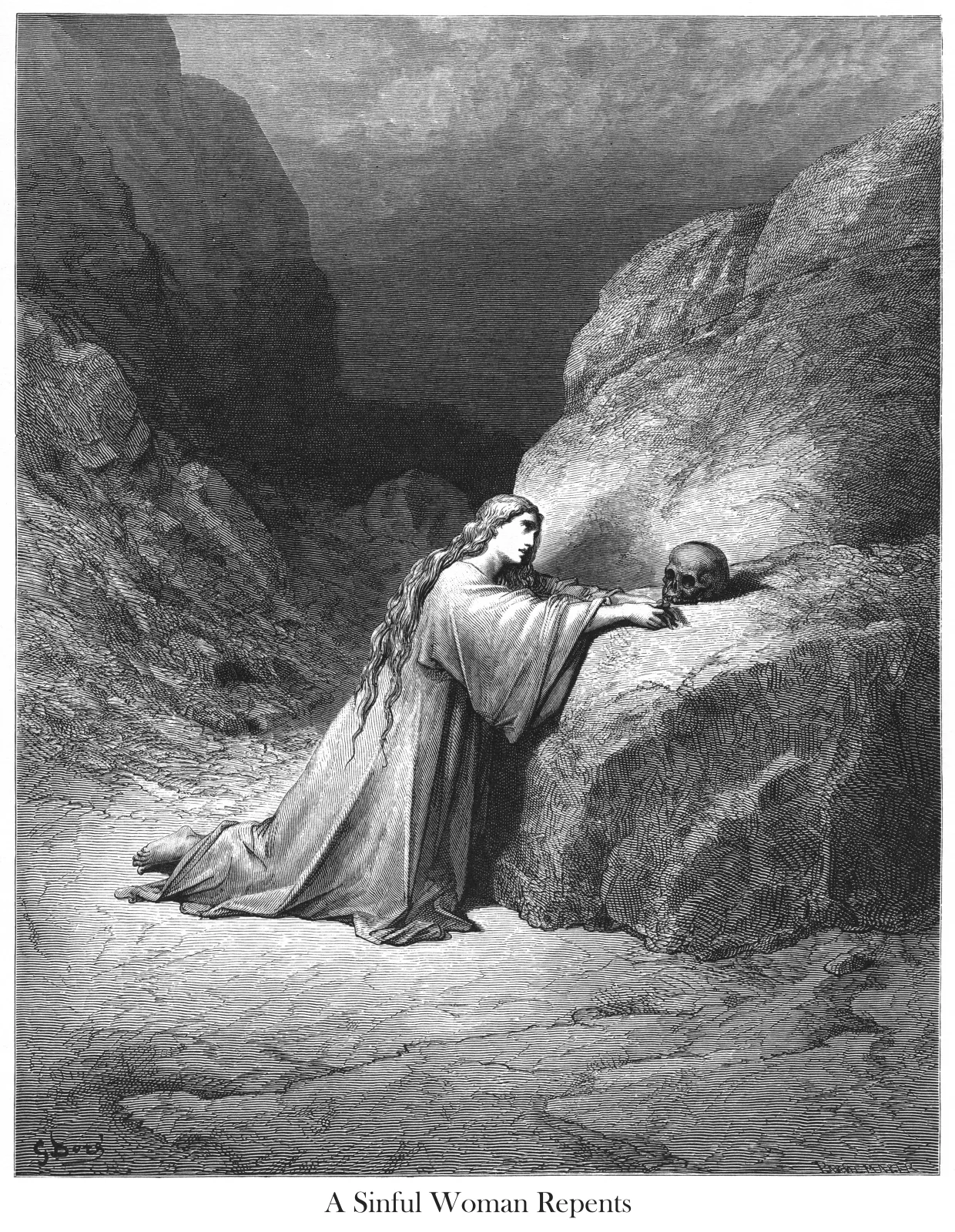
A Sinful Woman Repents
Luke 7:36-50 · World English Bible (Catholic)
36One of the Pharisees invited him to eat with him. He entered into the Pharisee’s house and sat at the table.
37Behold, a woman in the city who was a sinner, when she knew that he was reclining in the Pharisee’s house, brought an alabaster jar of ointment.
38Standing behind at his feet weeping, she began to wet his feet with her tears, and she wiped them with the hair of her head, kissed his feet, and anointed them with the ointment.
39Now when the Pharisee who had invited him saw it, he said to himself, “This man, if he were a prophet, would have perceived who and what kind of woman this is who touches him, that she is a sinner.”
40Jesus answered him, “Simon, I have something to tell you.” He said, “Teacher, say on.”
41“A certain lender had two debtors. The one owed five hundred denarii, and the other fifty.
42When they couldn’t pay, he forgave them both. Which of them therefore will love him most?”
43Simon answered, “He, I suppose, to whom he forgave the most.” He said to him, “You have judged correctly.”
44Turning to the woman, he said to Simon, “Do you see this woman? I entered into your house, and you gave me no water for my feet, but she has wet my feet with her tears, and wiped them with the hair of her head.
45You gave me no kiss, but she, since the time I came in, has not ceased to kiss my feet.
46You didn’t anoint my head with oil, but she has anointed my feet with ointment.
47Therefore I tell you, her sins, which are many, are forgiven, for she loved much. But one to whom little is forgiven, loves little.”
48He said to her, “Your sins are forgiven.”
49Those who sat at the table with him began to say to themselves, “Who is this who even forgives sins?”
50He said to the woman, “Your faith has saved you. Go in peace.”
Kneeling before a block of stone, a woman stretches out her arms. Her hands rest near a skull; her face is turned toward it. Her long hair falls over her dress and follows the line of her body down to the ground. Around her, the rocky walls close in on the space, while a dark depth opens behind her head.
The skull is small beside the mass that bears it. Yet it draws the eye toward the ends of her arms and gives this solitude its object: the woman stands before a sign of death. The light on the stone brings out both her hands and the skull, without quite joining them. Her gesture remains suspended near it.
The title identifies a repentant sinful woman, and the reference points to the meal at the Pharisee’s house in the Gospel according to Saint Luke. Yet neither the house, nor the table, nor Jesus is present here. In the text, the woman brings a jar of perfume, weeps at Jesus’ feet, and wipes them with her hair. Her hair remains visible in the engraving, but it no longer serves this gesture of welcome. The woman is alone, outside the encounter recounted by Luke.
The skull and the rocky setting add a meditation on the mortal condition to the passage. They do not make it possible to place the depicted episode before or after the meal. In Luke, forgiveness is a word addressed to the woman, before Simon and the other guests; the parable of the two debtors links this forgiveness to love. Before the stone, no comparable word is depicted. The gap makes visible what solitary penitence lacks: in the passage, the woman is also the one to whom Jesus speaks and whom he sends away in peace.