Gustave Doré · Luke 1:26-28
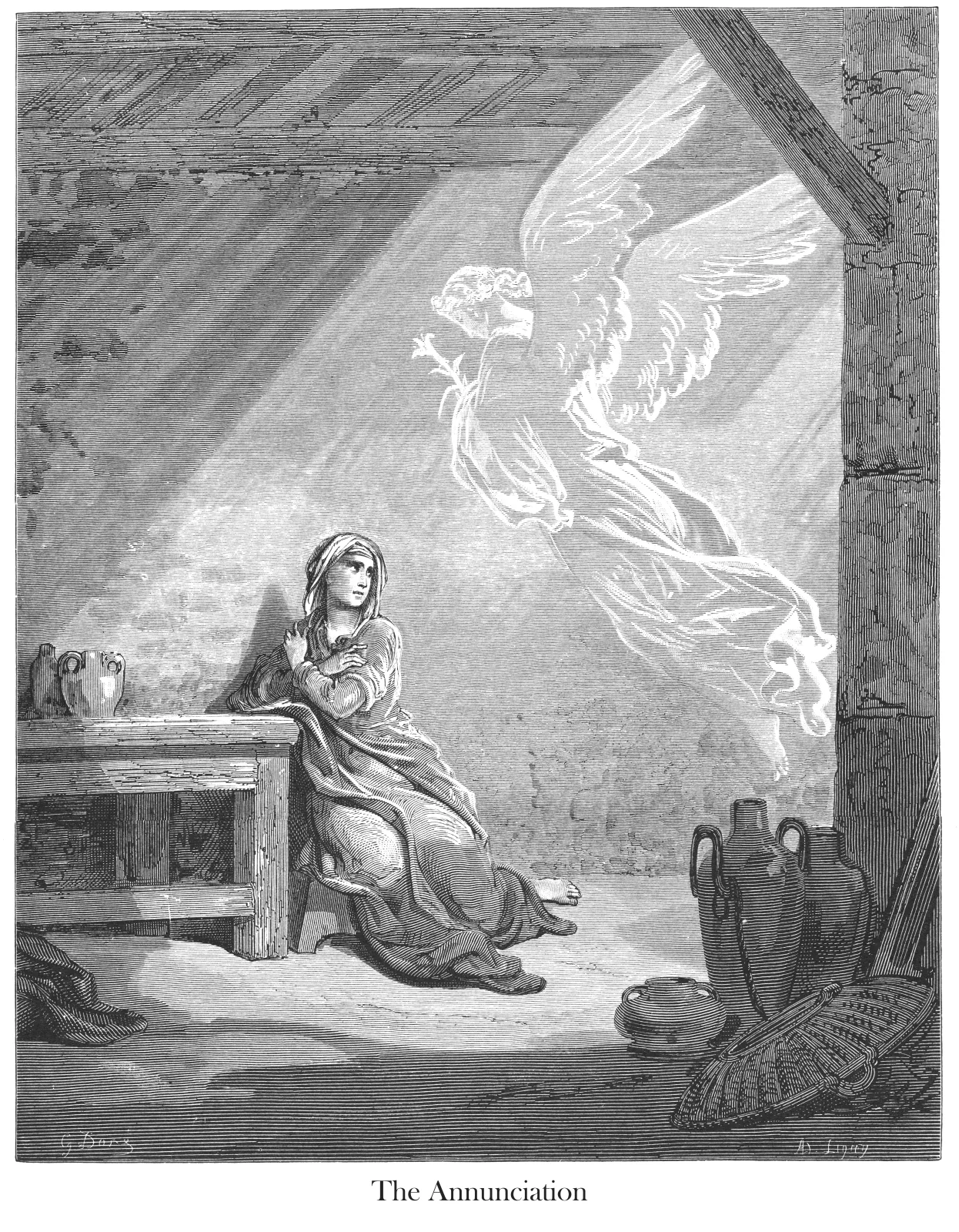
The Annunciation
Luke 1:26-28 · World English Bible (Catholic)
26Now in the sixth month, the angel Gabriel was sent from God to a city of Galilee named Nazareth,
27to a virgin pledged to be married to a man whose name was Joseph, of David’s house. The virgin’s name was Mary.
28Having come in, the angel said to her, “Rejoice, you highly favored one! The Lord is with you. Blessed are you among women!”
Mary has crossed her arms over her chest. Seated beside the table, she turns her head toward Gabriel without rising; her gaze lifts toward the angel’s inclined face. Their bodies do not touch. Between them stretches a portion of bare wall, crossed by the light that accompanies the messenger.
Gabriel occupies almost the full height of the room. His outspread wings extend beneath the beams, while his garment still floats behind him. One foot remains suspended above the jars set on the floor: the angel has entered, but his arrival retains something of a movement still in progress. Mary, by contrast, remains beside the piece of furniture whose horizontal lines and massive legs anchor her in the space of the house. Her compact posture answers the expansiveness of the winged figure.
In Luke, Gabriel is sent by God to Nazareth, to a young woman betrothed to Joseph. He enters where she is and greets her. The verses describe neither the room nor the messenger’s appearance. Here, the light makes his presence almost transparent, while the vessels and the table give the place of their encounter a familiar solidity. The lily Gabriel carries adds a sign absent from the passage given.
Mary’s gesture takes on particular significance in light of the following verse: she is troubled by the angel’s words and wonders what they mean. The engraving gives visible form to this moment of uncertainty, without being able to represent the words themselves. Her crossed arms do not, by themselves, tell us what she is thinking; yet they hold the gaze on the one who receives the greeting. Before any reply, the announced grace reaches a person in an inhabited place, and leaves her facing words to be understood.