Gustave Doré · Luke 2:15-16
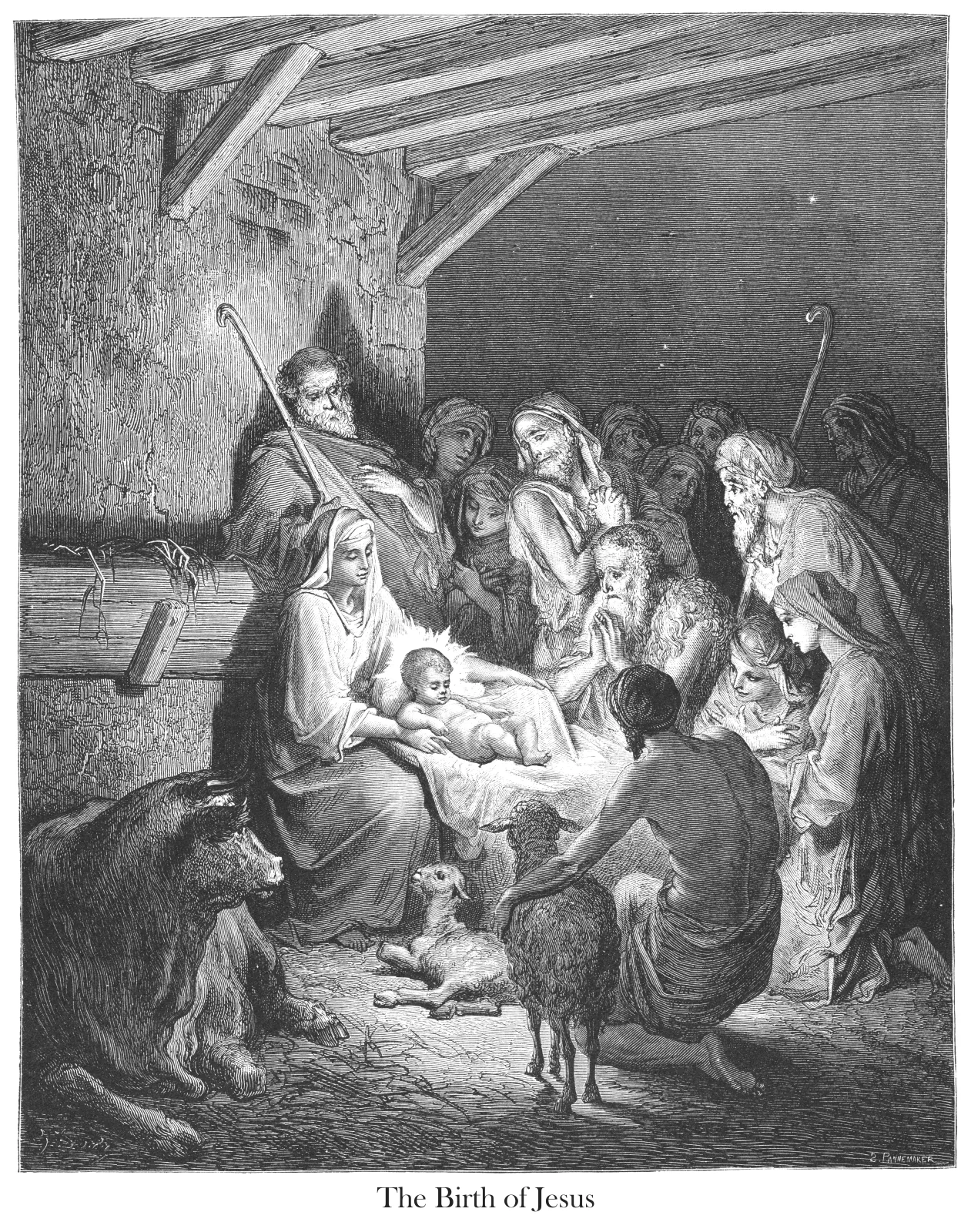
The Birth of Jesus
Luke 2:15-16 · World English Bible (Catholic)
15When the angels went away from them into the sky, the shepherds said to one another, “Let’s go to Bethlehem, now, and see this thing that has happened, which the Lord has made known to us.”
16They came with haste and found both Mary and Joseph, and the baby was lying in the feeding trough.
In the foreground, a shepherd kneels with his arm resting on the back of a sheep. Seen from behind, he looks toward the child, as do the faces gathered behind him. His presence gives the scene depth: one must pass by this man and his animal to reach the bright cloth on which Jesus rests.
Mary holds the newborn close beside her. The whiteness of the cloth and the radiance around her head draw the eye to the center of the group. Close by, an old man clasps his hands; others lean forward or remain farther back, beneath the roof timbers and before the opening onto the starry night. The bodies are crowded together, but a space remains around the child. The movement of those who have come seems to stop as they approach him.
In Luke, the shepherds decide to go to Bethlehem after the angels have departed. They go in haste and find Mary, Joseph, and the newborn lying in the manger. Doré chooses the moment of meeting rather than that of the journey. The words exchanged on the way have given way to looks and clasped hands. The passage describes neither these gestures nor the animals gathered beside the group. As for the manger mentioned by Luke, here the child appears on a cloth, close beside Mary.
The sheep in the foreground nevertheless retains something of the journey. The shepherd has not come alone: his animal still occupies the space between him and the child. The flock’s proximity gives physical form to the visitors’ identity, whom the text simply calls shepherds. After the announcement from heaven, what they find is presented to their eyes in the closeness of a mother and a newborn. The light surrounding the child gives this ordinary encounter a significance that the words of the announcement had prepared.