Gustave Doré · Mark 15:42-46
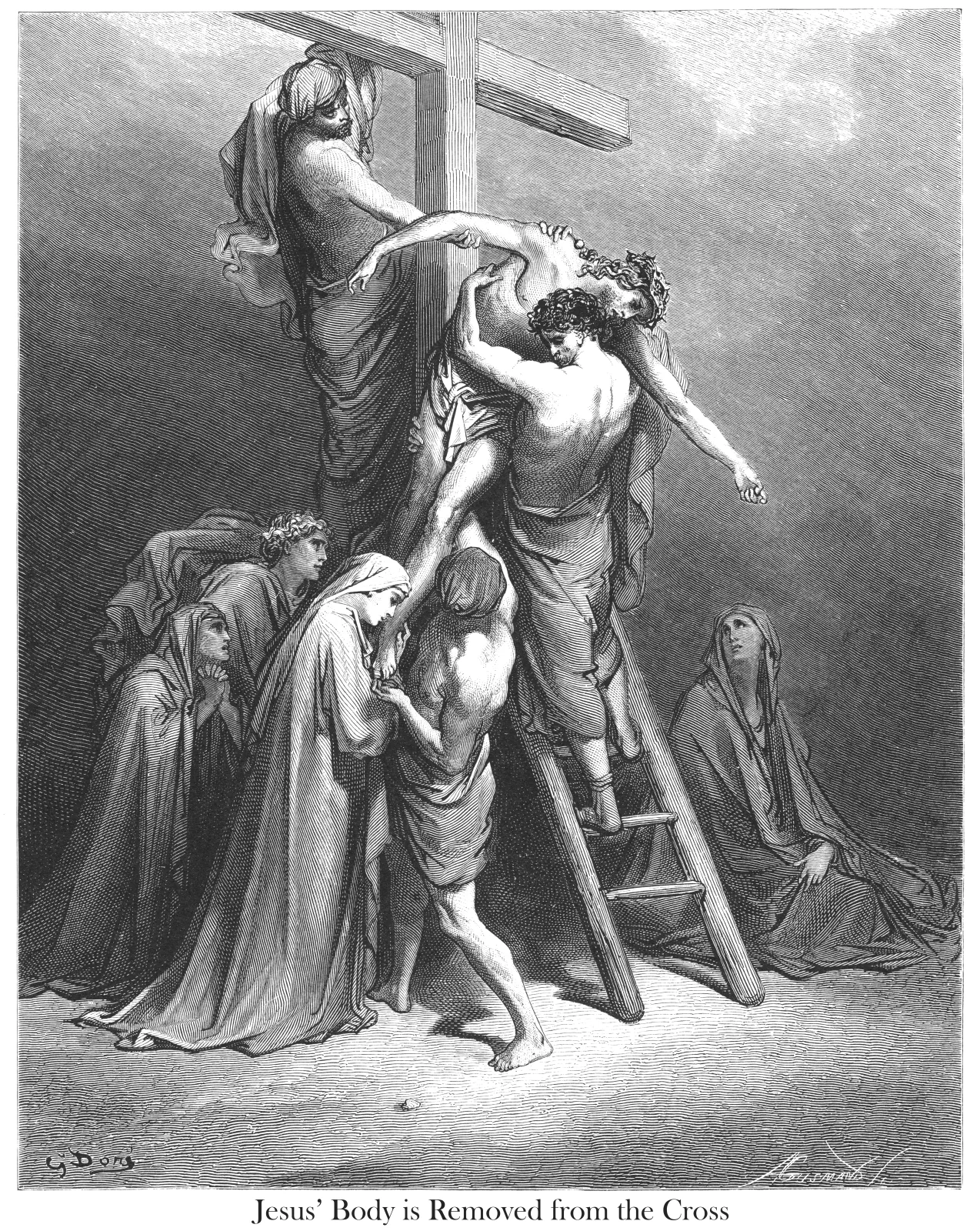
Jesus' Body Is Removed from the Cross
Mark 15:42-46 · World English Bible (Catholic)
42When evening had now come, because it was the Preparation Day, that is, the day before the Sabbath,
43Joseph of Arimathaea, a prominent council member who also himself was looking for God’s Kingdom, came. He boldly went in to Pilate, and asked for Jesus’ body.
44Pilate was surprised to hear that he was already dead; and summoning the centurion, he asked him whether he had been dead long.
45When he found out from the centurion, he granted the body to Joseph.
46He bought a linen cloth, and taking him down, wound him in the linen cloth and laid him in a tomb which had been cut out of a rock. He rolled a stone against the door of the tomb.
Jesus’ arm hangs toward the right, far from the hands supporting his body. His head falls back onto the shoulder of the man on the ladder. On the left, his other arm is still held near the cross; lower down, a man reaches out toward his legs. The body passes from one person to another, without yet finding rest.
The ladder gives this descent its precarious balance. The man bearing the upper body braces himself on a rung, while the slanting upright leads the eye toward the ground. The cross remains above the group, but attention now turns to what is being detached from it. At the foot of the ladder, a bent woman stands very close to the hand of the man receiving Jesus. On the right, another woman remains seated apart; her upturned face joins the movement of the gazes toward the body.
In Mark’s account, Joseph of Arimathea asks Pilate for Jesus’ body. Pilate makes sure of his death by consulting the centurion before granting Joseph’s request. Then the actions follow in quick succession: Joseph buys a linen cloth, takes Jesus down, wraps him in it, and lays him in a tomb hewn in the rock. The engraving stops midway through this sequence. Neither the exchange with Pilate nor the tomb is represented; the body is not yet wrapped.
Where Mark attributes the removal to Joseph, several figures share the burden here, though Joseph cannot be identified with certainty. The account has named a death verified by the centurion; the engraving gives it a bodily presence in these limbs surrendered to the support of others. Before the stone is rolled in front of the tomb, it holds this fragile passage in view: Jesus’ body is entrusted to human hands.