Gustave Doré · Mark 1:6-7
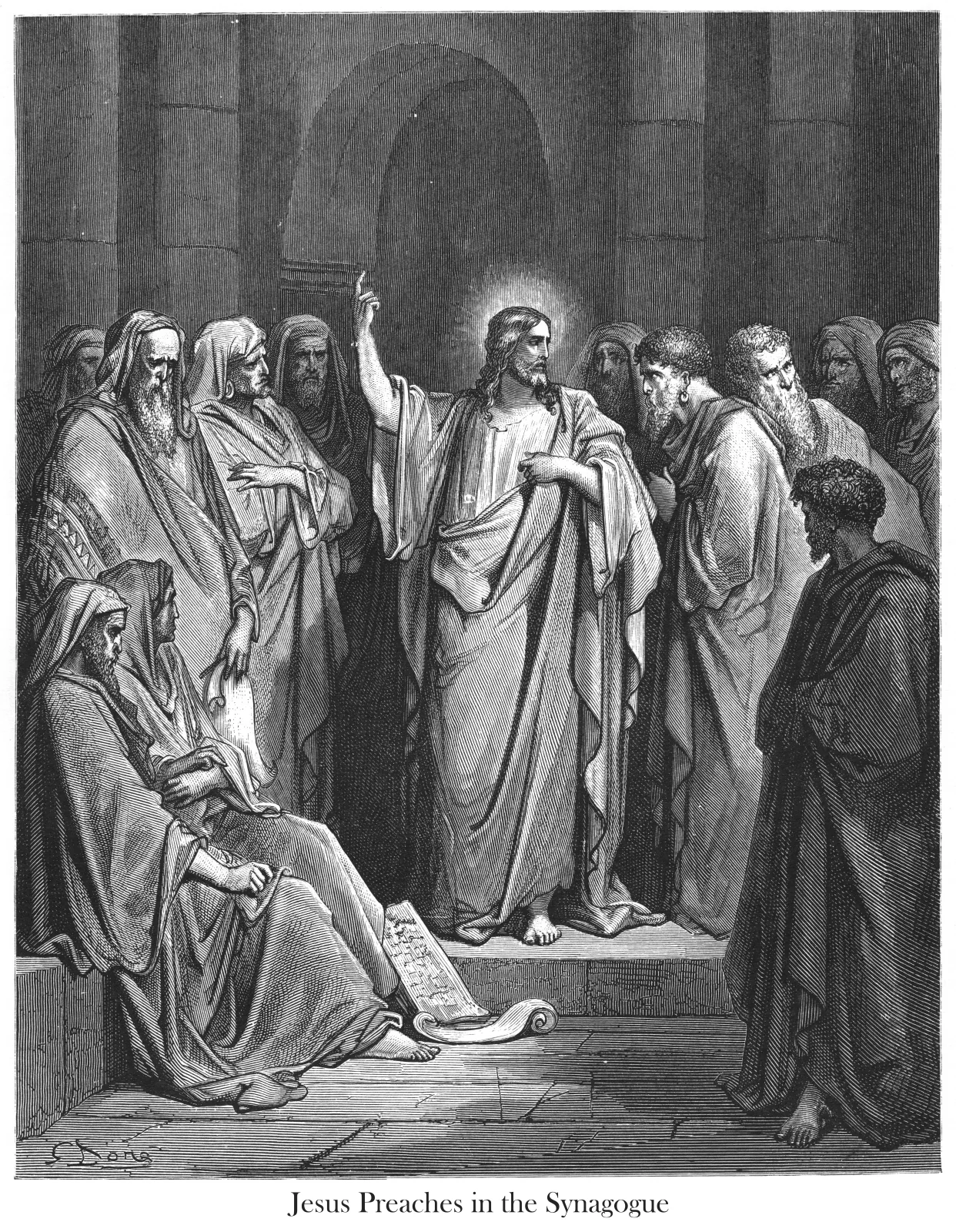
Jesus Preaches in the Synagogue
Mark 1:6-7 · World English Bible (Catholic)
6John was clothed with camel’s hair and a leather belt around his waist. He ate locusts and wild honey.
7He preached, saying, “After me comes he who is mightier than I, the strap of whose sandals I am not worthy to stoop down and loosen.
Jesus’s raised index finger stands out against the dark wall. His arm draws the eye upward, while his face turns toward a man leaning close beside him. The gesture addresses the assembly, but the proximity of the two faces gives the preaching the form of an encounter. Around them, listeners gather closely, some standing, others seated; their attitudes do not merge into a single response.
At the bottom of the scene, a scroll bearing written signs lies open on the ground, near Jesus’s feet. This detail brings Scripture into the very space where the words are being spoken. Yet the scroll remains separate from the preacher: Jesus does not hold it, and his gesture does not point to it. Placed before the group, it belongs to the scene without, by itself, explaining what is being said.
The catalogue title identifies the central figure as Jesus teaching in the synagogue. Yet the reference given, Mark 1:6–7, concerns John: it describes his clothing and food, and the announcement of the one who comes after him. The context evokes the Jordan and baptism. None of these elements allows us to identify John here or to recognize the place of his ministry. The title and the engraving therefore do not correspond to the scene indicated by the reference; this discrepancy calls for verification rather than an interpretation that would make them coincide.
A connection remains possible, provided this difference is respected: John proclaims a word and a power greater than himself, whereas the engraving places Jesus himself among those listening to him. The passage, however, does not give the words of this preaching in the synagogue. Before the open scroll, the raised gesture thus retains its force without its content being fixed by the verses provided.