Gustave Doré · Mark 1:6-7
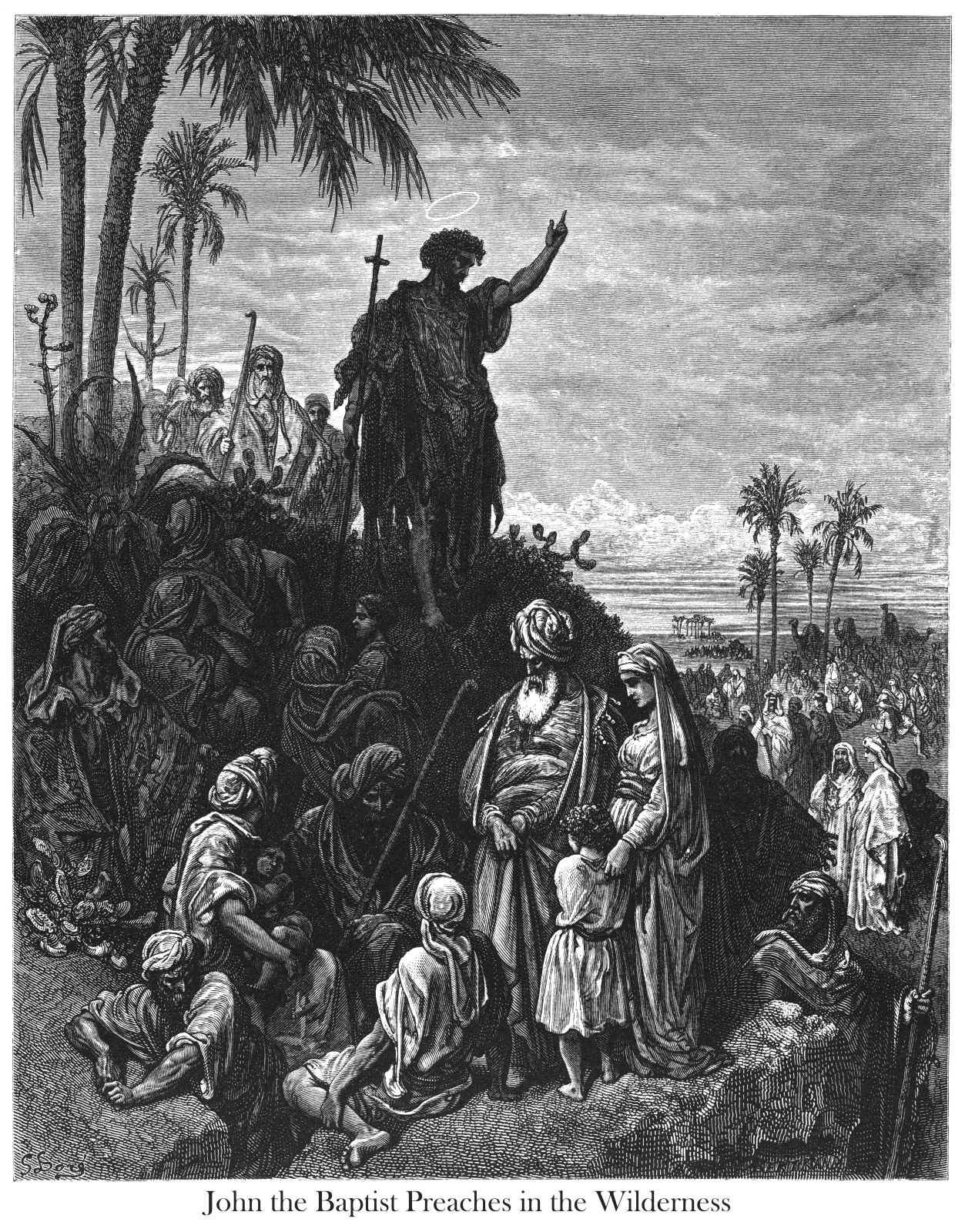
John the Baptist Preaches in the Wilderness
Mark 1:6-7 · World English Bible (Catholic)
6John was clothed with camel’s hair and a leather belt around his waist. He ate locusts and wild honey.
7He preached, saying, “After me comes he who is mightier than I, the strap of whose sandals I am not worthy to stoop down and loosen.
John the Baptist’s arm stands out against the bright sky. His raised finger extends the dark silhouette of the preacher, standing on a rise. Below him, the listeners fill the slope: some are seated, while others stand in small groups. His gesture presides over the assembly without pointing to any visible person. It opens a space above the crowd.
Mark records the words that this gesture gives bodily form to: John announces the one who comes after him and says that he is unworthy to untie the straps of his sandal. The preacher’s elevated position could make him the sovereign centre of the scene; his words, by contrast, direct attention to one more powerful than he. The one he announces does not appear in the engraving. Attention rests on John, but the movement of his arm leads it beyond his own figure.
In the foreground, an old man lowers his head; near him, a woman holds a child against her. Farther away, on the right, numerous groups make their way among the palm trees. This depth gives a presence to the gathering evoked just before the verses cited, when the inhabitants of Judea and Jerusalem come to John. Yet no baptism is shown: the crowd gathers around a spoken message rather than around the act performed in the Jordan.
John’s dark, rough garment accords with the austerity Mark describes, without making visible the locusts and wild honey on which he feeds. Beside him stands a long staff topped with a cross, a detail absent from the passage provided. The engraving thus brings the preacher close to a Christian sign, while his raised finger still leaves out of view the one of whom he speaks. John’s eminent place remains that of a witness: his figure draws all eyes to a coming that it cannot replace.