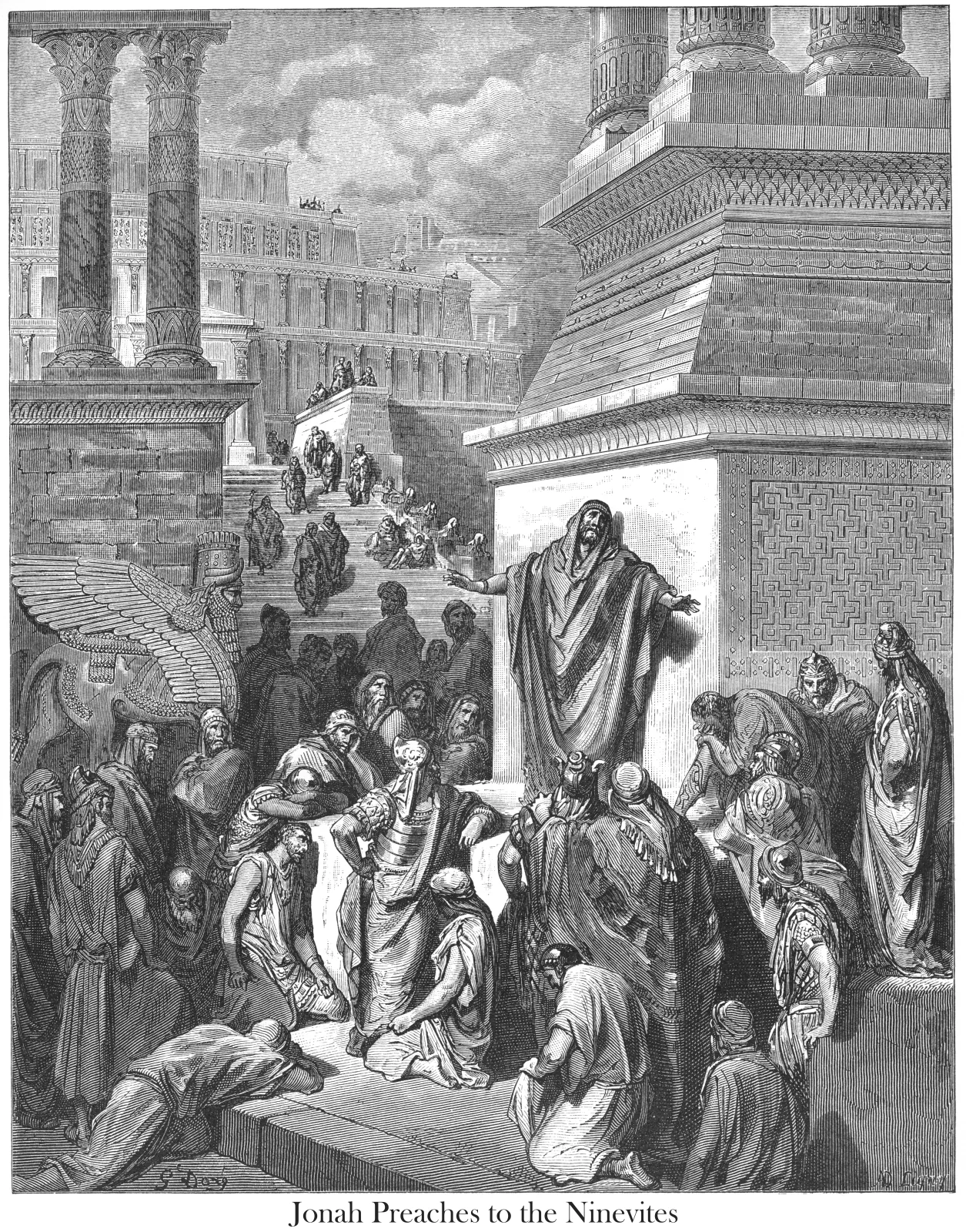
Gustave Doré · Jonah 3:4-5
Jonah Preaches to the Ninevites
Jonah 3:4-5 · World English Bible (Catholic)
4Jonah began to enter into the city a day’s journey, and he cried out, and said, “In forty days, Nineveh will be overthrown!”
5The people of Nineveh believed God; and they proclaimed a fast and put on sackcloth, from their greatest even to their least.
With his arms open, Jonah stands before a pale wall, at the foot of an immense building. His figure towers over the group gathered around him, but the structure looming above him gives his words a different scale: the prophet is small before the city he has come to warn. On the steps behind him, other figures move about or pause. The crowd in the foreground does not encompass all of Nineveh; the city extends beyond it.
At the foot of the platform, a richly dressed man stands with one hand on his hip. Close by, a figure kneels; lower down, a body lies against the step. These postures are not the same. Some people turn towards Jonah, while others lower their heads or hide them. His words reach an assembly still marked by differences, and not every gesture can be interpreted in the same way.
The Book of Jonah gives this preaching a precise deadline: in forty days, Nineveh will be destroyed. The inhabitants believe in God, proclaim a fast, and put on sackcloth, from the greatest to the least. The engraving brings the warning together with the first responses it elicits. Yet it does not directly show the fast or the sackcloth worn throughout the city. Several garments remain ornamented, and the posture of each figure is not enough to indicate that person’s place in the collective response.
On the left, the large winged figure with a human head belongs to the monumental setting as much as it accompanies the crowd. Its mass and the tall columns recall the power of the city, which the biblical threat addresses in its entirety. Before these intact stones, the bodies already incline the scene towards another possibility: the word of judgment is heard. The text names as faith what gestures alone could not establish.