Gustave Doré · Jonah 2:1,10
Jonah Is Spewed Forth by the Whale
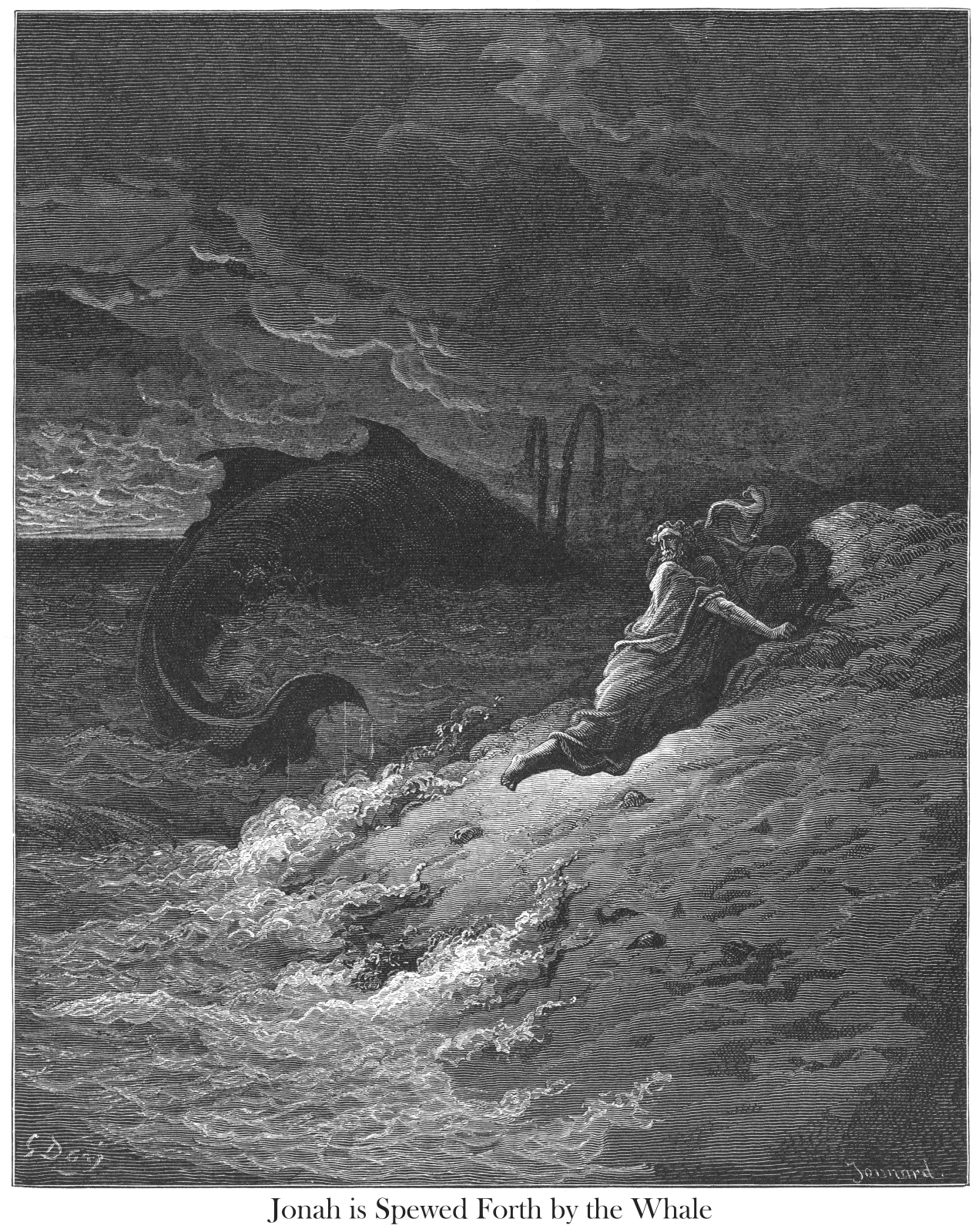
Jonah 2:1,10 · World English Bible (Catholic)
1Then Jonah prayed to the LORD, his God, out of the fish’s belly.
2He said, “I called because of my affliction to the LORD. He answered me. Out of the belly of Sheol I cried. You heard my voice.
3For you threw me into the depths, in the heart of the seas. The flood was all around me. All your waves and your billows passed over me.
4I said, ‘I have been banished from your sight; yet I will look again toward your holy temple.’
5The waters surrounded me, even to the soul. The deep was around me. The weeds were wrapped around my head.
6I went down to the bottoms of the mountains. The earth barred me in forever; yet you have brought my life up from the pit, LORD my God.
7“When my soul fainted within me, I remembered the LORD. My prayer came in to you, into your holy temple.
8Those who regard vain idols forsake their own mercy.
9But I will sacrifice to you with the voice of thanksgiving. I will pay that which I have vowed. Salvation belongs to the LORD.”
10Then the LORD spoke to the fish, and it vomited out Jonah on the dry land.
Jonah’s hand braces against the slope of the shore. His body is still low, his legs stretched out toward the water; he turns his head back. A few steps away, the great animal’s dark mass fills the sea. The prophet has reached land, but his posture retains something of the passage from which he has just emerged: he is not yet standing.
The pale bank rises toward the right, while the foam traces its edge. This strip of land gives Jonah precarious support, beneath a sky laden with clouds. Behind him, the fish’s body curves in the water; its size and almost-black back hold the gaze as much as the small human figure. Yet the animal is no longer swallowing Jonah. Its immense presence remains at the edge of the place where the man has been returned to the land.
The cited verses first speak of the great fish summoned by Yahweh and of the three days and three nights spent in its entrails. Then comes Jonah’s speech: he promises a sacrifice, declares that he will fulfill his vow, and acknowledges that salvation belongs to Yahweh. The engraving chooses the action that follows this prayer: in verse 11 of the supplied text, God speaks to the fish, which casts Jonah onto the land. The catalogue title calls the animal a whale, whereas the passage says “great fish.”
The praise uttered in the entrails remains invisible; no explicit gesture of sacrifice takes its place. Instead, the eye discovers a man bracing himself. The animal’s lingering proximity lends this emergence its full weight: dry land has been reached without erasing the sojourn in the depths. In the text, the word of salvation precedes this body still stretched out on the shore.